
Lawn Care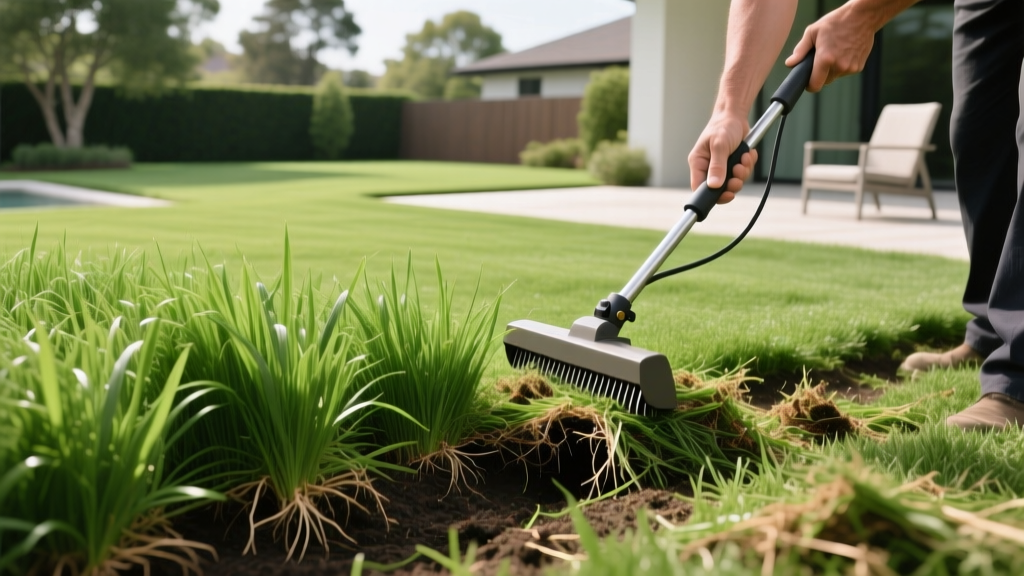
Step-by-Step Cacuya Grass Maintenance and Thatch Control
The Biology of Cacuya Grass: Why Standard Care Fails
Cacuya grass (botanically Cenchrus clandestinus, widely recognized as Kikuyu) is an aggressive, warm-season perennial that spreads via a dense network of thick stolons and rhizomes. According to the USDA Plants Database, its rapid vegetative growth makes it highly wear-tolerant but exceptionally prone to thatch accumulation and soil compaction. Standard lawn care protocols designed for fescue or bermudagrass will result in a spongy, disease-susceptible cacuya lawn within two growing seasons. Effective maintenance requires a targeted approach focusing on vertical growth management, aggressive thatch control, and specific micronutrient supplementation.
Step 1: Precision Mowing and Reel vs. Rotary Selection
Cacuya grass exhibits rapid vertical leaf extension during peak summer temperatures (80°F–95°F). Mowing must adhere strictly to the one-third rule, but absolute height dictates turf density and thatch prevention.
Optimal Cutting Heights
- Summer (Active Growth): 1.5 to 2.0 inches. Cutting lower than 1.5 inches risks scalping the uneven stolon network, exposing the soil to weed invasion.
- Winter (Dormancy): 2.0 to 2.5 inches. Raising the canopy protects the crown from frost damage and reduces winter weed pressure.
Mower Selection and Blade Maintenance
While a standard rotary mower (e.g., Honda HRX217) is sufficient for heights above 2 inches, a reel mower (such as the McLane 17-inch Power Reel) provides a cleaner scissor-cut at 1.5 inches. Rotary blades tend to shred the fibrous cacuya stolons at lower heights, creating entry points for fungal pathogens. Because of the high lignin content in cacuya leaves, rotary mower blades must be sharpened every 8 to 10 hours of runtime to prevent ragged tearing, which leads to moisture loss and tip browning.
Step 2: Aggressive Thatch Management and Core Aeration
Because cacuya grass produces lignin-rich stolons that decompose slowly, thatch layers can exceed 1 inch in a single season. A thatch layer thicker than 0.5 inches blocks water infiltration, repels liquid fertilizers, and harbors turf pests like white grubs.
Diagnostic and Removal Protocol
- Measure Thatch Depth: Use a 6-inch soil probe to extract a core. Measure the brown, spongy organic layer between the green canopy and the mineral soil. If it exceeds 0.5 inches, intervention is required.
- Verticutting (Late Spring): Use a power rake with flail blades set to penetrate 0.25 inches into the soil surface. Perform this when soil temperatures consistently reach 65°F to ensure rapid recovery.
- Core Aeration (Early Summer): Use a walk-behind core aerator (e.g., Ryan Lawnaire IV) with 5/8-inch hollow tines. Extract cores at a depth of 3 inches, spaced 2 inches apart. Leave the cores on the lawn to dry and shatter; this introduces soil microbes back into the thatch layer to accelerate biological decomposition.
Step 3: Watering and Soil Moisture Management
Despite its reputation for drought tolerance, cacuya grass requires precise irrigation to maintain deep root architecture. Shallow, frequent watering encourages roots to remain in the thatch layer, making the turf highly vulnerable to summer heat stress.
The Cycle-and-Soak Method
In heavy clay soils, applying 1.5 inches of water in a single session results in surface runoff. Instead, use the cycle-and-soak method: apply 0.5 inches of water, wait 30 minutes for infiltration, and repeat until the target volume is reached. Utilize a wireless soil moisture sensor (such as the Toro Precision Soil Sensor) to automatically override irrigation schedules when the root zone reaches 25% volumetric water content, preventing the anaerobic conditions that trigger root rot.
Step 4: Targeted Fertilization and Iron Supplementation
Cacuya grass requires moderate nitrogen but has a high demand for iron, particularly in alkaline soils (pH > 7.0) where iron becomes chemically locked. Research from the UC Davis Center for Turfgrass Environmental Research and Education emphasizes that excessive nitrogen without balanced micronutrients leads to soft, disease-prone growth and rapid thatch buildup.
The NPK and Iron Strategy
Apply a slow-release nitrogen fertilizer with a 3-1-2 or 4-1-2 ratio (e.g., 16-4-8 or 20-5-10) at a rate of 1 lb of actual nitrogen per 1,000 square feet every 8 weeks during the growing season. To prevent chlorosis (yellowing), apply chelated iron (Fe-EDDHA) at 2 to 3 oz per 1,000 sq ft immediately after aeration. Fe-EDDHA remains stable and plant-available in high-pH soils, unlike cheaper Fe-EDTA variants which oxidize rapidly in alkaline conditions.
Annual Cacuya Grass Maintenance Calendar
| Season | Mowing Height | Fertilizer (N-P-K) | Watering Protocol | Key Action |
|---|---|---|---|---|
| Early Spring | 2.0 inches | None (Wait for green-up) | 0.5 inches/week | Pre-emergent weed control (Prodiamine) |
| Late Spring | 1.5 - 2.0 inches | 16-4-8 (Slow Release) | 1.0 inch/week | Verticutting and dethatching |
| Summer | 1.5 - 2.0 inches | 20-5-10 + Iron Chelate | 1.5 inches/week (Deep) | Core aeration and grub monitoring |
| Early Fall | 2.0 inches | 16-4-8 (Low Nitrogen) | 1.0 inch/week | Overseed thin areas with perennial ryegrass |
| Winter | 2.0 - 2.5 inches | 0-0-7 (Potassium for cold) | Natural rainfall only | Minimize traffic to prevent crown damage |
Troubleshooting: Cacuya Yellows vs. Environmental Dormancy
⚠️ Warning: Kikuyu/Cacuya Yellows Disease
Do not confuse winter dormancy with Cacuya Yellows, a devastating disease caused by the fungus Magnaporthe grisea. While dormancy causes uniform browning across the entire lawn in winter, Cacuya Yellows manifests as distinct, irregular yellow patches (2 to 6 inches in diameter) during warm, wet summer periods. The roots will appear black and necrotic. If identified, immediately halt nitrogen applications, improve surface drainage, and apply a systemic fungicide containing azoxystrobin (e.g., Heritage TL) at the curative rate of 0.4 oz per 1,000 sq ft.
Weed Control Without Stolon Damage
Cacuya grass is highly sensitive to certain herbicides, particularly those containing MSMA or high concentrations of 2,4-D during peak summer heat, which can cause severe stunting and stolon bleaching.
- Pre-Emergents: Prodiamine (Barricade) applied in early spring at 0.5 lbs per 1,000 sq ft provides excellent crabgrass and spurge control without harming the shallow cacuya root system.
- Post-Emergents: For broadleaf weeds (dandelion, clover), use a quinclorac-based product or a low-ester 2,4-D formulation. Apply only when ambient temperatures are below 85°F and the turf is not drought-stressed to prevent phytotoxicity.

