
Lawn Care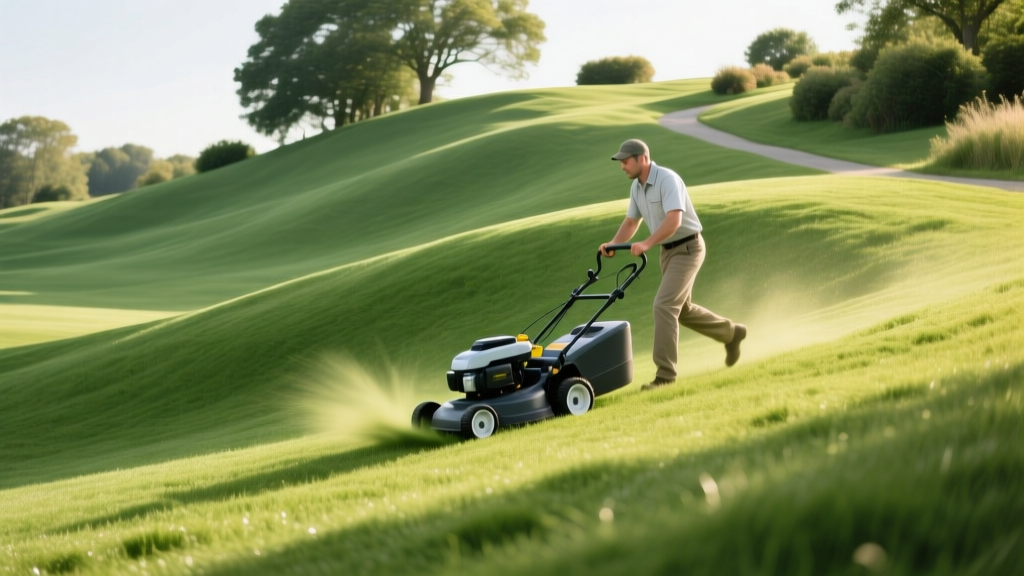
Step-by-Step Guide to Maintaining and Mowing a Grass Hillside
The Unique Challenges of Sloped Turf
Maintaining a grass hillside requires a fundamental shift in standard lawn care protocols. Slopes introduce severe erosion risks, rapid water runoff, and significant machinery hazards that flat lawns do not present. A standard approach to mowing, watering, or aerating on an incline will inevitably result in scalped turf, muddy ruts, or dangerous equipment rollovers. This step-by-step procedural guide breaks down the exact mechanical, hydraulic, and agronomic adjustments required to maintain a healthy, stable grass hillside.
Phase 1: Slope Assessment and Equipment Safety
Before initiating any maintenance, you must quantify the slope grade and select the appropriate machinery. Guessing the angle is a primary cause of lateral tip-overs.
⚠️ CRITICAL SAFETY WARNING: According to the U.S. Consumer Product Safety Commission (CPSC), riding mower tip-overs on slopes cause dozens of fatal crush injuries annually. Never operate a standard lawn tractor or zero-turn mower on slopes exceeding 15 degrees.
Step 1: Measure the Grade
Use a digital inclinometer or a dedicated slope gauge (often provided by tractor manufacturers like John Deere) to measure the steepest 10-foot section of your hillside.
- 0 to 10 degrees: Safe for most riding mowers and zero-turns with wide wheelbases.
- 10 to 15 degrees: Restrict to wide-stance lawn tractors. Avoid zero-turns due to caster wheel slippage.
- 15 to 22 degrees: Use a self-propelled, rear-wheel-drive push mower or a specialized slope mower (e.g., Ventrac 4520).
- Over 22 degrees: Do not mow with wheeled equipment. Transition to a commercial string trimmer or terrace the landscape.
Step 2: Select the Correct Drive System
If using a walk-behind mower on a grass hillside, front-wheel drive (FWD) is entirely ineffective; the front wheels will lift and lose traction when you tilt the handle back. You must use a rear-wheel drive (RWD) or all-wheel drive (AWD) self-propelled mower to maintain traction pushing up the incline.
Phase 2: Step-by-Step Mowing Execution
The directional pattern you use to mow a grass hillside is dictated entirely by the type of mower you are operating. Reversing these patterns is the leading cause of hillside turf damage and operator injury.
Procedure A: Mowing with a Walk-Behind Push Mower
- Orientation: Always mow across the slope (side-to-side), never up and down.
- The Physics: If your foot slips on wet grass while mowing across the slope, you will slide downhill, away from the mower deck. If you mow up and down and slip, you risk falling backward and pulling the running mower down on top of yourself.
- Turning: Never attempt a 180-degree turn on the incline. Walk the mower to the flatter crest or base of the hill, turn around on level ground, and begin the next pass.
- Deck Height: Raise the cutting deck by at least 0.5 inches higher than your flat lawn settings to prevent the front caster wheels from digging into the soil and scalping the turf on uneven micro-contours.
Procedure B: Mowing with a Riding Lawn Tractor
- Orientation: Always mow up and down the slope, never side-to-side.
- The Physics: Riding mowers have a high center of gravity. Driving laterally across a slope shifts the weight to the downhill wheels, drastically increasing the risk of a lateral rollover. Driving straight up and down keeps the weight distributed evenly across the rear axle.
- Ascent and Descent: Drive up the hill in a forward gear. When descending, use the lowest gear possible and allow engine compression to brake the machine. Never ride the brakes or put the tractor in neutral while going downhill, as this causes wheel lock-up and sliding.
Phase 3: Cycle-and-Soak Irrigation for Runoff Prevention
Watering a grass hillside using standard flat-land timers guarantees massive water waste and topsoil erosion. When water is applied faster than the soil's infiltration rate, it sheets off the surface. According to University of Minnesota Extension, sloped landscapes require a 'cycle-and-soak' methodology to allow water to penetrate the root zone without triggering runoff.
Implementing the Cycle-and-Soak Framework
Program your smart irrigation controller (such as a Rachio 3 or Hunter Hydrawise) to divide your total required watering time into multiple short bursts, separated by 45 to 60 minutes of soak time.
| Slope Grade | Total Weekly Water Need | Cycle-and-Soak Programming | Soak Interval |
|---|---|---|---|
| 5% - 10% | 1.0 inch | 2 cycles of 12 minutes | 45 minutes |
| 10% - 15% | 1.0 inch | 3 cycles of 8 minutes | 60 minutes |
| 15% - 20% | 1.25 inches | 4 cycles of 6 minutes | 90 minutes |
| Over 20% | 1.25 inches | Drip irrigation / Micro-sprays | Continuous low-flow |
Note: For slopes exceeding 20%, traditional rotary or spray heads are entirely inefficient. Transition to subsurface drip irrigation or low-volume micro-sprays to eliminate kinetic water impact, which dislodges soil particles and accelerates erosion.
Phase 4: Soil Health, Aeration, and Erosion Control
Compacted soil on a hillside exacerbates runoff, but traditional core aeration can actually destabilize the slope. Pulling thousands of 3-inch soil plugs from a steep incline compromises the structural integrity of the turf mat. During the next heavy rainstorm, the aeration holes can act as channels for subsurface water, causing the entire turf layer to shear and slide.
The Liquid Aeration Alternative
For any grass hillside with a grade over 12%, abandon mechanical plug aeration. Instead, utilize liquid soil loosening agents. Products containing ammonium lauryl sulfate or specialized surfactants (such as N-EXT AirR8T or Simple Lawn Solutions Liquid Aerating Soil Loosener) break down soil surface tension and reduce compaction chemically without physically disturbing the root matrix.
Fertilization and Root Anchoring
To anchor the soil, you must promote deep, aggressive root systems. Avoid high-nitrogen, quick-release synthetic fertilizers (like standard urea), which push rapid, shallow top-growth at the expense of root depth.
- Spring/Fall Application: Apply a slow-release, methylene-urea based fertilizer (e.g., 24-0-11 with 50% slow-release nitrogen) at a rate of 1 lb of nitrogen per 1,000 sq ft.
- Mycorrhizal Inoculants: During overseeding, apply a granular mycorrhizal fungi inoculant. These fungi form a symbiotic relationship with grass roots, extending their reach by up to 100 times and drastically improving the plant's ability to bind soil particles together on steep grades.
Troubleshooting Common Hillside Lawn Failures
Problem: Severe Mower Ruts
Cause: Mowing when the soil profile is saturated, or using a mower that is too heavy for the soil bearing capacity.
Fix: Enforce a strict 48-hour drying rule after rainfall before mowing. If ruts persist, switch to a lighter walk-behind mower or install a temporary track mat system for the mower's turning zones at the hill's base.
Problem: Dry, Brown Spots at the Crest
Cause: Water naturally migrates downhill via gravity. The top 5 feet of a grass hillside dries out 3x faster than the base.
Fix: Create a separate irrigation zone exclusively for the hill's crest. Program this zone to run 20% longer than the mid-slope zones to compensate for gravitational drainage.
Long-Term Grass Selection for Slopes
If your current turf is continually failing on the incline, you may be growing the wrong species. According to EPA WaterSense guidelines on landscape efficiency, matching the plant to the micro-climate is critical. For hillsides, you need grasses that spread via aggressive rhizomes or stolons to form a dense, interlocking erosion-control mat.
- Cool-Season Zones: Avoid Kentucky Bluegrass, which has shallow roots. Overseed with Creeping Red Fescue or Tall Fescue (specifically rhizomatous tall fescue varieties like RTF). Their deep, fibrous root systems can penetrate 2 to 3 feet into the subsoil, acting as biological rebar.
- Warm-Season Zones: Zoysia grass (specifically 'Meyer' or 'Zeon' cultivars) and Bermudagrass are superior choices. Their dense stolon networks create a virtually impenetrable surface layer that deflects raindrop impact and holds topsoil in place during severe weather events.
By strictly adhering to slope-specific mowing vectors, implementing cycle-and-soak hydration, and prioritizing deep-root biological anchoring over cosmetic top-growth, you can transform a hazardous, eroding grass hillside into a stable, low-maintenance landscape feature.

