
Lawn Care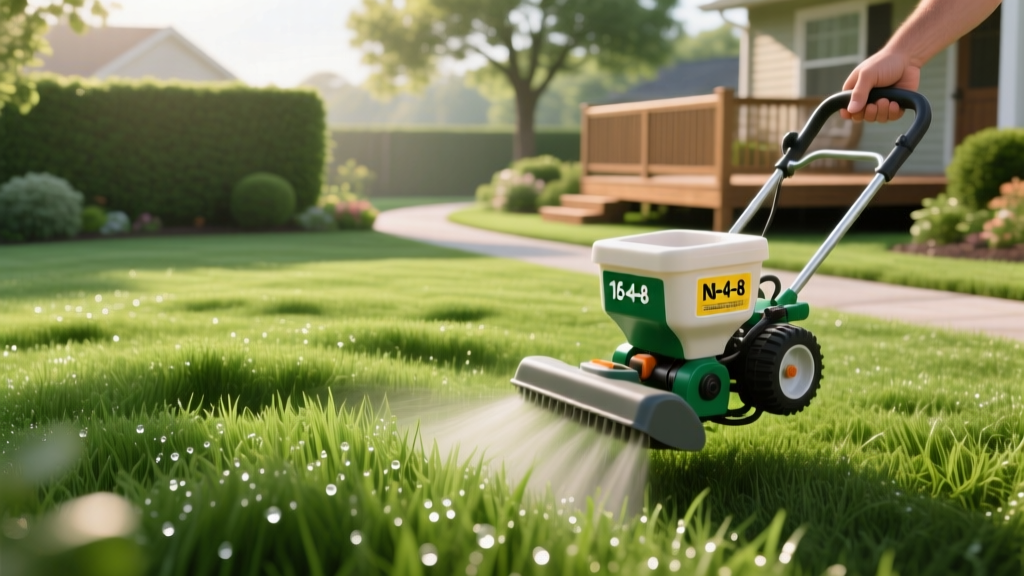
Step-by-Step Lawn Fertilization: NPK Ratios & Timing
Executing a precise lawn fert schedule requires moving beyond generic big-box store four-step programs. True turf health depends on matching specific Nitrogen-Phosphorus-Potassium (NPK) ratios to your grass species, soil baseline, and local climate. In 2026, with premium granular fertilizers averaging $45 to $65 per 50lb bag, misapplication is not just an agronomic failure—it is a direct financial loss. This guide provides a rigorous, step-by-step framework for testing, selecting, calibrating, and applying lawn fertilization products with commercial-grade accuracy.
Decoding the NPK Ratio for Your Specific Grass Type
The three numbers on a fertilizer bag represent the percentage by weight of Nitrogen (N), Phosphorus (P), and Potassium (K). However, the ideal ratio shifts dramatically based on whether you are managing cool-season or warm-season turf.
| Grass Category | Common Species | Ideal NPK Ratio | Annual Nitrogen Requirement |
|---|---|---|---|
| Cool-Season | Kentucky Bluegrass, Tall Fescue, Perennial Ryegrass | 3:1:2 or 4:1:2 (e.g., 32-8-16) | 2.0 to 4.0 lbs N / 1,000 sq ft |
| Warm-Season | Bermudagrass, Zoysia, St. Augustine, Centipede | 1:0:1 or 1:1:1 (e.g., 15-0-15 or 16-4-8) | 1.0 to 3.0 lbs N / 1,000 sq ft |
⚠️ Regulatory Warning: Many states and municipalities have strict phosphorus bans to prevent aquatic eutrophication. Unless a soil test explicitly confirms a phosphorus deficiency, you must select a zero-phosphorus formulation (the middle number must be 0, such as 32-0-4) for established lawns.
Step 1: Soil Testing and Baseline Calibration
Applying fertilizer without a recent soil test is equivalent to prescribing medication without a diagnosis. You need to know your soil's pH and cation exchange capacity (CEC) to ensure the nutrients you apply are actually bioavailable.
- Extract Core Samples: Use a soil probe to pull 10 to 15 cores at a depth of 3 to 4 inches across your lawn. Avoid areas near driveways or under heavy tree canopies.
- Mix and Dry: Combine the cores in a clean plastic bucket, break apart clods, and allow the soil to air dry for 24 hours.
- Submit to a Lab: Send a 1-cup composite sample to a university extension lab or a certified private lab (e.g., SoilKit or Waypoint Analytical). Expect to pay $15 to $35 for a comprehensive analysis.
- Interpret the pH: If your pH is below 6.0, apply pelletized limestone at the rate of 40 lbs per 1,000 sq ft to raise it. If above 7.5, apply elemental sulfur at 5 to 10 lbs per 1,000 sq ft to lower it. Nutrient lockout occurs rapidly outside the 6.2 to 6.8 optimal range.
Step 2: Selecting the Right Fertilizer Formulation
Not all nitrogen is created equal. The source of nitrogen dictates how quickly the grass absorbs it and how long the feeding lasts. According to University of Minnesota Extension, slow-release nitrogen sources are critical for preventing rapid flush growth and subsequent disease susceptibility.
Fast-Release vs. Slow-Release Nitrogen Matrix
| Nitrogen Source | Release Speed | Longevity | Best Application Window | Cost per 1,000 sq ft |
|---|---|---|---|---|
| Urea (46-0-0) | Immediate (24-48 hrs) | 2 to 4 weeks | Late fall dormancy feeding | $0.08 - $0.12 |
| Ammonium Sulfate (21-0-0) | Immediate | 2 to 3 weeks | Spring green-up (acidic soils) | $0.10 - $0.15 |
| Methylene Urea (MU) | Gradual (microbe dependent) | 8 to 12 weeks | Early summer primary feeding | $0.25 - $0.35 |
| Polymer-Coated Urea (PCU) | Controlled (temperature dependent) | 12 to 16 weeks | Spring single-application programs | $0.40 - $0.55 |
Expert Synthesis: For a premium, commercial-grade result, look for a blended granular product where at least 50% to 70% of the total nitrogen is derived from slow-release sources (like Methylene Urea or Sulfur-Coated Urea). Products like Andersons Professional PGF 10-10-10 or Lesco 18-24-12 offer these blended profiles, typically costing $50 to $65 per 50lb bag.
Step 3: Spreader Calibration and Application Technique
The dial on your spreader is merely a suggestion. Manufacturing variances, humidity, and granule size dictate actual output. You must manually calibrate your spreader to avoid the two most common lawn fert failures: fertilizer burn (over-application) and striping (under-application).
The 100-Square-Foot Calibration Method
Pro Tip: Never calibrate over your actual lawn. Use a driveway or a large tarp to catch the granules so you can weigh them accurately.
- Measure a Test Area: Mark off exactly 100 square feet (e.g., a 10 ft x 10 ft square on your driveway).
- Weigh the Product: Place an empty catch pan on a digital scale and tare it to zero. Fill your spreader with the fertilizer.
- Execute the Pass: Walk at your normal mowing pace (approx. 3 mph) over the 100 sq ft area with the spreader engaged.
- Calculate the Output: Weigh the captured granules. If the bag's recommended rate is 3.0 lbs per 1,000 sq ft, you need to catch exactly 0.30 lbs (or 4.8 ounces) in your pan for the 100 sq ft test.
- Adjust and Repeat: If you caught 5.5 ounces, close the dial one notch and test again. If you caught 3.5 ounces, open it one notch.
When applying to the lawn, use a rotary spreader with an active edge guard (like the Scotts EdgeGuard series) when near hardscapes to prevent staining and runoff. Always overlap your wheel tracks by 10% to 15% on each pass to ensure uniform distribution.
Step 4: Seasonal Timing Matrix
Timing applications to the grass's natural growth cycles is non-negotiable. Feeding cool-season grasses in the heat of summer forces top-growth when the plant is trying to conserve water for root survival, leading to severe stress. Consult the NC State TurfFiles database for localized transition-zone adjustments.
Cool-Season Grass Schedule (Fescue / Bluegrass)
- Early Spring (April): Light application (0.5 lbs N/1000 sq ft) only if the lawn was not fed in late fall. Use a fast-release source to push early green-up.
- Late Spring (May/June): Moderate application (0.8 lbs N/1000 sq ft) using a slow-release formula to sustain the plant into summer without causing excessive flush growth.
- Early Fall (September): Heavy application (1.0 lbs N/1000 sq ft). This is the most critical feeding of the year, promoting deep root storage before winter.
- Late Fall (November): Dormancy feeding (0.5 to 0.8 lbs N/1000 sq ft) using a fast-release source like Urea. The grass will store the nitrogen in its roots for an explosive spring green-up.
Warm-Season Grass Schedule (Bermuda / Zoysia)
- Mid-Spring (May): Apply 1.0 lbs N/1000 sq ft only after the lawn has fully broken dormancy and required its first mowing.
- Early Summer (June/July): Apply 1.0 lbs N/1000 sq ft every 4 to 6 weeks during peak growing season. Include iron (Fe) if the turf shows interveinal chlorosis (yellowing).
- Early Fall (September): Apply a low-nitrogen, high-potassium 'winterizer' (e.g., 5-10-30) to harden off the turf against frost damage. Cease all nitrogen applications.
Troubleshooting Common Fertilization Failures
Even with precise calibration, environmental variables can cause issues. Here is how to diagnose and correct the three most frequent application errors.
1. Fertilizer Burn (Osmotic Stress)
Symptom: Brown, scorched streaks matching the spreader's wheel tracks or overlap zones, appearing 24 to 48 hours after application.
Cause: High salt-index fertilizers (like Urea or Ammonium Sulfate) drawing moisture out of the grass blades due to over-application or lack of watering.
Fix: Immediately irrigate the lawn with 1 inch of water to dissolve the salts and push them below the root zone. Do not mow the burned areas until they recover.
2. Striping and Uneven Green-Up
Symptom: Alternating bands of dark green and pale yellow grass.
Cause: Inadequate spreader overlap, clogged spreader ports, or applying in high winds.
Fix: Clean the spreader hopper and agitator with compressed air after every use to prevent hygroscopic clumping. Always apply granular products when wind speeds are below 10 mph.
3. Phosphorus Runoff and Hardscape Staining
Symptom: Rust-colored stains on concrete driveways and sidewalks, or algae blooms in adjacent ponds.
Cause: Iron-containing fertilizers (like Milorganite or ironite) landing on concrete, or phosphorus washing into storm drains.
Fix: Use a leaf blower to immediately sweep stray granules off hardscapes back into the turf. Never apply fertilizer within 10 feet of a waterway or storm drain without a vegetative buffer zone.

