
Lawn Care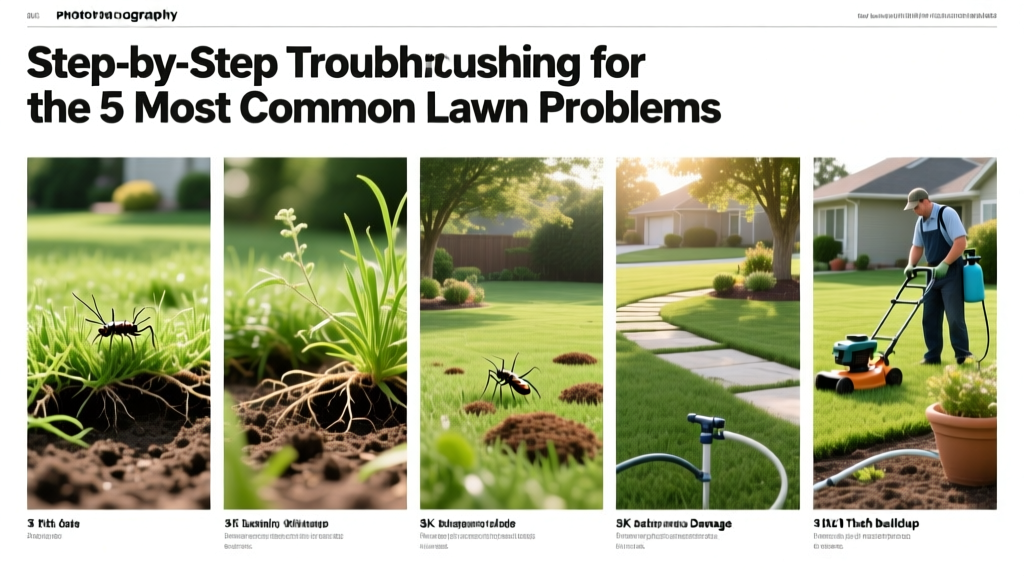
Step-by-Step Troubleshooting for the 5 Most Common Lawn Problems
The 3-Step Diagnostic Framework for Lawn Problems
When your turf declines, guessing the cause wastes time and money. Accurate diagnosis requires a systematic approach before any chemical or mechanical intervention. Professional turfgrass managers rely on a triage protocol to isolate variables. Before applying any product, execute these three diagnostic steps:
Step 1: Inspect the Transition Zone. Look at the border between healthy and dying grass. Active fungal pathogens and insect feeding will show the most aggressive symptoms at this margin, not in the dead center.
Step 2: Perform the Tug Test. Grab a handful of declining turf and pull upward. If it lifts like loose carpet, roots are severed (insects). If it resists, the root system is intact but struggling (disease, drought, or chemical burn).
Step 3: Check Subsurface Moisture. Use a 6-inch soil probe or screwdriver. If it penetrates easily to 4 inches, moisture is adequate. If it stops at 1 inch, you have hydrophobic soil or severe compaction.
Step 2: Perform the Tug Test. Grab a handful of declining turf and pull upward. If it lifts like loose carpet, roots are severed (insects). If it resists, the root system is intact but struggling (disease, drought, or chemical burn).
Step 3: Check Subsurface Moisture. Use a 6-inch soil probe or screwdriver. If it penetrates easily to 4 inches, moisture is adequate. If it stops at 1 inch, you have hydrophobic soil or severe compaction.
Problem 1: Brown Patch Fungus (Rhizoctonia solani)
Brown patch is the most destructive summer disease for cool-season grasses (Tall Fescue, Kentucky Bluegrass, Perennial Ryegrass). It thrives when nighttime temperatures remain above 65°F with high humidity and prolonged leaf wetness.
Symptoms & Edge Cases
Look for circular patches ranging from 6 inches to several feet in diameter. In the early morning, you may see a 'smoke ring'—a dark, water-soaked border at the edge of the patch. Individual grass blades will exhibit irregular, tan lesions with dark brown margins. NC State Extension notes that excessive nitrogen application in late spring drastically increases susceptibility.
Step-by-Step Treatment Protocol
- Halt Nitrogen Fertilization: Stop all nitrogen inputs immediately. High nitrogen promotes lush, weak tissue that the fungus easily penetrates.
- Adjust Irrigation: Switch watering to early morning (4:00 AM - 6:00 AM). Never water in the evening; leaves must dry before nightfall.
- Apply a Systemic Fungicide: Use a FRAC Code 11 (QoI) fungicide like Syngenta Heritage SC (Azoxystrobin). Apply at a rate of 0.4 fl oz per 1,000 sq ft. Water it in with 1/8 inch of irrigation to move the active ingredient into the thatch layer.
- Rotate Chemistry: If a second application is needed 21 days later, switch to a FRAC Code 3 (DMI) fungicide like Bayer Advanced Disease Control (Propiconazole) to prevent pathogen resistance.
Problem 2: Grub Infestation vs. Drought Stress
Homeowners frequently misdiagnose grub damage as drought stress because both result in large, irregular brown patches in late summer. Misidentifying the problem leads to unnecessary water bills or ineffective insecticide applications.
Comparison Matrix: Grubs vs. Drought
| Diagnostic Metric | White Grub Infestation | Severe Drought Stress |
|---|---|---|
| Tug Test Result | Turf rolls back easily; roots severed. | Turf resists pulling; roots anchored but brittle. |
| Soil Probe Test | Soil may be moist; probe finds C-shaped larvae. | Soil is hard, dry, and hydrophobic below 1 inch. |
| Patch Edges | Irregular, jagged margins; often dug up by wildlife. | Uniform browning; footprints remain visible (wilting). |
| Threshold for Action | More than 5-7 grubs per square foot. | No visible insects; soil moisture deficit. |
Targeted Eradication Steps
If you confirm grubs, timing dictates your chemical choice. According to Penn State Extension, preventative treatments are vastly superior to curative ones.
- Preventative (June - Mid-July): Apply Acelepryn (Chlorantraniliprole). It costs roughly $45 for a residential bottle covering 10,000 sq ft. It requires 30-60 days to reach peak efficacy in the root zone but is highly safe for pollinators.
- Curative (August - September): If you missed the preventative window and grubs are actively feeding, use Dylox (Trichlorfon). It acts as a contact poison within 48 hours but degrades quickly in high-pH soils (above 7.2).
Problem 3: Compacted Soil & Hydrophobic Thatch
When soil bulk density exceeds 1.4 g/cm³, oxygen is depleted from the root zone, and water pools on the surface or runs off. This leads to shallow root systems that cannot survive summer heat.
Core Aeration vs. Liquid Aeration
Warning: Do not use mechanical core aeration on lawns suffering from severe drought or active fungal disease. The physical wounding of the turf canopy will accelerate moisture loss and spread pathogens like Dollar Spot.
Mechanical Core Aeration: Best performed in early fall for cool-season grasses. Rent a walk-behind aerator (approx. $80-$100/day) that pulls 2-to-3-inch plugs. You must make two passes in perpendicular directions to achieve the recommended 20-40 holes per square foot.
Liquid Aeration (Surfactants): For mid-summer compaction issues, use a liquid soil conditioner like N-Ext Air-8 ($40 per bottle). It contains humic acid and yucca extract (a natural wetting agent) that breaks surface tension, allowing water to penetrate hydrophobic thatch. Apply at 3 oz per 1,000 sq ft every 3 weeks during peak heat.
Problem 4: Dollar Spot (Clarireedia jacksonii)
Dollar spot presents as small, silver-dollar-sized bleached spots that can coalesce into large dead zones. The defining visual marker is the hourglass-shaped lesion on individual grass blades, often accompanied by cobweb-like mycelium in the morning dew.
The Nitrogen Deficiency Link
Unlike Brown Patch, which exploits excess nitrogen, Dollar Spot aggressively attacks nitrogen-starved turf. The first step in management is applying a fast-release nitrogen source like Ammonium Sulfate (21-0-0) at a rate of 0.2 lbs of actual nitrogen per 1,000 sq ft. This stimulates rapid growth, allowing the grass to outpace the fungal infection.
Fungicide Rotation Strategy
If cultural controls fail, apply a contact fungicide like Chlorothalonil (FRAC Code M5) at 3.2 fl oz per 1,000 sq ft. Because Dollar Spot develops resistance rapidly, alternate with a systemic SDHI fungicide (FRAC Code 7) like Fluxapyroxad (Xzemplar) for subsequent applications.
Preventative Maintenance Calendar
Preventing lawn problems is significantly cheaper than curing them. Use this baseline schedule for cool-season turf (Fescue/Bluegrass) to maintain optimal soil health and pathogen resistance.
| Month | Primary Action | Product / Tool Example | Est. Cost (per 1k sq ft) |
|---|---|---|---|
| April | Pre-emergent Crabgrass Control | Prodiamine 65 WDG | $0.08 |
| May | Broadleaf Weed Control | 3-Way Ester (Trimec) | $0.12 |
| June | Preventative Grub Control | Acelepryn (Chlorantraniliprole) | $0.18 |
| August | Late Summer Fungicide (Preventative) | Heritage SC (Azoxystrobin) | $0.35 |
| September | Core Aeration & Overseeding | Titan TTTF Seed Blend | $0.45 (seed only) |
Frequently Asked Questions
Can I mix fungicide and insecticide in the same sprayer?
Yes, tank-mixing is common in professional turf management to save time, provided the labels do not explicitly prohibit it. For example, mixing a liquid systemic insecticide (like Imidacloprid) with a contact fungicide (like Chlorothalonil) is generally safe. However, never mix copper-based fungicides with products containing acidic adjuvants, as this can cause severe phytotoxicity (leaf burn).
Why is my lawn turning yellow after applying a weed and feed product?
Yellowing (chlorosis) after a 'weed and feed' application is usually caused by herbicide stress on the turfgrass itself, particularly if applied when temperatures exceed 85°F. Products containing 2,4-D or Quinclorac can stunt cool-season grasses in high heat. To mitigate this, apply a liquid kelp extract (like N-Ext RGS) at 3 oz per 1,000 sq ft to stimulate stress-recovery hormones, and ensure the lawn receives 1 inch of water within 24 hours of application.
How do I know if my soil pH is causing lawn problems?
Nutrient lockout occurs when soil pH drifts outside the 6.0 to 7.0 range. If your grass is pale despite adequate nitrogen applications, or if moss is invading, your pH is likely acidic (below 5.5). Submit a soil sample to your local university extension office (e.g., University of Minnesota Extension) for a $15-$25 test. If the test recommends liming, apply pelletized calcitic limestone at 50 lbs per 1,000 sq ft in the fall to gradually raise the pH over 6 months.

