
Lawn Care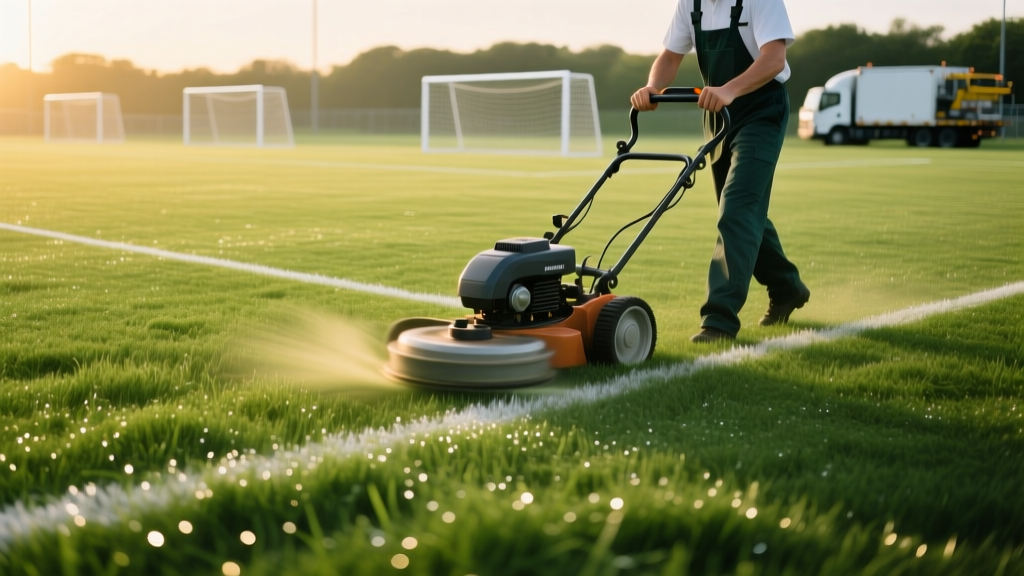
How to Maintain Pro-Grade Soccer Field Grass: Step-by-Step Guide
The Foundation: Understanding Soccer Field Grass Demands
Maintaining natural turf for athletic use is fundamentally different from residential lawn care. A professional or high-school soccer field grass surface must withstand extreme mechanical stress from cleats, sliding tackles, and concentrated foot traffic, all while providing a predictable, true ball roll and sufficient shock absorption to prevent athlete injuries. According to the Penn State Extension Sports Turf Program, the failure rate of sports fields often stems from a misunderstanding of soil compaction thresholds and improper mowing heights rather than a lack of water or fertilizer.
Whether your pitch is planted with a warm-season cultivar like Tifway 419 Bermudagrass or a cool-season blend of Kentucky Bluegrass and Perennial Ryegrass, the maintenance protocols require surgical precision. Below is the definitive, step-by-step procedure for maintaining a high-performance soccer pitch.
Step 1: Precision Mowing and Grooming Protocols
The mowing regimen dictates the density, tillering rate, and ultimately the shear strength of the turf canopy. Rotary mowers are unacceptable for elite soccer surfaces; they tear the leaf tip, creating entry points for pathogens like Pyricularia grisea (Gray Leaf Spot) and causing a whitish, ragged appearance.
Height of Cut (HOC) Specifications
- Warm-Season (Bermudagrass): Maintain between 0.50 and 0.75 inches. Lower HOC encourages lateral stolon growth, creating a tighter, more resilient mat.
- Cool-Season (Kentucky Bluegrass/Ryegrass): Maintain between 1.0 and 1.5 inches. Cutting lower than 1.0 inches severely restricts root mass and invites annual bluegrass (Poa annua) invasion.
⚠️ Critical Warning: The One-Third Rule
Never remove more than 33% of the leaf blade in a single pass. During peak spring and early fall growth, this necessitates mowing 3 to 4 times per week. If you fall behind schedule, raise the HOC temporarily and gradually lower it over subsequent cuts to avoid scalping the crown.
Never remove more than 33% of the leaf blade in a single pass. During peak spring and early fall growth, this necessitates mowing 3 to 4 times per week. If you fall behind schedule, raise the HOC temporarily and gradually lower it over subsequent cuts to avoid scalping the crown.
Implement a weekly grooming or brushing pass using a turf brush attached to your triplex or walk-behind reel mower (e.g., Toro Greensmaster Flex). Brushing stands the creeping stolons upright before the bedknife cuts them, preventing grain and ensuring a uniform, carpet-like ball roll.
Step 2: Advanced Soil Aeration and Decompaction
Soccer players exert up to 300 PSI of pressure through their cleats during sudden stops and pivots. This creates a severe hardpan layer typically 2 to 4 inches below the surface, suffocating roots and causing localized dry spots. Core aeration with standard 0.5-inch tines is insufficient for deep compaction.
The Deep-Tine Aeration Protocol
- Timing: Execute deep-tine aeration during peak root growth phases (late spring for Bermuda; early fall for Bluegrass).
- Equipment: Utilize a deep-tine aerator (such as the Toro ProCore 648 or Wiedenmann Super 500) capable of penetrating 8 to 10 inches.
- Pattern: Perform two passes in perpendicular directions to maximize hole density, targeting 15 to 20 holes per square foot.
- Topdressing: Immediately drag USGA-specification sand (medium to coarse, sub-angular particles) into the cores. This prevents the holes from collapsing and permanently improves the soil's macroporosity and drainage rate.
For in-season maintenance when deep cores would disrupt play, utilize solid-tine aeration or hydro-injection systems like DryJect. These fracture the soil profile and inject sand/water without pulling a messy core, allowing the field to be playable within 24 hours.
Step 3: Targeted Fertilization and Nutrient Management
Sports turf managers avoid heavy, single-dose nitrogen applications that cause rapid, succulent vertical growth. Fast growth depletes carbohydrate reserves and weakens cell walls, making the grass highly susceptible to tearing under cleat pressure. Instead, adopt a spoon-feeding strategy.
Seasonal Fertilizer Application Matrix
| Season | Nitrogen Rate (lbs N/1000 sq ft) | Primary Focus | Recommended Source |
|---|---|---|---|
| Early Spring | 0.5 - 0.75 | Root development, spring green-up | Methylene Urea / PCU |
| Peak Summer | 0.25 (every 14 days) | Sustained recovery, stress tolerance | Ammonium Sulfate / Urea |
| Early Fall | 0.75 - 1.0 | Carbohydrate storage, winter prep | Methylene Urea / IBDU |
| Late Fall | 0.5 | Late-season root growth | Fast-release Urea |
Always pair nitrogen with adequate Potassium (K2O). A 1:1 or 2:1 N-to-K ratio in the fall is critical for osmotic regulation, helping the soccer field grass survive winter freezing and summer drought stress. Consult the NC State TurfFiles database for specific regional soil test interpretations before applying phosphorus, as many established sports fields already have excessive soil P levels.
Step 4: Overseeding, Divot Repair, and Turf Recovery
Even with meticulous care, the center circle, goal mouths, and penalty areas will suffer severe wear. Reactive seeding is too slow; proactive recovery is mandatory.
The Pre-Germinated Seed Technique
For high-traffic zones requiring immediate repair, utilize pre-germinated seed. Soak Perennial Ryegrass or Kentucky Bluegrass seed in water for 24-36 hours until the radicle (white root tip) emerges. Mix this pre-germinated seed with a calcined clay soil conditioner (like Profile or Turface) and topdressing sand. Press this mixture into divots and bare spots. Because the germination phase is already complete, the seed will establish in 3 to 5 days rather than the standard 10 to 14 days.
For warm-season fields transitioning into winter, overseed with a high-quality, dark-green Perennial Ryegrass (e.g., Barsprinter or Pangea GLR) at a rate of 8 to 12 lbs per 1,000 sq ft in early autumn. This provides a live, playable surface while the underlying Bermudagrass remains dormant.
Step 5: Irrigation and Moisture Stress Management
Overwatering is the fastest way to destroy a soccer pitch. Shallow, frequent irrigation promotes shallow root systems and invites shallow-rooted weeds. Furthermore, a saturated field becomes dangerously slick and prone to massive chunking during matches.
- Deep and Infrequent: Apply 0.5 to 0.75 inches of water in a single cycle, allowing the top 1-2 inches of soil to dry out before the next irrigation. This forces roots to chase moisture deeper into the soil profile.
- Syringing: During extreme summer heat (above 90°F), use a light syringing cycle (1 to 2 minutes) during the hottest part of the day to cool the turf canopy via evaporation, without wetting the soil.
- Technology Integration: Install soil moisture sensors (e.g., Toro Precision Soil Sensor) at varying depths (3-inch and 6-inch) to measure volumetric water content (VWC). Irrigate only when the 6-inch sensor drops below 15% VWC.
Troubleshooting Common Soccer Field Turf Failures
When the pitch fails to perform, use this diagnostic framework to identify the root cause before applying chemical or mechanical fixes.
1. Localized Dry Spot (LDS)
Symptom: Irregular, hydrophobic patches that refuse to absorb water, often surrounded by healthy, moist turf.
Cause: Fungal mycelium and organic acids coating sand particles, repelling water.
Fix: Apply a high-quality soil surfactant (wetting agent) like Cascade Plus or Revolution. Follow immediately with deep-tine aeration to break the hydrophobic barrier and incorporate the surfactant into the root zone.
2. Cleat Tear and Shearing
Symptom: Large divots pulled up easily during play, exposing shallow roots.
Cause: Excessive thatch buildup (greater than 0.5 inches) acting as a slippery slip-plane between the root zone and the turf canopy, or overly wet soil conditions.
Fix: Implement aggressive verticutting to physically remove thatch. Reduce irrigation frequency to firm up the soil profile, and apply a plant growth regulator (PGR) like Trinexapac-ethyl (Primo Maxx) to shorten internode length and increase lateral turf density.
3. Algae and Surface Sealing
Symptom: A black or dark green, slippery crust forming on the soil surface in shaded or poorly drained areas.
Cause: Constant surface moisture combined with soil compaction preventing drainage.
Fix: Improve surface drainage by topdressing with coarse sand. Apply a targeted contact fungicide/algicide containing Chlorothalonil or Mancozeb, but prioritize mechanical aeration to resolve the underlying moisture retention issue. The Sports Turf Managers Association (STMA) frequently publishes updated cultural practice bulletins for managing surface sealing in shaded stadium environments.
Frequently Asked Questions
Can I use a standard lawn tractor to mow a soccer field?
No. Standard rotary tractors tear the grass blade and cannot achieve the low, consistent heights required for sports turf. You must use a dedicated walk-behind or triplex reel mower to achieve a scissor-like cut below 1.5 inches.
How often should I drag the field?
Drag the field with a stiff drag mat after every aeration and topdressing event to work sand into the canopy. During the growing season, a light brushing once a week helps stand the grass up and distribute worm castings or minor debris.
What is the best grass for a shaded soccer stadium?
In heavily shaded stadiums, cool-season grasses like fine fescues or shade-tolerant Kentucky Bluegrass cultivars are preferred in northern climates. In southern climates, stadium managers often rely on high-intensity LED grow lights to sustain Bermudagrass, or transition to reinforced hybrid turf systems (like Desso GrassMaster) that combine natural grass with 3% synthetic fibers for structural stability in low-light conditions.

