
Lawn Care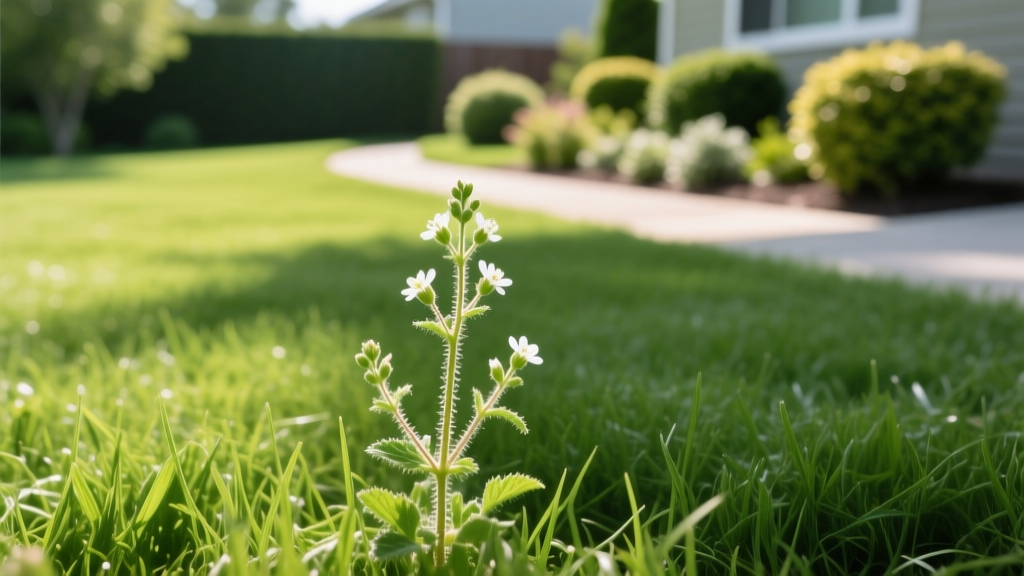
How to Get Rid of Sticky Weed: Catchweed Bedstraw Control
The Science of the Snag: Understanding Sticky Weed
When homeowners ask how to get rid of sticky weed, they are almost always battling Galium aparine, commonly known as catchweed bedstraw, cleavers, or goosegrass. This winter annual is notorious for its sprawling, mat-forming growth habit and its uncanny ability to cling to clothing, pet fur, and lawn mower decks. According to the University of California Integrated Pest Management (UC IPM) program, catchweed bedstraw thrives in moist, shaded areas and can quickly smother desirable turfgrass by blocking sunlight and competing for soil nitrogen.
Unlike taprooted weeds like dandelions, sticky weed features a shallow, fibrous root system combined with brittle, sprawling stems that root at the nodes. This makes it a unique challenge for standard lawn care routines. Mowing often fails to control it because the weed grows horizontally beneath the mower deck, while standard broadleaf herbicides frequently bead up and roll off its heavily textured foliage. To successfully eradicate it, you need a targeted, multi-phase spot-treatment strategy.
Identifying the Culprit: Is it Catchweed, Chickweed, or Burweed?
Before mixing any chemicals, proper identification is critical. The term 'sticky weed' is occasionally used by gardeners to describe other nuisance plants. Misidentification leads to wasted money and ineffective chemical applications. Use the matrix below to confirm your specific weed species.
| Weed Species | Leaf Arrangement | Stem Shape | The 'Sticky' Mechanism | Life Cycle |
|---|---|---|---|---|
| Catchweed Bedstraw (Galium aparine) | Whorled (6-8 leaves per node) | Square | Microscopic downward-pointing hooked bristles on stems and leaf margins. | Winter Annual |
| Sticky Chickweed (Cerastium glomeratum) | Opposite | Round | Glandular, sticky hairs concentrated on upper stems and flower stalks. | Winter Annual |
| Sandbur / Burweed (Cenchrus spp.) | Alternate | Round | Spiny, velcro-like burs that develop on seed heads in late summer. | Summer Annual |
This guide focuses strictly on Catchweed Bedstraw, the most pervasive and structurally complex 'sticky weed' found in residential lawns and garden borders.
Mechanical Spot-Treatment: Why Hand-Pulling Fails (And How to Fix It)
Mechanical removal of catchweed bedstraw is notoriously frustrating. The USDA Plants Database notes that the plant's stems are highly brittle. If you grab a handful and pull, the stem snaps at the node, leaving the rooted base in the soil to resprout within days.
Pro-Tip for Manual Extraction: Wear thick leather or nitrile-coated gloves (the hooks will easily snag on bare skin or knit fabrics). Grasp the weed at the absolute base of the crown, right at the soil line, and pull slowly at a 45-degree angle. If the soil is dry, water the area deeply 24 hours prior to pulling to loosen the top two inches of soil, allowing the fibrous root mat to release cleanly.
For large patches, use a sharp, flat-edged stirrup hoe to sever the stems just below the soil surface. Do not rototill or aggressively rake the area, as this will chop the stems into fragments, each of which can potentially generate new adventitious roots if left in contact with moist soil.
Chemical Spot-Treatment: Overcoming the Waxy Cuticle
The primary reason homeowners fail when applying off-the-shelf weed killers to sticky weed is the plant's physical defense. The hooked bristles and waxy cuticle cause aqueous herbicide solutions to bead up and roll onto the soil, where they are rendered useless. To achieve chemical control, you must select the right active ingredients and, crucially, use a surfactant.
Selecting the Right Post-Emergent Herbicide
Your choice of herbicide depends entirely on your turfgrass type. Applying the wrong chemistry will result in severe phytotoxicity (lawn burn or death).
- For Cool-Season Lawns (Fescue, Kentucky Bluegrass, Ryegrass): Use a multi-active-ingredient blend like SpeedZone or Trimec Classic. These contain a combination of 2,4-D, MCPP, Dicamba, and Carfentrazone. Carfentrazone is particularly effective here, as it provides rapid 'burn-down' of the sticky foliage, allowing the systemic hormones (2,4-D and Dicamba) to translocate to the roots. Expect to pay around $45 to $60 for a 20 oz bottle of concentrate.
- For Warm-Season Lawns (Bermuda, Zoysia, Centipede): Avoid standard 2,4-D products during the heat of summer, as they will stunt Bermuda and severely damage Centipede grass. Instead, use Celsius WG (thiencarbazone, iodosulfuron, dicamba). It is highly effective on Galium aparine and remains safe for warm-season turf even when daytime temperatures exceed 90°F. A 10 oz bottle costs roughly $85, but the mix rate is incredibly low (0.057 oz per gallon), making it highly cost-effective per square foot.
The Non-Negotiable Surfactant Rule
You must add a Non-Ionic Surfactant (NIS) to your spray tank when targeting catchweed bedstraw. The surfactant breaks the surface tension of the water, allowing the herbicide to flatten out, penetrate the hooked bristles, and absorb through the leaf cuticle. Add 0.25% v/v of a high-quality NIS (such as DyneAmic or Surf-Ac 820) to your tank mix. This translates to roughly 1/2 teaspoon of surfactant per gallon of mixed herbicide.
Herbicide Safety Warning: Never apply products containing Dicamba or 2,4-D when daytime temperatures are forecast to exceed 85°F within 48 hours of application. High heat causes these chemicals to vaporize and drift, potentially damaging nearby ornamental shrubs, tomato plants, and neighboring lawns.
Pre-Emergent Strategy: Winning the Fall Battle
Because catchweed bedstraw is a winter annual, its seeds germinate in the fall when soil temperatures drop to around 65°F–70°F. If you are constantly fighting sticky weed in April and May, you missed your primary window of opportunity the previous autumn.
Apply a pre-emergent herbicide in late August or early September (depending on your USDA Hardiness Zone). Prodiamine 65 WDG is highly effective against Galium aparine germination. Apply at a rate of 0.5 oz per 1,000 square feet, water it in with 0.5 inches of irrigation immediately, and avoid core aeration for at least four weeks to preserve the chemical barrier in the top inch of soil.
Common Mistakes That Guarantee Sticky Weed Returns
Even with the right chemicals, poor application techniques will result in treatment failure. Avoid these three critical errors:
- Mowing Before Spraying: Mowing removes up to 60% of the weed's leaf surface area. Since post-emergent herbicides are foliar-absorbed, spraying freshly mowed sticky weed leaves the chemical with nowhere to land. Always spray 48 hours before your scheduled mowing, and wait another 48 hours after spraying to mow, giving the herbicide time to translocate to the roots.
- Ignoring Soil Moisture: Herbicides do not translocate effectively through drought-stressed plants. If the sticky weed is wilting, its vascular system has slowed down. Water your lawn deeply two days before applying chemical treatments to ensure the weeds are actively growing and pulling moisture (and herbicide) down into their root zones.
- Over-Applying Nitrogen: According to Penn State Extension, excessive early-spring nitrogen applications can fuel rapid, sprawling growth in winter annuals like bedstraw, allowing them to outpace the turf canopy. Stick to a slow-release, soil-test-driven fertilization program.
By combining a fall pre-emergent barrier with precise, surfactant-enhanced spring spot-treatments, you can permanently break the life cycle of catchweed bedstraw and reclaim a clean, snag-free lawn.

