
Lawn Care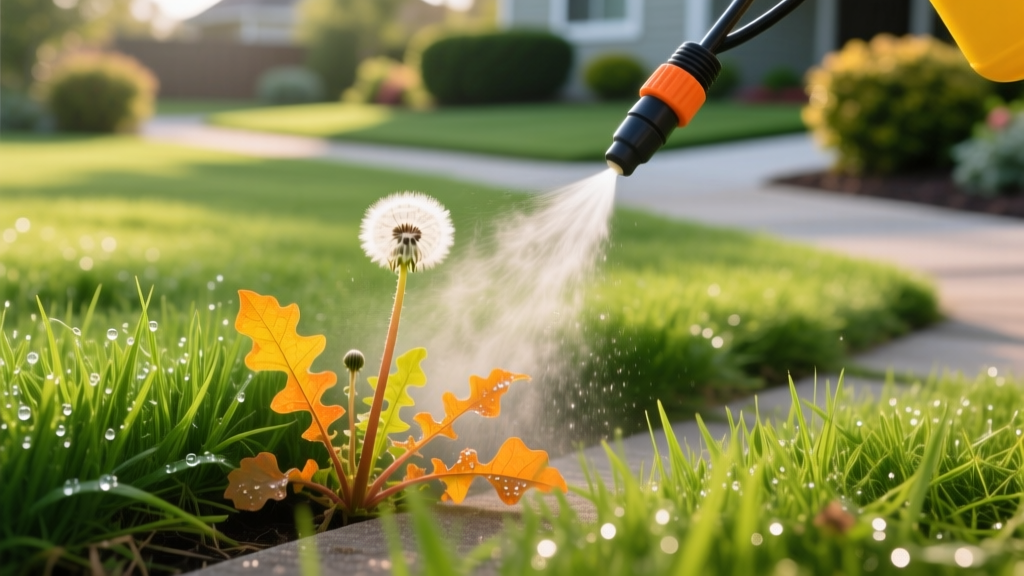
Strongest Weed and Grass Killer: Spot-Treating Invasive Species
When Selective Herbicides Fail: The Case for Non-Selective Spot-Treatment
Maintaining a pristine lawn often involves battling invasive grassy weeds that mimic your desirable turf. Selective herbicides like Quinclorac or Fenoxaprop are highly effective against broadleaf weeds and annual grasses, but they frequently fail against aggressive perennial grassy invaders like dallisgrass, torpedograss, and unwanted bermudagrass in cool-season lawns. When these selective options fall short, turf managers and homeowners must turn to the strongest weed and grass killer available: non-selective, systemic herbicides.
Non-selective herbicides do not discriminate; they will kill any green plant tissue they contact. Therefore, using the strongest weed and grass killer requires a shift from broadcast spraying to meticulous, precision spot-treatment. This guide details the exact chemistry, equipment, and application protocols required to eradicate stubborn invasive grass species without causing collateral damage to your surrounding lawn.
The Chemistry of the Strongest Weed and Grass Killers
The term 'strongest' in turf management refers to the active ingredient's ability to translocate through the plant's vascular system, ultimately reaching and destroying the root and rhizome networks. There are two primary chemical classes used for heavy-duty spot-treatment in 2026.
1. Glyphosate (41% Concentration)
Glyphosate is an amino acid synthesis inhibitor. It is the industry standard for perennial grassy weed control because of its exceptional systemic translocation. Products like Roundup Pro or Ranger Pro (containing 41% glyphosate as the isopropylamine salt) are the go-to choices. A 2.5-gallon jug typically costs between $130 and $150, yielding hundreds of gallons of mixed solution. According to the Environmental Protection Agency (EPA), when used according to label directions, glyphosate remains a highly effective tool for targeted vegetation management.
2. Glufosinate-Ammonium (24.5% Concentration)
Glufosinate (found in products like Finale) is a contact herbicide with limited systemic movement. It acts faster than glyphosate, showing necrosis in 24 to 48 hours, but it struggles to kill deep rhizome networks in mature perennial grasses. It is best reserved for younger weeds or as a rapid-burndown alternative when glyphosate resistance is suspected.
| Active Ingredient | Trade Name Examples | Translocation | Visible Results | Best Target Species |
|---|---|---|---|---|
| Glyphosate (41%) | Roundup Pro, Ranger Pro | Excellent (Systemic) | 7 to 14 days | Dallisgrass, Torpedograss, Bermudagrass |
| Glufosinate (24.5%) | Finale, InterLine | Poor (Contact/Limited) | 1 to 3 days | Annual grasses, young seedlings |
| Pelargonic Acid (31%) | Scythe, Avenger | None (Contact only) | Hours | Top-growth burndown (will not kill roots) |
Target Species Requiring the Strongest Formulations
Not every weed warrants the use of non-selective herbicides. Reserve the strongest weed and grass killer for species that possess deep vegetative reproductive structures (rhizomes and stolons) that survive standard selective treatments.
Target Profile: Dallisgrass (Paspalum dilatatum)
Dallisgrass forms deep, segmented rhizomes that store massive energy reserves. The University of California Statewide Integrated Pest Management Program notes that mechanical removal often leaves rhizome fragments behind, leading to rapid regrowth. Spot-treatment with 41% glyphosate is required to translocate the chemical down into these subterranean storage organs.
Dallisgrass forms deep, segmented rhizomes that store massive energy reserves. The University of California Statewide Integrated Pest Management Program notes that mechanical removal often leaves rhizome fragments behind, leading to rapid regrowth. Spot-treatment with 41% glyphosate is required to translocate the chemical down into these subterranean storage organs.
Other High-Priority Targets:
- Torpedograss (Paspalum repens): Features both stolons and sharp, spear-like rhizomes. Highly tolerant of most selective turf herbicides.
- Common Bermudagrass (Cynodon dactylon): When invading cool-season lawns (like Tall Fescue or Kentucky Bluegrass), bermudagrass cannot be selectively removed. Non-selective spot-treatment followed by renovation is the only viable protocol.
- Smutsgrass (Sporobolus indicus): A coarse, clumping perennial that laughs at standard MSMA or Quinclorac applications.
Precision Application Protocol: Step-by-Step
Applying the strongest weed and grass killer requires specialized equipment to prevent drift. A standard fan-nozzle sprayer will aerosolize the chemical, allowing wind to carry it onto your desirable turf, causing severe phytotoxicity.
Step 1: Equipment Selection and Calibration
Discard standard adjustable nozzles. For spot-treatment, equip a 1-gallon or 2-gallon pump sprayer (such as the Chapin Premier) with an air-induction nozzle, specifically the TeeJet AI11002. Air-induction nozzles inject air into the spray stream, creating large, heavy droplets that drop straight down, virtually eliminating fine-drift. Expect to pay around $12 to $15 for a genuine TeeJet AI nozzle.
Step 2: Mixing the Solution
For mature perennial grassy weeds, a standard mix rate is insufficient. You must use a higher concentration to ensure enough active ingredient penetrates the thick cuticle and translocates to the roots.
- Herbicide: Mix 2.5 fluid ounces (approx. 74 ml) of 41% Glyphosate per 1 gallon of water.
- Surfactant: Glyphosate requires a Non-Ionic Surfactant (NIS) to break the leaf surface tension. Add 0.25% v/v of a high-quality NIS (like Preference or Induce), which equates to roughly 1 teaspoon per gallon. Do not use Methylated Seed Oil (MSO) with glyphosate, as it can cause rapid leaf burn that halts translocation before the chemical reaches the roots.
- Water Quality: Use clean, potable water. Hard water containing high calcium or magnesium ions can bind to glyphosate molecules, rendering them inactive. If you must use well water, add 1 to 2 ounces of liquid ammonium sulfate (AMS) to the water before adding the herbicide to condition it.
Step 3: Application Techniques
Choose your application method based on the density of the weed patch and its proximity to desirable turf.
WARNING: Drift and Volatility
Never apply the strongest weed and grass killer when wind speeds exceed 5 mph. Avoid applications when ambient temperatures are above 85°F (29°C), as heat can increase the volatility of certain adjuvants and cause vapor drift, which will damage nearby ornamental shrubs and desirable turf.
Never apply the strongest weed and grass killer when wind speeds exceed 5 mph. Avoid applications when ambient temperatures are above 85°F (29°C), as heat can increase the volatility of certain adjuvants and cause vapor drift, which will damage nearby ornamental shrubs and desirable turf.
- Shielded Spraying: Use a physical shield (a piece of heavy cardboard or a commercially available plastic spray shield) held inches above the desirable turf. Spray the invasive weed while the shield blocks overspray.
- Wand Wicking (Sponge Applicator): For weeds intermingled tightly with desirable grass, use a sponge-tipped wicking wand. Dip the sponge into the mixed solution and physically wipe it onto the leaves of the target weed. This guarantees zero drift but is highly labor-intensive.
- Painting: For isolated, single-plant invaders, use a disposable foam brush to paint the solution directly onto the weed's foliage.
Step 4: The Waiting Period (Crucial for Translocation)
The most common failure mode when using the strongest weed and grass killer is impatience. Glyphosate takes 7 to 14 days to move from the leaves down to the rhizomes. Do not mow the area for at least 48 hours before application, and do not mow for 5 to 7 days after application. Removing the leaf tissue prematurely cuts off the transport highway, leaving the roots alive to regenerate.
Post-Treatment Renovation and Recovery
Once the targeted invasive grass has completely browned and the root system is dead (usually 14 to 21 days post-application), you must renovate the bare spot to prevent new weed seeds from colonizing the open soil.
Soil Preparation and Seeding Timelines
Glyphosate binds tightly to soil particles upon contact and is deactivated by soil microbes; it leaves no residual pre-emergent effect in the soil. However, you must wait until the dead weed material is removed before seeding.
- Rake out the dead thatch: Use a steel bow rake to aggressively remove the dead dallisgrass or bermudagrass roots and crowns.
- Core Aerate or Slice Seed: Break up the compacted soil left behind by the invasive species.
- Seed Selection: Match your surrounding turf. For cool-season lawns, apply Tall Fescue or Kentucky Bluegrass seed at a rate of 6 to 8 lbs per 1,000 sq ft for bare patch renovation.
- Starter Fertilizer: Apply a high-phosphorus starter fertilizer (e.g., 18-24-12) to promote rapid root establishment in the new seedlings.
Troubleshooting Regrowth
If you notice green shoots emerging from the center of the treated patch 30 days later, the initial application failed to reach the deepest rhizome nodes. This is common with mature torpedograss. Do not panic. Mix a fresh batch of 41% glyphosate at the 2.5 oz/gallon rate and re-treat the new growth immediately. Because the new shoots are young and actively growing, translocation will be much faster, and a second application is usually sufficient to achieve 100% control.

