
Lawn Care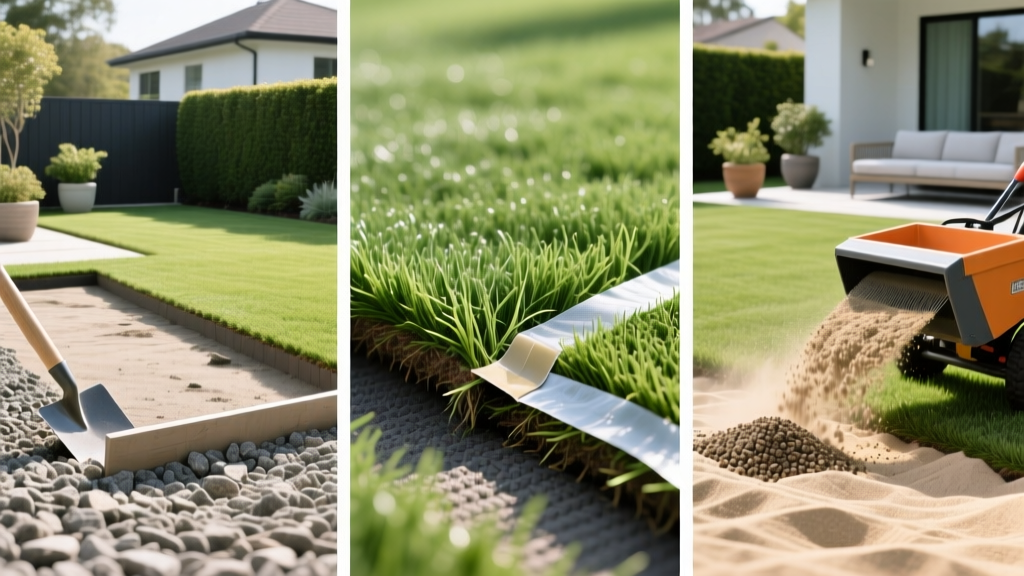
Synthetic Grass Installation: Base Prep, Seaming, and Infill Guide
The Material Science and Economics of Artificial Turf
A successful synthetic grass installation hinges on understanding the specific polymers and face weights required for your climate and traffic levels. Unlike natural sod, which establishes roots into the native soil, artificial turf is a permanent structural surface. The upfront investment typically ranges from $8 to $14 per square foot for professional installation, or $3 to $6 per square foot for a DIY approach, heavily dependent on site accessibility and base material costs.
Choosing the right fiber is the first critical decision. According to The Home Depot's landscaping guidelines, matching the fiber type to the application prevents premature matting and UV degradation.
| Fiber Type | Best Application | Face Weight (oz/yd²) | Pile Height | Material Cost (per sq ft) |
|---|---|---|---|---|
| Polyethylene (PE) | Residential lawns, landscaping | 50 - 75 oz | 1.5" - 2.25" | $2.50 - $4.50 |
| Nylon | High-traffic zones, pet runs, putting greens | 60 - 90 oz | 0.5" - 1.5" | $5.00 - $7.50 |
| Polypropylene (PP) | Indoor/outdoor carpets, low-budget projects | 30 - 50 oz | 0.5" - 1.0" | $1.50 - $2.50 |
Phase 1: Excavation and Base Engineering
The most common point of failure in synthetic grass installation is improper sub-base preparation. If the base shifts, the turf seams will split, and depressions will pool water. You must excavate 3 to 4 inches below the finished grade to accommodate the base aggregate, the turf backing, and the infill.
Warning: Heavy Clay Soils
If your native soil is heavy clay, standard excavation is insufficient. Clay expands when wet and shrinks when dry, causing severe base heaving. In these scenarios, lay a non-woven geotextile fabric over the native soil before adding aggregate, and consider installing a French drain system at the lowest elevation point to intercept lateral groundwater.
Aggregate Selection and Compaction Specs
Do not use pea gravel or round river rock; these do not lock together. The industry standard is Class II Road Base (a mix of crushed rock up to 3/4-inch and fine dust). Apply 2.5 to 3 inches of road base, moisten it lightly with a hose, and compact it using a vibratory plate compactor. You are aiming for a 90% to 95% Standard Proctor Density. Follow this with a 0.5-inch to 1-inch cap of Decomposed Granite (DG) or stone dust to create a perfectly smooth, porous surface.
Phase 2: Turf Acclimation, Layout, and Seaming
Before cutting, unroll the synthetic grass and let it acclimate to the ambient temperature for at least two hours. This allows the backing to relax and prevents post-installation wrinkling. Always ensure the turf grain (the direction the blades lean) faces the primary viewing point, usually the house or patio.
The Seaming Matrix: Tape vs. Glue vs. Staples
Seaming is where DIY installations often fail. Relying solely on staples or nails will result in visible gaps as the turf expands and contracts with temperature fluctuations. For a permanent, invisible seam, use a dual-component polyurethane adhesive spread over a 12-inch wide seaming tape.
- Tape Placement: Center the 12-inch tape directly under the two edges to be joined.
- Adhesive Application: Mix the polyurethane resin and hardener, then use a notched trowel (1/8-inch notch) to spread the glue evenly across the tape.
- Joining: Carefully fold the turf edges down onto the tape. Use a weighted lawn roller (minimum 75 lbs) to press the backing into the adhesive.
- Cure Time: Allow 24 hours for the polyurethane to fully cross-link and cure before applying infill or allowing foot traffic.
Phase 3: Infill Dynamics and Grooming
Infill is not optional; it is the structural ballast that keeps the turf pinned to the ground, protects the primary backing from UV rays, and keeps the grass blades standing upright. The University of Nebraska-Lincoln Extension notes that proper infill also aids in the thermal regulation of the surface, reducing the heat island effect common with synthetic materials.
Infill Material Comparison
- Silica Sand (Mesh 12/20): The most economical option. Apply at 1.0 to 1.5 lbs per square foot. Best for low-traffic landscaping areas.
- Envirofill (Acrylic-Coated Sand): Infused with Microban antimicrobial technology. Apply at 1.5 to 2.0 lbs per square foot. Mandatory for pet areas to prevent ammonia and bacterial buildup.
- Crumb Rubber (SBR): Provides maximum shock absorption. Apply at 2.0 to 3.0 lbs per square foot. Ideal for playgrounds and sports fields, though increasingly scrutinized for environmental runoff.
- Organic Infill (Walnut Shells/Cork): Natural cooling properties, retaining up to 30% more moisture than sand. Apply at 1.5 lbs per square foot.
After dropping the infill with a drop spreader, you must use a motorized power broom to brush the infill down to the backing and stand the fibers up. Broom in alternating directions to ensure even distribution.
Troubleshooting Common Installation Failures
Even with meticulous planning, environmental factors can introduce complications. Use this diagnostic framework to address post-installation anomalies.
| Symptom | Root Cause | Corrective Action |
|---|---|---|
| Visible seams separating | Adhesive applied in high humidity or insufficient tape width | Cut out the failed seam, re-lay 12-inch tape, and re-glue using a moisture-tolerant polyurethane adhesive. |
| Puddling after rain | Base compaction below 90% or lack of 1-2% grading slope | Cut an X into the turf, excavate the depressed base, add DG, re-compact, and patch the turf. |
| Fibers matting flat | Insufficient infill weight or wrong fiber type for traffic | Add 0.5 lbs/sq ft of Envirofill and power broom. If severe, the turf face weight was too low for the application. |
| Foul odor (Pet Areas) | Urine trapped in standard silica sand or impermeable backing | Flush with enzymatic cleaner. For long-term fixes, replace silica sand with antimicrobial acrylic-coated infill. |
Drainage Verification
Before laying the turf, perform a percolation test on your compacted base. Pour a 5-gallon bucket of water over a 10-square-foot area. The base should drain completely within 3 to 5 minutes. If it pools, your aggregate mix contains too much fine clay or dust, and you must scarify the surface and integrate more 3/4-inch crushed rock to meet the EPA's green infrastructure permeability standards.
Executing a precise synthetic grass installation requires treating the project as a civil engineering task rather than a simple landscaping upgrade. By adhering to strict compaction densities, utilizing polyurethane seaming matrices, and calculating exact infill ratios, you ensure a surface that remains structurally sound and aesthetically pristine for 15 to 20 years.

