
Lawn Care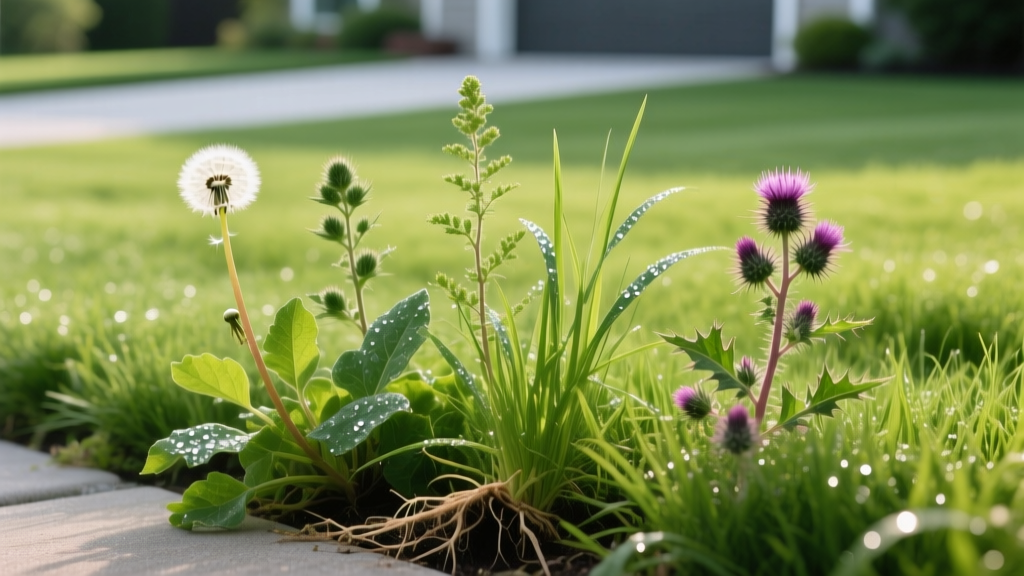
Tall Weeds Photo Guide: Identify and Spot-Treat Common Lawn Invaders
When lawn weeds escape regular mowing cycles and bolt upward, they transition from minor nuisances to structural threats to your turf. A standard 2.5-inch mowing height easily decapitates young seedlings, but mature, tall weeds develop thick cuticles, woody stems, and deep taproots that resist standard broadcast applications. While searching for a tall weeds photo online can help you visually match the invader in your yard, visual identification is only the first step. Effective eradication requires matching the specific botanical profile of the weed to a targeted chemical or mechanical spot-treatment protocol.
This guide breaks down the visual markers of the most common towering lawn invaders and provides exact, professional-grade spot-treatment formulations, mix rates, and application techniques to eliminate them without damaging the surrounding turf.
The Big Four: Visual Profiles and Spot-Treatment Protocols
Mature weeds that outgrow your turfgrass generally fall into two categories: broadleaf dicots with deep taproots, and annual grassy weeds with aggressive lateral growth. Here is how to identify and treat the most frequent offenders.
1. Common Ragweed (Ambrosia artemisiifolia)
Visual Markers: Ragweed features highly dissected, fern-like leaves that are bright green on top and silver-green underneath. As it matures, it develops a hairy, rigid central stem that can reach 3 to 4 feet in height, topped with inconspicuous green flower spikes that produce highly allergenic pollen in late summer.
The Problem: Once ragweed exceeds 12 inches, its stem becomes semi-woody, and the leaf cuticle thickens, causing standard off-the-shelf herbicides to bead up and roll off.
Spot-Treatment Protocol:
- Active Ingredients: A three-way herbicide blend containing 2,4-D, MCPP (mecoprop), and Dicamba (e.g., Hi-Yield Trimec or Ortho WeedClear).
- Mix Rate: 2.0 fluid ounces of concentrate per 1 gallon of water.
- Surfactant: Add 0.25% v/v non-ionic surfactant (approx. 1/2 teaspoon per gallon) to break the surface tension on the hairy leaves.
- Application: Spray until the leaves are uniformly wet but not dripping. Expect visible wilting within 48 hours and complete necrosis in 14 days.
2. Pokeweed (Phytolacca americana)
Visual Markers: Pokeweed is unmistakable. It features thick, hollow, vibrant red-purple stems, large alternate oval leaves (up to 10 inches long), and drooping clusters of white flowers that mature into dark purple, glossy berries. It can easily reach 6 to 8 feet tall in a single season.
The Problem: Pokeweed grows from a massive, fleshy taproot that can weigh over 10 pounds and penetrate 18 inches deep. Pulling it usually snaps the root, guaranteeing aggressive regrowth. Furthermore, it is highly toxic to humans and pets.
Spot-Treatment Protocol:
- Mechanical Prep: Do not spray the massive leaf surface area; it wastes chemical and risks drift. Instead, use loppers to cut the main stem 2 inches above the soil line.
- Chemical Application (Cut-Stump Method): Within 60 seconds of cutting, use a small foam brush to paint undiluted 41% glyphosate (e.g., Roundup Pro Concentrate) directly onto the exposed cambium ring (the outer edge of the cut stem).
- Follow-up: The plant will translocate the glyphosate down into the massive taproot, killing it systemically over 2 to 3 weeks. Monitor for secondary shoots and spot-spray with a 2% glyphosate solution if they emerge.
3. Goosegrass (Eleusine indica)
Visual Markers: Often confused with crabgrass, goosegrass has a distinct silver or white center at the crown of the plant. Its seedheads resemble a zipper, with seeds arranged in neat, tight rows along the spikes. The stems are tough, flat, and highly resilient to mower blades.
The Problem: Goosegrass thrives in heavily compacted soils where turfgrass roots struggle to penetrate. Its low, spreading growth habit allows it to duck under mower decks until it bolts to produce seed.
Spot-Treatment Protocol:
- Active Ingredients: Fluazifop-P-butyl (e.g., Ortho Grass B Gon) for selective control in broadleaf lawns, or Fenoxaprop-P-ethyl for cool-season turf.
- Mix Rate: Follow label rates precisely, typically 1.5 to 2.0 ounces per gallon for spot treatments.
- Edge Case: If the goosegrass has already produced mature 'zipper' seedheads, chemical control is significantly less effective. Manually dig out the clump using a stand-up weeder, ensuring you extract the fibrous root mass, and immediately overseed the bare patch with a fast-germinating perennial ryegrass to prevent reinvasion.
4. Bull Thistle (Cirsium vulgare)
Visual Markers: Bull thistle forms a large, spiny rosette in its first year, then bolts in the second year to produce a tall, branching stem (up to 5 feet) topped with large, magenta-purple flowers. The leaves are deeply lobed with stiff, yellow spines at the tips.
The Problem: A single mature thistle can produce up to 5,000 wind-dispersed seeds. The spines make manual removal painful and difficult without heavy leather gloves.
Spot-Treatment Protocol:
- Active Ingredients: Clopyralid + 2,4-D (e.g., Millennium Ultra) or a high-concentration Dicamba mix.
- Timing: Treat in the rosette stage or early bolt stage. If the plant is already towering and flowering, cut the flower heads off with shears and dispose of them in sealed bags to prevent seeding, then spray the remaining foliage.
- Application: Use a shielded spray nozzle to prevent herbicide drift onto desirable broadleaf plants or ornamentals.
CRITICAL WARNING: Mature Seed Heads
If the tall weed you are identifying has already developed mature, dry seed heads (e.g., dandelion puffballs, thistle down, or ragweed spikes), do not spray immediately. Spraying causes the plant to rapidly shut down its vascular system, which can trap viable seeds on the dead stalk. Always snip and bag mature seed heads first, then apply your spot-treatment to the remaining foliage.
If the tall weed you are identifying has already developed mature, dry seed heads (e.g., dandelion puffballs, thistle down, or ragweed spikes), do not spray immediately. Spraying causes the plant to rapidly shut down its vascular system, which can trap viable seeds on the dead stalk. Always snip and bag mature seed heads first, then apply your spot-treatment to the remaining foliage.
Herbicide Selection Matrix for Spot-Treatments
Selecting the correct chemistry is paramount. Using a non-selective herbicide like glyphosate on a broadleaf weed in the middle of a Kentucky Bluegrass lawn will leave a dead, brown halo. Use the matrix below to match your weed type and turfgrass species.
| Weed Category | Active Ingredient | Safe for Cool-Season Turf? | Safe for Warm-Season Turf? | Surfactant Required? |
|---|---|---|---|---|
| Broadleaf (Ragweed, Thistle) | 2,4-D + Dicamba + MCPP | Yes | Yes (with caution) | Yes (NIS) |
| Tough Broadleaf (Pokeweed, Clover) | Triclopyr | Yes | No (causes severe damage) | Yes (Methylated Seed Oil) |
| Grassy Weeds (Goosegrass, Crabgrass) | Fluazifop-P-butyl | Yes | No | Yes (Crop Oil Concentrate) |
| Grassy Weeds (in Bermudagrass) | Quinclorac | Yes | Yes (Bermuda only) | Yes (Methylated Seed Oil) |
| Non-Selective (Cut-Stump / Edges) | Glyphosate (41%) | No (kills all grass) | No (kills all grass) | No |
For comprehensive regional identification resources and updated chemical resistance data, consult the University of California Statewide IPM Program and the Penn State Extension Turfgrass Management databases. These institutions provide peer-reviewed, updated efficacy trials for modern herbicide formulations.
Spot-Treatment Application: The 3-Step Calibration Method
Broadcast spraying is inefficient and environmentally taxing. For tall weeds scattered across a lawn, a 1-gallon or 2-gallon handheld pump sprayer is the ideal tool. However, improper calibration leads to herbicide waste and turf burn. Follow this exact calibration method.
- Calculate the Output Rate: Fill your sprayer with exactly 1 gallon of plain water. Spray a 10x10 foot area (100 sq ft) on your driveway at your normal walking pace and pumping rhythm. Measure how much water is left. If you used 1/4 gallon (32 oz) to cover 100 sq ft, your output is 32 oz per 100 sq ft.
- Mix the Concentrate: If the herbicide label calls for 2 oz per 1,000 sq ft, you need 0.2 oz per 100 sq ft. Add 0.2 oz of herbicide to your sprayer, then add water up to the 1-gallon mark. Add your required surfactant last to prevent excessive foaming.
- Execute the 'Wet, Not Dripping' Rule: When targeting a tall weed, use a pin-stream nozzle rather than a wide fan nozzle. Aim at the center of the weed and use a slow, sweeping motion. The goal is to coat the leaves until they glisten, but stop before the liquid runs off the leaf edge and pools on the soil, which can damage the roots of your desirable turfgrass.
Pro Tip: The Dye Indicator
When spot-treating multiple tall weeds across a large property, add 1/4 teaspoon of blue turf marker dye to your tank. This allows you to see exactly which weeds have been treated, preventing accidental double-applications that could harm the soil microbiome and surrounding grass roots.
When spot-treating multiple tall weeds across a large property, add 1/4 teaspoon of blue turf marker dye to your tank. This allows you to see exactly which weeds have been treated, preventing accidental double-applications that could harm the soil microbiome and surrounding grass roots.
Post-Treatment Lawn Recovery and Soil Correction
Tall weeds do not appear in a vacuum; they are indicator species for underlying soil deficiencies. Eradicating the weed leaves a void that must be filled immediately to prevent a new flush of weed seeds from germinating in the exposed sunlight.
- For Broadleaf Voids (Pokeweed, Thistle): Once the weed is dead and removed, the deep taproot leaves a physical hole and a pocket of decaying organic matter. Fill the void with a 70/30 mix of topsoil and compost. Overseed with a turf-type tall fescue blend (for cool-season lawns) at a rate of 4 to 6 lbs per 1,000 sq ft. Keep the patch moist for 14 days.
- For Grassy Weed Voids (Goosegrass): Goosegrass indicates severe soil compaction. Before reseeding, use a manual core aerator or a heavy-duty digging fork to penetrate the soil to a depth of 4 inches in the affected area. Topdress with 1/4 inch of fine compost, then overseed. This breaks up the compacted clay layer that allowed the goosegrass to outcompete your turf.
- pH Adjustment: Many tall broadleaf weeds, particularly plantain and dandelion, thrive in acidic soils (pH below 6.0). Conduct a soil test and apply pelletized lime at the recommended rate (typically 20-30 lbs per 1,000 sq ft) to raise the pH to the optimal 6.5-7.0 range, favoring turfgrass over weed seedlings.
By combining precise visual identification with targeted, calibrated spot-treatments, you can eliminate towering weeds efficiently while preserving the health, density, and aesthetic of your primary lawn.

