
Lawn Care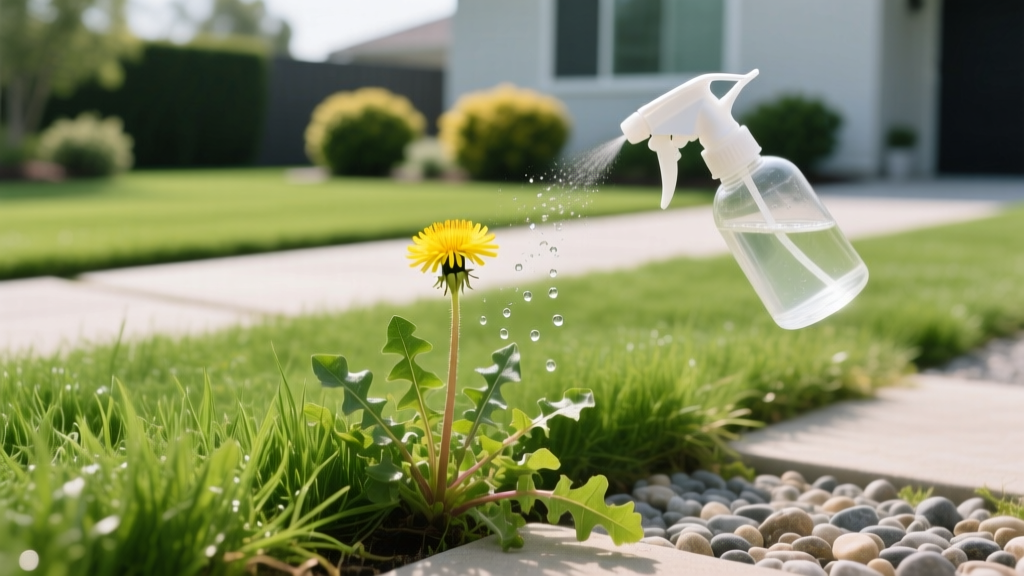
Targeted Home Remedies for Killing Weeds: A Spot-Treatment Guide by Species
The Reality of DIY Weed Control: Contact vs. Systemic
When evaluating home remedies for killing weeds, the most critical distinction to understand is the difference between contact and systemic herbicides. Commercial products like glyphosate or 2,4-D are systemic; they are absorbed through the foliage and translocated down to the root system, killing the entire plant. Home remedies, by contrast, are strictly contact desiccants. They destroy the cellular structure of the leaves they touch but do not travel to the roots.
Because of this biological limitation, the efficacy of any DIY weed killer depends entirely on the weed species, its growth stage, and the exact formulation you use. A 5% kitchen vinegar solution will merely stunt a seedling, while a properly formulated 20% acetic acid mixture will obliterate broadleaf foliage in hours. This guide breaks down exact formulations, application protocols, and failure modes for specific weed categories.
⚠️ Safety Warning: Horticultural vinegar (20-30% acetic acid) is highly corrosive. It can cause irreversible corneal damage and severe chemical burns. Always wear ANSI Z87.1-rated splash goggles and nitrile gloves when mixing or applying. According to Penn State Extension, treating high-concentration acetic acid with the same casualness as kitchen vinegar is a leading cause of DIY landscaping injuries.
Species-Specific Spot Treatment Matrix
Not all weeds respond to the same organic compounds. The waxy cuticle on clover leaves repels water-based solutions, while the deep tubers of nutsedge laugh at foliar burn-downs. Use this matrix to select the correct home remedy for your specific infestation.
| Weed Species | Primary Home Remedy | Optimal Application Timing | Expected Kill Rate |
|---|---|---|---|
| Dandelion (Taraxacum) | 20% Acetic Acid + Surfactant | Mid-day, full sun, 75°F+ | 85% (foliar), 40% (root) |
| White Clover (Trifolium) | 30% Acetic Acid + Orange Oil | Early morning (dew present) | 70% (requires 2-3 passes) |
| Crabgrass (Digitaria) | Boiling Water (Hardscape only) | Any time, dry soil | 99% (crown destruction) |
| Yellow Nutsedge (Cyperus) | Manual Extraction / Sugar Method | Spring (before 6-leaf stage) | Variable (tuber dependent) |
Broadleaf Weeds: The Horticultural Vinegar Protocol
Dandelions, plantain, and thistle rely on deep taproots. To maximize the effectiveness of home remedies for killing weeds in this category, you must achieve total foliar desiccation before the plant can initiate stress-response root growth.
The 20% Burn-Down Recipe
- 1 Gallon 20% Horticultural Vinegar (Cost: ~$35-$45 per gallon in 2026)
- 1 Ounce Non-ionic surfactant (or 1 tablespoon of liquid dish soap as a budget alternative)
- 1 Ounce D-Limonene (Orange Oil) to dissolve waxy leaf cuticles
The surfactant reduces the surface tension of the water, allowing the acidic solution to spread across the leaf rather than beading up and rolling off. D-Limonene acts as a natural solvent, stripping the protective wax layer off stubborn weeds like plantain.
Application Technique
- Wait for Heat: Apply between 11:00 AM and 2:00 PM when UV radiation and ambient temperatures are highest. The sun accelerates the desiccation process.
- Spray to Wetness: Coat the leaves until they are uniformly wet, but stop before the liquid drips onto the soil. Dripping wastes the solution and unnecessarily lowers your soil pH.
- The 48-Hour Rule: Do not water the lawn or allow rainfall for 48 hours. Water will dilute the acid on the leaf surface before cellular collapse is complete.
Expert Insight: Kitchen vinegar (5% acetic acid) is largely ineffective on mature broadleaf weeds. Research highlighted by the University of Minnesota Turfgrass Science team demonstrates that while 5% vinegar burns the tips of young seedlings, it lacks the concentration to penetrate the cuticle of established dandelions, leading to rapid regrowth within 10 days.
Grassy Weeds and Hardscape Cracks: Thermal Treatment
Using liquid home remedies for killing weeds in driveway cracks, paver joints, or sidewalk seams is often a mistake. The runoff pools in the gravel base, altering the pH of adjacent soil and harming nearby ornamental beds. For grassy weeds like crabgrass, poa annua, or torpedo grass growing in hardscapes, thermal treatment is vastly superior.
The Boiling Water Method
Pouring water at 212°F (100°C) directly onto the crown of the weed instantly cooks the plant's cellular structure and destroys the meristematic tissue at the base. Unlike vinegar, which leaves acidic residue, boiling water leaves zero soil-altering chemicals behind once it cools and evaporates.
Thermal Spot-Treatment Specs
- Volume Required: 1.5 to 2 quarts per mature crabgrass clump.
- Pour Height: Keep the spout within 2 inches of the weed crown to prevent heat dissipation in the air.
- Target Zone: Focus strictly on the center crown where the tillers emerge. Scalding the outer leaf blades is unnecessary.
The Nutsedge Anomaly: Why Home Remedies Fail
Yellow and purple nutsedge are not broadleaves or standard grasses; they are sedges. They reproduce via underground tubers (nutlets) located 8 to 14 inches deep in the soil profile. No topical home remedy for killing weeds will penetrate the soil deeply enough to destroy these tubers without simultaneously sterilizing the earth and killing your turfgrass.
If you spray nutsedge with 30% vinegar, the top growth will die in hours. However, the tuber will simply push up a new shoot within 7 days. In fact, the stress of the chemical burn often triggers the tuber to produce multiple new shoots, worsening the infestation.
The Biological Suppression Method
Instead of chemical burn-downs, use microbial competition. Applying dry granulated sugar or molasses to the affected area at a rate of 1 pound per 50 square feet stimulates indigenous soil bacteria. These microbes consume the sugars and subsequently feed on the exudates released by the nutsedge tubers, weakening the sedge's root system over a 6-to-8-week period. While slower than synthetic herbicides like Sulfentrazone, this is the only biologically sound home approach to sedges.
Pre-Emergent Home Remedies: Corn Gluten Meal
Spot-treating existing weeds is reactive. Preventing them is proactive. Corn Gluten Meal (CGM) is a byproduct of corn milling that acts as a natural pre-emergent herbicide. It does not kill existing weeds, but it inhibits the root formation of germinating seeds.
- Active Mechanism: CGM releases organic dipeptides into the soil that dry out the initial feeder root of a germinating seed.
- Application Rate: Exactly 20 lbs per 1,000 square feet. Under-applying provides zero weed control; over-applying acts as a heavy nitrogen fertilizer (CGM is roughly 10-0-0 NPK).
- Timing: Apply when soil temperatures at a 2-inch depth consistently hit 55°F for three consecutive mornings (typically early spring for crabgrass).
- Watering Protocol: Water lightly (1/4 inch) immediately after application to activate the proteins, then allow the top inch of soil to dry out completely. If the soil remains wet, the germinating seed will grow a secondary root and survive.
Soil Health Warnings: The Remedies You Must Avoid
The internet is saturated with dangerous DIY weed control advice that causes long-term ecological damage to your lawn. Avoid these common pitfalls at all costs:
🚫 Banned DIY Ingredients:
- Sodium Chloride (Table Salt): Salt permanently destroys soil structure by displacing calcium and magnesium, leading to severe soil compaction and total sterilization. Nothing will grow in salt-treated earth for years.
- Sodium Bicarbonate (Baking Soda): While it burns foliage, the heavy sodium load ruins the soil's cation exchange capacity (CEC), locking out essential nutrients like iron and potassium for your surrounding turf.
- Bleach (Sodium Hypochlorite): Highly toxic to soil microbes, earthworms, and local groundwater systems. It breaks down into harmful chlorides that persist in the soil matrix.
Cost and Efficacy: DIY vs. Commercial Spot Treaters
Are home remedies for killing weeds actually cheaper than commercial options? Let's break down the 2026 economics of spot-treating a standard 5,000 sq ft lawn with scattered broadleaf weeds.
| Metric | 20% Vinegar DIY Mix | Commercial Iron HEDTA (e.g., Fiesta) |
|---|---|---|
| Initial Material Cost | $45 (1 Gal Vinegar + Surfactant) | $35 (32 oz Ready-to-Spray) |
| Cost Per 1,000 sq ft (Spot) | ~$4.50 | ~$12.00 |
| Root Kill Efficacy | Low (40%) | High (85%+) |
| Turfgrass Safety | Low (Burns grass on contact) | High (Selective broadleaf killer) |
While the DIY vinegar route is cheaper per gallon, its lack of selectivity means you will likely burn the surrounding turfgrass, requiring overseeding and topdressing to repair the bald spots. Commercial chelated iron products (Iron HEDA) are selective, meaning they kill broadleaves while safely darkening your turfgrass, making them a more cost-effective choice for weeds embedded directly in the lawn canopy.
Frequently Asked Questions
Can I use Epsom salt to kill weeds?
Epsom salt is magnesium sulfate. While a massive overdose can cause osmotic stress and burn weed foliage, it is primarily a fertilizer. You are more likely to inadvertently fertilize the weed's root system than kill it. Stick to acetic acid for foliar burn-downs.
Does vinegar permanently lower my soil pH?
When used correctly as a spot treatment (sprayed only on leaves, not drenched into the soil), the impact on soil pH is negligible. Soil buffering capacity easily neutralizes the minor acidic runoff from targeted spot-spraying. However, repeatedly drenching the same soil area with vinegar will harm local microbial life.
Why did my vinegar weed killer turn the leaves white but the weed grew back?
White leaves indicate successful cellular desiccation of the top growth. If the weed grew back, the solution failed to reach the crown or taproot. This happens when you spray too lightly, or when you spray on a cloudy, cool day where the acid evaporates before fully penetrating the plant tissue. Increase your surfactant ratio and apply during peak afternoon heat.

