
Lawn Care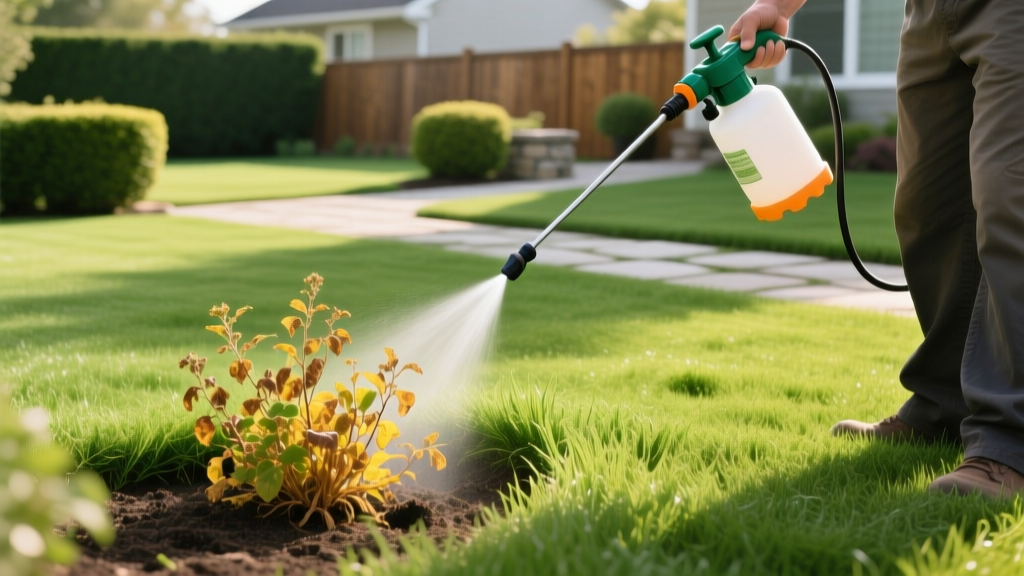
How to Kill Weeds and Grass Using Targeted Spot Treatments
The Chemistry of Killing Weeds and Grass: Selective vs. Non-Selective
When homeowners decide to kill weeds and grass in specific problem areas, the most common and costly mistake is reaching for a non-selective herbicide when a selective formula is required. Spot-treating a lawn requires a precise understanding of active ingredients, surfactant chemistry, and application timing. According to NC State Extension TurfFiles, misidentifying weed species and applying the wrong chemistry not only fails to eradicate the target weed but can leave unsightly dead patches in your turfgrass for months.
Before mixing any chemicals, you must determine your end goal: Are you trying to clear a patch of driveway cracks (total vegetation control), or are you trying to eliminate an invasive grassy weed like Bermudagrass from a Fescue lawn without harming the surrounding desirable turf?
| Active Ingredient | Herbicide Type | Target Weeds | Turfgrass Safety | Avg. Cost (2026) |
|---|---|---|---|---|
| Glyphosate (41%) | Non-Selective | All broadleaf & grassy | Kills all turf | $35 / gallon |
| Glufosinate | Non-Selective | All broadleaf & grassy | Kills all turf | $45 / gallon |
| Fluazifop-p-butyl | Selective (Grassy) | Bermuda, Crabgrass, Dallis | Safe for Fescue/Ryegrass | $80 / 8 oz |
| Triclopyr + 2,4-D | Selective (Broadleaf) | Violets, Ground Ivy, Clover | Safe for most cool/warm turf | $40 / quart |
Scenario A: Total Vegetation Control (Killing Everything)
There are specific scenarios where you actually want to kill weeds and grass simultaneously. This includes clearing expansion joints in concrete, renovating a completely dead section of lawn before reseeding, or eradicating deep-rooted, highly invasive perennials like Dallisgrass or Johnson grass where selective herbicides are ineffective.
Warning on Soil Residuals: Never use Imazapyr (Arsenal) or Prometon for residential spot treatments. While they are highly effective non-selective herbicides, they possess a soil half-life of up to 9 months, meaning you will not be able to grow new grass or plants in that spot for nearly a year. Stick to Glyphosate or Glufosinate, which bind tightly to soil particles and become inert within days.
Step-by-Step Non-Selective Spot Protocol
- Mix the Solution: For a standard 1-gallon pump sprayer, mix 2 fluid ounces of 41% Glyphosate concentrate with 126 ounces of water.
- Add a Surfactant: Glyphosate requires a non-ionic surfactant (NIS) to break the surface tension of the weed's waxy cuticle. Add 0.5% v/v of NIS (approximately 1/3 fluid ounce per gallon). Without this, the herbicide will bead up and roll off the leaves.
- Address Hard Water Tie-Up: If your local water is hard (high in calcium and magnesium), the minerals will bind to the glyphosate molecule, rendering it useless. For small 1-gallon batches, use distilled water. For larger batches, add 1 ounce of Ammonium Sulfate (AMS) per gallon to condition the water.
- Apply with a Shield: Use a cardboard shield or a commercial bell-nozzle attachment to prevent drift onto desirable turf. Apply until the leaves are uniformly wet, but not dripping.
Scenario B: Selective Spotting (Killing Weeds, Saving Grass)
If your goal is to eliminate invasive species without damaging your lawn, you must use selective chemistry. This requires accurate weed identification. The University of Minnesota Extension emphasizes that grassy weeds in broadleaf lawns (and vice versa) require entirely different modes of action.
Targeting Grassy Weeds in Cool-Season Lawns
Killing invasive Bermudagrass or Dallisgrass in a Tall Fescue lawn is one of the most difficult challenges in turf management. Standard broadleaf herbicides will not touch them. You need Fluazifop-p-butyl (commonly sold as Ornamec 170 or Fusilade II).
- Mix Rate: 0.3 to 0.5 fluid ounces per gallon of water.
- Surfactant: 0.5% v/v non-ionic surfactant is mandatory.
- Application Timing: Apply in late spring or early fall when the invasive grass is actively growing. Do not apply during the peak heat of summer (above 85°F), as this will cause severe phytotoxicity (yellowing/burning) to your desirable Fescue.
- Expectations: It takes 14 to 21 days to see complete necrosis. A second application is often required 14 days after the first for mature rhizomes.
Targeting Stubborn Broadleaf Perennials
For tough broadleaf weeds like Wild Violet, Ground Ivy (Creeping Charlie), and Plantain, standard 2,4-D is insufficient. You need a formulation containing Triclopyr. Triclopyr mimics plant growth hormones, causing the weed's vascular system to collapse.
Pro-Tip for Violets and Ground Ivy: These weeds have thick, waxy leaves. Substitute your standard non-ionic surfactant with a methylated seed oil (MSO) or a silicone-based spreader-sticker. MSO penetrates the waxy cuticle far more effectively than standard NIS, increasing Triclopyr uptake by up to 40%.
Calibrating Your Spot Sprayer for Accurate Dosing
Over-application is a primary cause of turf damage during spot treatments. Herbicide labels dictate rates per 1,000 square feet, not per gallon of water. To calibrate your spot sprayer:
- Fill your sprayer with exactly 1 gallon of plain water.
- Spray a 10x10 foot area (100 sq ft) on your driveway using your normal walking pace and spray pattern.
- Measure how much water is left. If you used 12 ounces to cover 100 sq ft, you know your sprayer outputs roughly 1.2 gallons per 1,000 sq ft.
- Adjust your chemical mixing ratio based on this output volume to ensure you are applying the exact micro-ounces of active ingredient required per square foot.
Pro-Troubleshooting: Why Your Spot Treatment Failed
If your targeted application did not result in total weed death, review these common failure modes:
- Rainfastness Violation: Glyphosate requires 2 hours of dry weather post-application to absorb into the phloem. 2,4-D and Triclopyr require 4 to 6 hours. If it rained 45 minutes after you sprayed, the herbicide washed off into the soil where it is inactive.
- Mowing Too Soon: Herbicides must translocate from the leaves down to the root system. Mowing the lawn 24 hours after a spot treatment physically removes the chemical before it reaches the roots. Wait a minimum of 48 hours (72 is optimal) before mowing.
- Wrong Growth Stage: Applying non-selective herbicides to drought-stressed weeds is highly ineffective. When weeds are drought-stressed, they shut down their stomata and halt internal fluid movement to conserve water. The herbicide sits on the leaf surface and degrades in the UV light. Always water the target area deeply 24 hours before application to ensure the weed is actively transpiring.
Mastering the art of the spot treatment saves hundreds of dollars in sod replacement and professional lawn care fees. By matching the exact active ingredient to the weed species, utilizing the correct surfactant chemistry, and calibrating your equipment, you can effectively kill weeds and grass in targeted zones while preserving the health and density of your surrounding lawn.

