
Lawn Care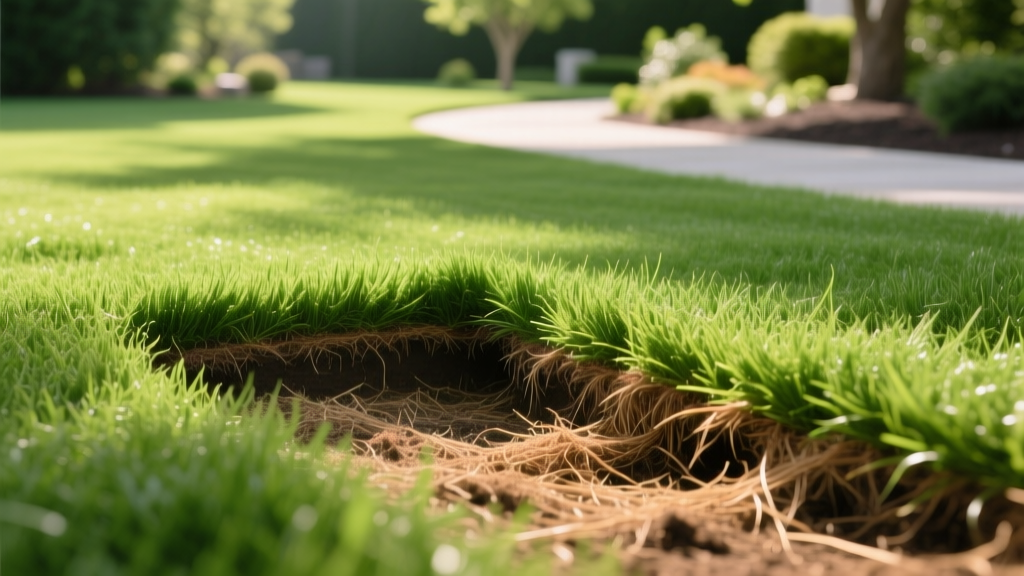
Thatch Meaning Explained: How to Identify and Manage Lawn Buildup
The True Thatch Meaning: Beyond the Grass Clipping Myth
When discussing lawn health, the thatch meaning is frequently misunderstood. Thatch is not merely a collection of unmulched grass clippings left behind after mowing. According to turfgrass science, thatch is a tightly intermingled layer of living and dead stems, roots, rhizomes, and stolons that develops between the zone of green vegetation and the soil surface. It is essentially an organic mat composed primarily of lignin—a complex structural polymer that resists rapid microbial decomposition.
A thin layer of thatch (under 0.5 inches) is actually beneficial. It acts as a natural mulch, moderating soil temperature fluctuations, retaining moisture, and providing a cushioned surface that protects grass crowns from foot traffic and mower wheels. However, when the production of organic matter outpaces the decomposition rate by soil microbes, this layer thickens into a hydrophobic barrier that blocks water, oxygen, and nutrients from reaching the root zone.
Myth Buster: Do Grass Clippings Cause Thatch?
No. Grass clippings are composed of 85% water and highly digestible cellulose. They possess a low carbon-to-nitrogen (C:N) ratio, allowing soil bacteria to break them down in a matter of weeks. Conversely, the stolons and rhizomes that form true thatch have a high lignin content and a high C:N ratio, taking months or even years to decompose. Leaving clippings on the lawn (grasscycling) returns valuable nitrogen to the soil without contributing to thatch buildup.
Diagnostic Framework: How to Measure Thatch Depth
You cannot manage what you do not measure. Visual inspection from the surface is highly deceptive; a lawn can look lush and green while harboring a destructive thatch layer beneath. To accurately assess your lawn, you must extract a physical core sample.
- Select the Right Tool: Use a stainless steel Hori Hori soil knife, a sharp flat-head spade, or a dedicated turfgrass cup cutter (1.5-inch diameter).
- Extract the Plug: Cut a vertical wedge or core at least 3 inches deep into the soil. Ensure you cut through the green canopy, the brown mat, and into the native topsoil.
- Measure the Mat: Using a tape measure, measure only the spongy, brown, intermingled organic layer situated directly above the mineral soil line. Do not include the living green grass blades or the subterranean roots in your measurement.
- Sample Multiple Zones: Thatch accumulation is rarely uniform. Test high-traffic areas, shaded zones, and areas near sprinkler heads to get an accurate average.
Thatch Thickness Action Matrix
| Measured Depth | Lawn Status | Required Action Protocol |
|---|---|---|
| < 0.5 Inches | Optimal / Healthy | Maintain current mowing and fertilization practices. No intervention needed. |
| 0.5 to 0.75 Inches | Warning Zone | Apply liquid biological dethatchers. Reduce quick-release nitrogen applications. |
| > 0.75 Inches | Critical / Restrictive | Mechanical dethatching (power raking) or heavy core aeration required immediately. |
Mechanical vs. Biological Thatch Removal
Once your thatch layer exceeds the 0.75-inch threshold, active removal is necessary to prevent shallow rooting, localized dry spot (hydrophobic soil), and increased susceptibility to turf diseases like brown patch and dollar spot. You have two primary pathways for remediation.
1. Mechanical Dethatching (Power Raking & Verticutting)
Mechanical removal involves using a machine with vertically spinning blades or stiff wire tines to physically tear the thatch layer and pull it to the surface. For cool-season grasses, this is best performed in early fall; for warm-season grasses, execute this in late spring after the second mowing.
- Equipment: Renting a dedicated dethatcher like the Classen TR-50 or Billy Goat HR520H typically costs between $85 and $120 per day at local equipment rental yards.
- Execution: Set the blade depth to penetrate the thatch layer and lightly scarify the top 1/8-inch of soil. Make two passes in perpendicular directions.
- Cleanup: You must aggressively rake and bag the pulled debris. Leaving the extracted thatch on the lawn will smother the existing grass and defeat the purpose of the operation.
- Drawback: Mechanical dethatching is highly stressful to the turf. It requires a 3-to-4-week recovery period and should be paired with overseeding and starter fertilizer application.
2. Biological Dethatching (Microbial Acceleration)
For lawns in the warning zone (0.5 to 0.75 inches) or as a preventative measure, biological dethatchers offer a non-destructive alternative. These liquid formulations introduce specialized Bacillus bacterial strains and fungal inoculants, combined with simple carbon sugars (molasses) and humic acids, to rapidly accelerate the microbial breakdown of lignin.
- Products: Formulations like N-Ext D-Thatch 55X (approx. $49.99 per 32oz bottle) or Simple Lawn Solutions Liquid Dethatcher are highly effective when applied via a hose-end sprayer.
- Application Rate: Apply 3 ounces per 1,000 square feet every 14 days during peak growing season when soil temperatures are consistently above 60°F.
- Advantage: Zero turf stress, no physical cleanup required, and it simultaneously improves soil biology and nutrient cycling.
Grass Species Susceptibility Matrix
Not all turfgrasses produce thatch at the same rate. The genetic growth habit of the grass—specifically whether it spreads via aggressive above-ground stolons or below-ground rhizomes—dictates its thatch potential. According to turfgrass researchers at the University of Minnesota Extension, managing species-specific growth rates is the first line of defense.
| Grass Species | Growth Habit | Thatch Risk Level | Management Note |
|---|---|---|---|
| Kentucky Bluegrass | Aggressive Rhizomes | High | Requires annual core aeration to manage rhizome matting. |
| Bermudagrass | Stolons & Rhizomes | Very High | Often requires annual verticutting; highly prone to rapid buildup. |
| Zoysiagrass | Stolons & Rhizomes | High | Dense, slow-decaying tissue makes biological breakdown difficult. |
| Tall Fescue | Bunchgrass | Low | Rarely forms thatch; issues usually stem from soil compaction instead. |
| Perennial Ryegrass | Bunchgrass | Low | Minimal lateral spread keeps organic matter production low. |
Preventative Maintenance Protocol
Preventing thatch accumulation is vastly more cost-effective and less labor-intensive than removing it. The Clemson University Home & Garden Information Center emphasizes that cultural practices dictate the microbial balance of your soil. Implement the following protocols to maintain an optimal decomposition rate:
- Audit Nitrogen Inputs: Over-application of quick-release synthetic nitrogen (like 46-0-0 Urea) forces explosive top growth and excessive stolon production that soil microbes cannot process fast enough. Transition to slow-release nitrogen sources like methylene urea or sulfur-coated urea, limiting total annual nitrogen to 2.5 - 3.5 lbs per 1,000 sq ft for cool-season lawns.
- Correct Soil pH: Soil microbes responsible for breaking down lignin become dormant in highly acidic soils (pH below 6.0). Conduct a laboratory soil test every two years and apply pelletized calcitic lime to maintain a pH between 6.2 and 6.8.
- Deep, Infrequent Irrigation: Frequent, shallow watering encourages grass roots to grow upward into the thatch layer rather than downward into the soil. This exacerbates the thatch problem and makes the lawn highly vulnerable to drought stress. Water deeply (0.5 to 0.75 inches per session) only when the turf shows signs of wilting.
- Annual Core Aeration: For heavy clay soils, compaction restricts the oxygen flow necessary for aerobic bacteria to decompose organic matter. Pulling 3-inch soil cores in the fall alleviates compaction and introduces soil microorganisms directly into the thatch layer, inoculating it for faster breakdown.
Expert Troubleshooting: The Hydrophobic Thatch Effect
If you water your lawn but the soil beneath the thatch remains bone dry, you are experiencing localized dry spot. The thatch layer has become hydrophobic (water-repellent) due to the accumulation of fungal hyphae and waxy organic coatings. To fix this, apply a liquid soil surfactant (wetting agent) like Aquatrols Revolution prior to irrigation. The surfactant breaks the surface tension of the water, allowing it to penetrate the waxy thatch barrier and reach the root zone.

