
Lawn Care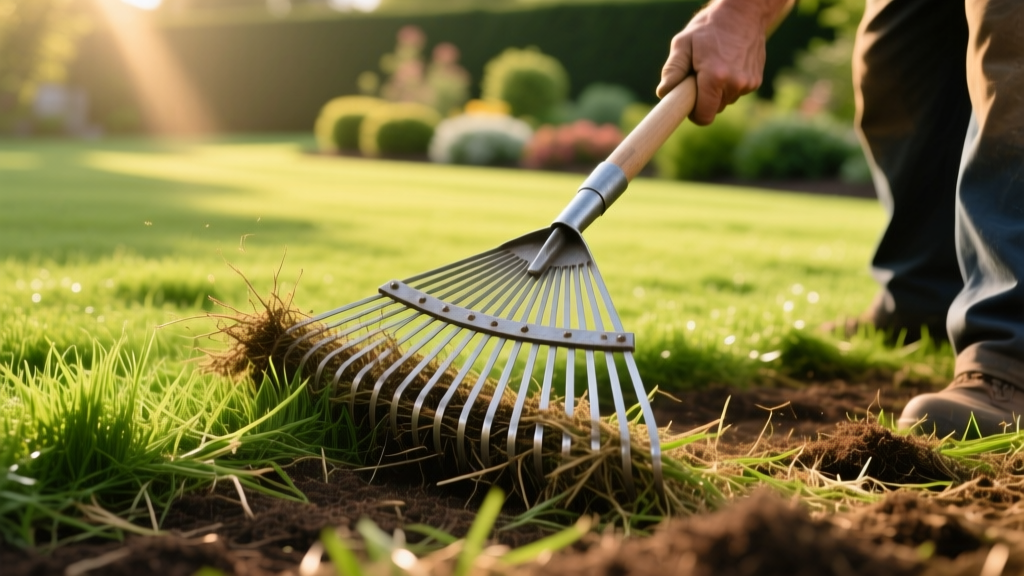
Thatching With a Rake: Best Manual Dethatching Tools & Techniques
The Semantics and Science of Manual Thatch Removal
While turfgrass scientists and agronomists strictly use the term dethatching to describe the removal of the organic debris layer, homeowners and DIYers frequently search for thatching with a rake. Regardless of the terminology, the mechanical objective remains identical: extracting the intermingled layer of dead and living shoots, stems, and roots that accumulate between the soil surface and the green vegetation canopy.
A thatch layer exceeding 0.5 inches acts as a hydrophobic barrier, preventing water, oxygen, and granular fertilizers from reaching the root zone. According to turfgrass researchers at the University of Minnesota Extension, excessive thatch also harbors fungal pathogens like Rhizoctonia solani (brown patch) and provides a nesting ground for chinch bugs. While power dethatchers (vertical mowers) are efficient for massive properties, manual thatching rakes remain the superior choice for lawns under 1,500 square feet, offering unparalleled precision around delicate landscape beds and shallow irrigation heads.
Equipment Anatomy: What Makes a Dedicated Thatching Rake?
Do not attempt thatching with a standard leaf rake. Leaf rakes feature thin, highly flexible tines designed to glide over the turf canopy. A true thatching rake must penetrate the canopy and aggressively engage the soil-thatch interface. When selecting equipment, evaluate three critical components:
1. Tine Metallurgy and Gauge
Premium thatching rakes utilize 12-gauge or 14-gauge high-carbon steel tines. Thinner tines (16-gauge and above) will bend and warp when encountering compacted clay soils or dense zoysiagrass stolons. High-carbon steel retains its edge and structural rigidity, though it requires strict moisture management to prevent oxidation.
2. Fixed-Tine vs. Spring-Tine Architecture
The debate between fixed and spring tines dictates your rake's aggression level. Fixed-tine rakes feature a solid steel crossbar where tines are welded or bolted directly to the head. Spring-tine rakes feature coiled steel loops that flex upon impact with hard soil.
| Feature | Fixed-Tine Thatching Rake | Spring-Tine (Coiled) Rake |
|---|---|---|
| Aggression Level | High (Penetrates soil up to 1/4 inch) | Moderate (Skims soil surface) |
| Ideal Grass Type | Warm-season (Bermuda, Zoysia, St. Augustine) | Cool-season (Fescue, Kentucky Bluegrass, Ryegrass) |
| Risk of Turf Damage | High if used on thin/weak lawns | Low (Forgiving on delicate crowns) |
| Physical Exertion | Extreme (Requires high pulling torque) | Moderate (Flex assists the pulling motion) |
3. Handle Leverage and Shock Absorption
Thatching generates immense kinetic feedback. Ash wood handles are traditionally preferred because the natural grain structure absorbs micro-vibrations, reducing forearm fatigue and preventing medial epicondylitis (golfer's elbow). However, modern fiberglass handles (often with a ribbed structural core) offer superior tensile strength and will not snap under heavy torsional loads, making them ideal for breaking up heavily compacted thatch mats.
Top Equipment Selections for 2026
Based on current retail availability, metallurgical durability, and ergonomic design, these are the premier manual rakes for thatch extraction:
Pro-Tip for Ergonomics: When purchasing a thatching rake, ensure the handle length is at least 54 inches. Shorter handles force you to bend at the lumbar spine rather than hinging at the hips, drastically increasing the risk of lower back strain during repetitive pulling motions.
- Ames True Temper 15-Tine Thatching Rake ($48 - $55): The industry standard for fixed-tine aggression. Features a 15-inch steel head with curved, hardened steel tines designed to slice through dense thatch mats. The 54-inch ash wood handle provides excellent shock dampening.
- Bully Tools 24-Tine Leaf and Thatching Rake ($32 - $38): A spring-tine hybrid. While marketed as a leaf rake, its reinforced 12-gauge steel tines are rigid enough to pull moderate thatch from cool-season fescue lawns. The fiberglass handle is virtually indestructible and comes with a lifetime warranty.
- Corona LR 3460 Thatching Rake ($55 - $65): Features a unique dual-sided head. One side features aggressive curved tines for deep thatch penetration, while the reverse side features flat tines for leveling soil and spreading topdressing sand after the thatch is removed.
Biomechanics: The Proper Technique for Thatching With a Rake
The most common failure mode in manual dethatching is treating the tool like a push-broom. Thatching rakes are unidirectional pull-tools. Pushing the rake will bend the tines and damage the turf crowns. Follow this precise mechanical sequence for optimal extraction:
- Hydrate the Profile: Water the lawn deeply 24 hours prior. The soil should be moist but not saturated. Dry thatch is highly elastic and will resist extraction; muddy soil will cause the tines to dig too deeply, tearing out healthy root systems.
- Set the Angle of Attack: Grip the handle near the base. Tilt the rake head so the tines meet the turf at a strict 45-degree angle.
- The Drop-and-Drag: Let the weight of the steel head drop the tines into the canopy. Do not press down manually. Pull the rake backward toward your body in short, 18-inch strokes.
- The Flick: At the end of the backward stroke, sharply flick your wrists upward to dislodge the thatch from the tines, depositing it on the surface.
- Cross-Hatch Pattern: Complete the entire lawn pulling in a North-South direction, then rotate 90 degrees and repeat in an East-West direction. This cross-hatching ensures no thatch ridges are left behind.
Tool Maintenance: Preventing Tine Fatigue and Oxidation
High-carbon steel tines are highly susceptible to flash rust, especially when exposed to the acidic sap of cut grass stolons and morning dew. Neglecting maintenance will result in pitted tines that tear the grass rather than slicing it cleanly.
Post-Use Maintenance Protocol
- Debris Clearance: Use a stiff nylon bristle brush to remove all impacted soil and organic matter from the tine base immediately after use.
- Moisture Displacement: Wipe the steel head with a rag soaked in WD-40 Specialist Water Displacer to drive out microscopic moisture.
- Protective Coating: Apply a micro-thin layer of Camellia oil or boiled linseed oil to the tines. Avoid standard motor oils, which can leach into your soil and harm beneficial microbes.
- Handle Care: If using an ash wood handle, rub it with raw linseed oil once per season to prevent the wood fibers from drying, splintering, and snapping under torque.
Decision Framework: When to Abandon the Rake
Manual thatching is highly effective, but it has strict physical and spatial limits. Use the following framework to determine if you should transition to a motorized vertical mower (power dethatcher):
- Area Threshold: If your lawn exceeds 1,500 square feet, the caloric expenditure and time required for manual raking become inefficient. Renting a Class 1 power dethatcher from a local equipment yard typically costs $65 to $85 per day.
- Thatch Depth: If a soil probe reveals a thatch layer thicker than 1.5 inches, manual rakes will struggle to penetrate the full depth. Power dethatchers utilize weighted blades that can slice through 2+ inches of thatch in a single pass.
- Grass Species: If you are maintaining a highly aggressive, stoloniferous warm-season grass like Tifway 419 Bermudagrass or Palmetto St. Augustine, the thatch mat is often too densely woven for manual tines to extract effectively without causing severe surface tearing.
For precise, targeted maintenance on cool-season fescue or small urban yards, thatching with a rake remains an indispensable, low-impact lawn care practice that preserves soil structure and avoids the severe turf trauma associated with heavy motorized equipment. For further reading on organic matter decomposition and turf health, consult the comprehensive turfgrass management guidelines provided by Better Homes & Gardens and your local university extension office.

