
Lawn Care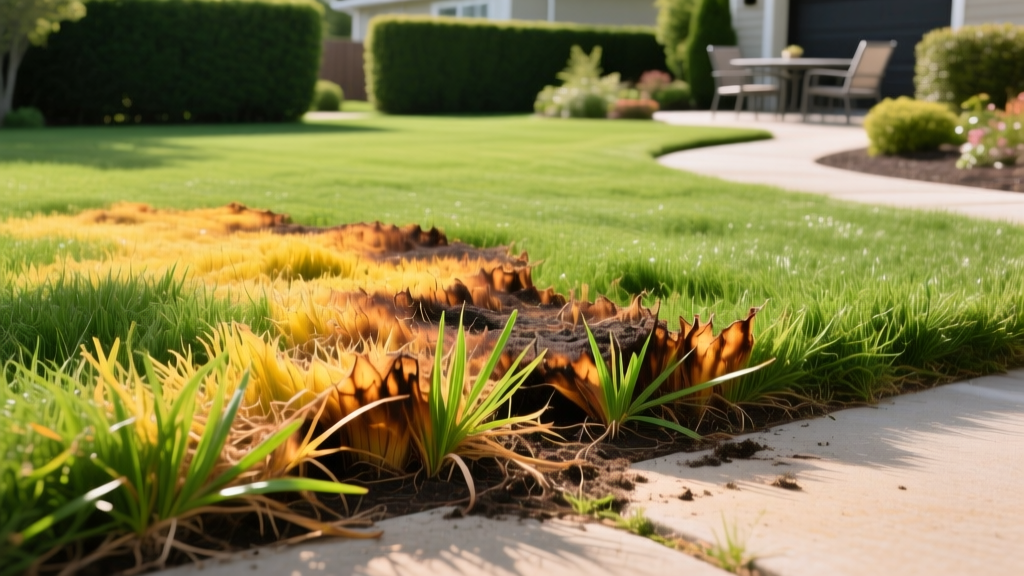
Fertilizer Burn Grass: How to Identify, Treat, and Prevent It
The Science of Fertilizer Burn: Osmotic Stress and Salt Toxicity
Fertilizer burn grass is not a fungal disease or a watering issue; it is a chemical injury caused by osmotic stress. When synthetic fertilizers dissolve in soil moisture, they release soluble salts. If the salt concentration in the soil exceeds the concentration inside the grass roots, water is pulled out of the plant tissue in a process called reverse osmosis. This dehydrates the grass from the inside out, resulting in the characteristic yellowing, browning, and crispy leaf tips associated with chemical burn.
The severity of the burn is dictated by the Salt Index (SI) of the fertilizer applied. Sodium nitrate is the baseline reference point with an SI of 100. Fertilizers with an SI above 50 pose a moderate risk, while those above 80 carry a high risk of burning turfgrass, especially when applied to dry soil or during high-temperature stress.
Warning: Burn vs. Drought Stress
Do not confuse fertilizer burn with drought stress. Drought stress typically causes uniform wilting and a bluish-gray hue before browning. Fertilizer burn manifests as localized, irregular brown or yellow streaks that perfectly match the application path of a spreader, often appearing within 24 to 48 hours of application.
4-Step Emergency Recovery Protocol for Burned Lawns
If you notice striping or browning within two days of feeding, immediate intervention is required to save the turfgrass crowns. Follow this exact protocol to flush salts and restore soil chemistry.
Step 1: Aggressive Leaching (First 24 Hours)
You must push the soluble salts below the 6-inch root zone. Apply exactly 1.5 inches of water to the affected area within the first 24 hours of noticing the burn. Use the 'tuna can method'—place an empty tuna can (which is roughly 1 inch deep) on the lawn and run your sprinklers until the can is full, then add another half-inch. This heavy leaching dilutes the soil solution and restores the osmotic gradient, allowing roots to absorb water again.
Step 2: Soil Buffering with Humic Acid (Days 2-4)
After leaching, apply a liquid humic acid amendment to chelate residual salts and buffer the soil pH. Products like Simple Lawn Solutions N-EXT Humic Acid (typically priced around $35 per gallon) are highly effective. Apply at a rate of 3 ounces per 1,000 square feet using a hose-end sprayer. Humic acid increases the soil's cation exchange capacity (CEC), binding excess sodium and ammonium ions so they no longer damage root tissue.
Step 3: The Crown Viability 'Pull Test' (Day 7)
Wait seven days after leaching to assess damage. Grasp a handful of the brown grass and pull gently. If the grass resists and the base (crown) is firm and white or pale green, the plant is alive and will push new leaf tissue in 2 to 3 weeks. If the grass pulls up effortlessly with brittle, brown roots, the crown is dead, and you must proceed to Step 4.
Step 4: Targeted Overseeding (Days 14-21)
For dead zones larger than a dinner plate, rake out the dead thatch, loosen the top 2 inches of soil, and overseed with a matching cultivar. Apply a starter fertilizer with a low salt index (such as a 10-18-10 formulation) at half the recommended rate to avoid re-burning the delicate new seedlings.
Fertilizer Salt Index Comparison Matrix
Understanding the Salt Index (SI) of your nitrogen sources is critical for preventing future damage. According to turfgrass management data from Penn State Extension, selecting the right nitrogen carrier is just as important as the NPK ratio.
| Nitrogen Source / Product | Typical NPK | Salt Index (SI) | Burn Risk Profile |
|---|---|---|---|
| Potassium Chloride (Muriate of Potash) | 0-0-60 | 116.0 | Extreme |
| Sodium Nitrate | 16-0-0 | 100.0 | High |
| Urea | 46-0-0 | 74.4 | Moderate |
| Ammonium Sulfate | 21-0-0 | 69.4 | Moderate |
| Milorganite (Biosolid) | 6-4-0 | < 1.0 | Very Low |
| Methylene Urea (MU) / IBDU | 38-0-0 | 15.0 - 20.0 | Low |
Preventing Future Burn: Product Selection & Application Rules
Preventing fertilizer burn grass requires shifting away from high-SI, fast-release synthetics during vulnerable weather windows. The UMass Amherst Turf Program recommends that at least 50% to 70% of the nitrogen in any summer or early-fall application should come from slow-release, water-insoluble sources.
Switch to Coated or Organic Nitrogen
For high-heat summer feeding, abandon standard urea-based products. Instead, use biosolids like Milorganite (6-4-0), which relies on microbial breakdown to release nitrogen, making it virtually impossible to burn grass even if spilled. Alternatively, look for premium synthetic blends utilizing PCSC (Polymer Coated Sulfur Coated Urea), which physically encapsulates the salt, releasing it slowly over 8 to 12 weeks based on soil temperature.
The 'Water-In' Mandate
Never apply granular fertilizer to dry soil and leave it on the surface. If rain is not in the immediate forecast, you must irrigate the lawn with 0.25 inches of water immediately after spreading. This dissolves the prills, moves the nutrients into the soil profile, and prevents the granules from resting against the grass blades, which causes localized contact burn.
Expert Soil Testing Tip: Before your spring application, conduct a soil test. Lawns with high baseline electrical conductivity (EC > 0.5 dS/m) already have high salt loads. Applying standard synthetic fertilizers to high-EC soils guarantees osmotic stress. In these cases, use liquid aeration and humic acid to flush the soil profile before introducing new nitrogen.
Frequently Asked Questions
Will grass grow back after fertilizer burn?
Yes, if the crown (the growing point at the soil line) survives the osmotic shock. Leaf tissue that has turned completely brown and crispy will not turn green again; it is dead. However, the plant will push new, green blades from the crown within 14 to 21 days once the soil salts are leached and normal water uptake resumes.
Can I use liquid fertilizer to avoid burn?
Liquid fertilizers can actually increase burn risk if applied incorrectly. Because liquids are immediately available and do not require dissolution, they instantly spike the soil's salt concentration. If using liquid nitrogen (like UAN 28% or 32%), you must adhere strictly to label rates (typically 10-15 oz per 1,000 sq ft) and avoid spraying during midday temperatures above 85°F.
How much does it cost to fix a burned lawn?
Emergency leaching costs roughly $5 to $15 in municipal water usage. A high-quality liquid humic acid treatment costs about $35 to $45 per gallon (covering up to 10,000 sq ft). If the crowns die and you must overseed, expect to spend $40 to $60 on premium seed and starter fertilizer for a 1,000 sq ft affected area.

