
Lawn Care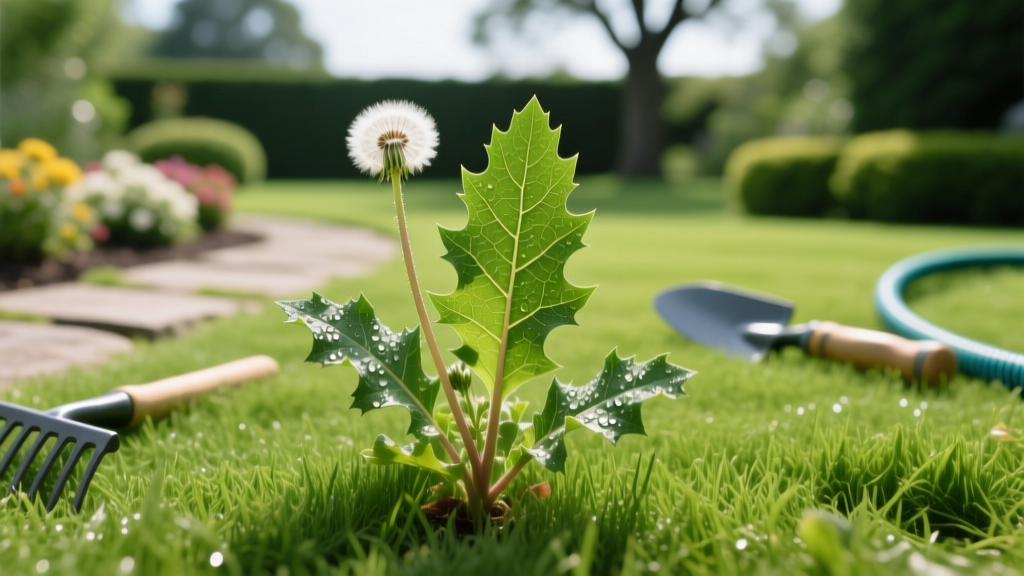
How to Identify and Treat Serrated Leaf Weeds in Your Lawn
The "Serrated Leaf" Confusion: Identifying the Big Three
Homeowners frequently search for "serrated leaf weed" when they notice jagged, toothed rosettes invading their turf. This descriptive term does not point to a single species; rather, it describes a morphological trait shared by several aggressive perennial broadleaf invaders. The serrated or deeply lobed leaf margin is an evolutionary adaptation that maximizes light capture in low-mow environments and channels morning dew directly down to the plant's taproot.
Before you mix a tank of herbicide, you must accurately identify which serrated leaf weed is colonizing your lawn. Misidentification leads to ineffective chemical selection, wasted money, and unnecessary stress on your desirable turfgrass. The three most common culprits in North American lawns are True Dandelion, False Dandelion (Catsear), and Prickly Lettuce.
Comparative Identification Matrix
| Feature | True Dandelion (Taraxacum officinale) | False Dandelion / Catsear (Hypochaeris radicata) | Prickly Lettuce (Lactuca serriola) |
|---|---|---|---|
| Leaf Serration | Deeply toothed, pointing toward the center | Lobed, irregular, less rigidly toothed | Spiny, deeply pinnatifid, sharp prickles on margins |
| Leaf Surface | Smooth, mostly hairless | Covered in coarse, stiff hairs | Smooth, but with a distinct spiny midrib |
| Flower Stalk | Hollow, unbranched, single flower per stalk | Solid, branched, multiple flowers per stalk | Solid, highly branched, pale yellow flowers |
| Root System | Thick, fleshy, deep single taproot | Fibrous, branched, woody crown | Shallow taproot with extensive lateral spread |
| Sap | Abundant milky white sap | Milky white sap (less abundant) | Milky white sap, sticky |
According to the University of California Integrated Pest Management (UC IPM) program, False Dandelion is often misidentified as True Dandelion by homeowners, leading to improper mowing practices that actually encourage its spread. While True Dandelion grows a single flower on a hollow stalk, Catsear produces multiple flowers on solid, branched stalks, making it much more resilient to standard mowing heights.
Why Serrated Leaf Weeds Invade Your Turf
These weeds do not invade healthy, dense turf by accident. They exploit specific environmental vulnerabilities in your lawn's ecosystem. Serrated leaf weeds are indicator species for underlying soil deficiencies.
⚠️ Soil Compaction & pH Warning:
If you are battling a heavy infestation of False Dandelion or Prickly Lettuce, test your soil pH immediately. These weeds thrive in highly compacted, acidic soils (pH below 5.5) where desirable turfgrass roots suffocate. Applying herbicide without addressing soil compaction via core aeration and lime application guarantees the weeds will return within 60 days.
If you are battling a heavy infestation of False Dandelion or Prickly Lettuce, test your soil pH immediately. These weeds thrive in highly compacted, acidic soils (pH below 5.5) where desirable turfgrass roots suffocate. Applying herbicide without addressing soil compaction via core aeration and lime application guarantees the weeds will return within 60 days.
Spot-Treatment Decision Tree: Selecting the Right Chemistry
Broadcast spraying an entire lawn for localized rosette weeds is ecologically irresponsible and financially wasteful. Spot-treatment requires matching the active ingredient to your specific turfgrass type. As of 2026, herbicide formulations have become highly specialized to prevent turf phytotoxicity.
- If you have Cool-Season Grass (Fescue, Kentucky Bluegrass, Ryegrass):
Use a three-way herbicide containing 2,4-D, MCPP, and Dicamba, enhanced with Carfentrazone for rapid burn-down. This combination disrupts the broadleaf weed's cellular growth without harming cool-season blades. - If you have Warm-Season Grass (Bermuda, Zoysia):
Use a mixture of 2,4-D and Quinclorac. Avoid Triclopyr-based products, as they can cause severe stunting in certain warm-season cultivars during high-heat summer months. - If you have St. Augustine Grass:
STOP. Do not use 2,4-D or Dicamba at standard rates; they will cause severe leaf curling and necrosis in St. Augustine. Use Atrazine or Penoxsulam for safe spot-treatment. - If you Require an Organic/Iron-Based Approach:
Use FeHEDTA (Chelated Iron). Iron is highly toxic to broadleaf weeds but acts as a micronutrient fertilizer for grass. Note that FeHEDTA requires multiple applications spaced 14 days apart for complete taproot kill.
Precision Application Protocol
To achieve a 95%+ kill rate on mature serrated leaf weeds without damaging surrounding grass, follow this exact application sequence recommended by Penn State Extension turfgrass specialists.
- Calibrate for Spot-Treatment: Mix your herbicide in a 1-gallon or 2-gallon pump sprayer. For a standard three-way selective herbicide (like SpeedZone), the spot-treatment rate is typically 1.5 fl oz per gallon of water. Do not exceed this rate, or you will burn the surrounding turf.
- Add a Non-Ionic Surfactant (NIS): Serrated leaves, particularly the hairy leaves of False Dandelion and the waxy cuticle of Prickly Lettuce, repel water droplets. Add a NIS at a rate of 0.25% v/v (roughly 1/2 teaspoon per gallon). This breaks the surface tension, allowing the herbicide to spread flat across the jagged leaf surface and penetrate the stomata.
- Check Environmental Parameters: Apply only when ambient temperatures are between 60°F and 85°F. Spraying 2,4-D when temperatures exceed 85°F causes the chemical to vaporize and drift, potentially damaging neighboring ornamental shrubs and garden beds.
- Target the Rosette Center: Spray directly into the crown (the center of the rosette) where the newest, most susceptible leaves are emerging. Ensure the leaves are wet but not dripping. Dripping indicates product waste and increases the risk of soil leaching.
- Enforce a 48-Hour Rainfast Window: Do not irrigate your lawn, and ensure no rain is in the forecast for at least 48 hours post-application to allow for complete systemic translocation down to the taproot.
Product Breakdown and Cost Analysis
Investing in professional-grade concentrates is vastly more economical than purchasing pre-mixed, ready-to-spray consumer bottles. Below is a breakdown of the most effective spot-treatment products available to homeowners in 2026.
SpeedZone Broadleaf Herbicide
Active Ingredients: 2,4-D, MCPP, Dicamba, Carfentrazone
Cost: ~$120 per gallon
Pros: Contains Carfentrazone for 24-hour visual burn-down; covers up to 4 acres per gallon (costs pennies per spot-treatment); excellent for cool-season grasses.
Cons: High initial upfront cost; requires careful calibration; not safe for St. Augustine grass.
Natria Lawn Weed Control (FeHEDTA)
Active Ingredient: Iron HEDTA
Cost: ~$35 per gallon
Pros: OMRI-listed organic option; safe for all turf types; no harsh chemical odor; safe for pets immediately after drying.
Cons: Requires 2-3 applications spaced 14 days apart to kill the taproot; can temporarily darken the grass blades green due to iron absorption.
Post-Treatment Lawn Recovery and Prevention
Eradicating the weed is only half the battle. When a mature serrated leaf weed dies, it leaves behind a bare circular patch in your turf. If left unaddressed, this bare soil will quickly be colonized by crabgrass or spurge within three weeks.
"The most critical step in weed management occurs after the herbicide has done its job. Overseeding the resulting void with a competitive, shade-tolerant turfgrass cultivar is the only way to permanently close the ecological niche the weed previously occupied."
— Best Practices in Turfgrass Renovation, Purdue University Turf Science
Once the weed has completely browned and desiccated (usually 10-14 days post-application), use a hand rake to aggressively scratch the bare soil. Apply a starter fertilizer (high in phosphorus, such as a 10-18-10 NPK ratio) and drop a pinch of grass seed that matches your existing lawn. Keep the spot lightly moist until germination occurs. By shifting your focus from reactive chemical warfare to proactive canopy density, you will naturally suffocate future serrated leaf weed seeds before they ever reach the soil surface.

