
Lawn Care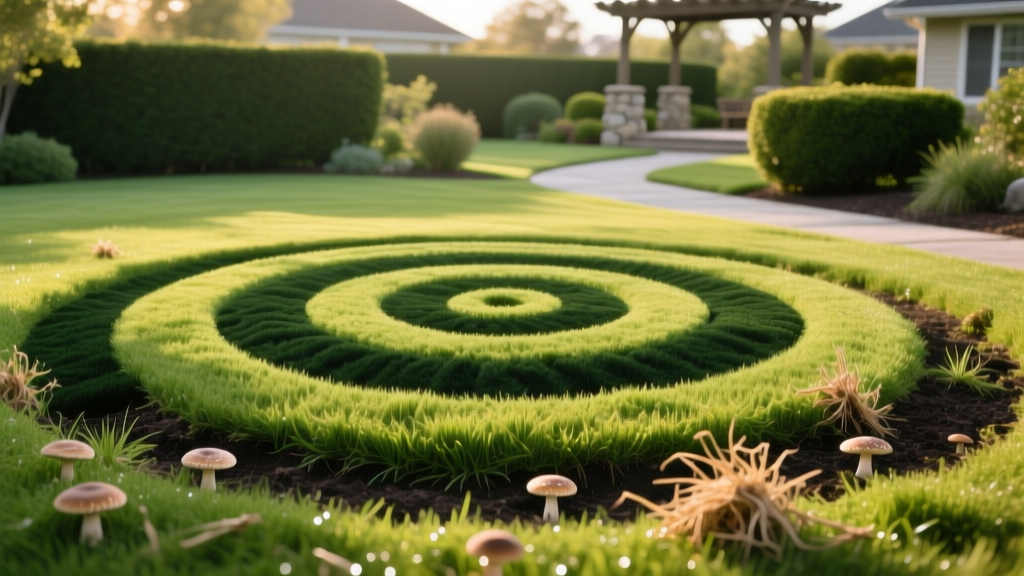
How to Treat Dark Green Circles in Grass: A Step-by-Step Fairy Ring Guide
Diagnosing the Root Cause: Fungal Mycelium vs. Nitrogen Spills
When homeowners notice perfectly round, dark green circles in grass, the immediate assumption is often localized fertilizer overlap or pet urine. However, uniform, expanding rings with distinct margins are the hallmark of Type II Fairy Rings. These circles are caused by soil-borne basidiomycete fungi—most commonly Marasmius oreades or Chlorophyllum molybdeites—that decompose buried organic matter like old tree roots, stumps, or thick thatch layers.
As the fungi break down this organic material, they release high concentrations of ammonium nitrogen into the soil. The turfgrass absorbs this nitrogen, resulting in a lush, dark green, rapidly growing ring that contrasts sharply with the surrounding lawn. According to NC State University TurfPath, these rings typically expand outward at a rate of 6 to 12 inches per year, eventually forming massive arcs across the property if left unchecked.
Differential Diagnosis: Fairy Rings vs. Dog Urine Spots
Before initiating treatment, you must confirm the source. Dog urine spots typically feature a brown, necrotic center surrounded by a thin dark green halo due to nitrogen burn followed by residual feeding. Type II fairy rings, conversely, consist entirely of vigorous, dark green grass with no dead center, and the ring width is usually uniform (often 4 to 12 inches wide).
| Fairy Ring Type | Visual Symptoms | Primary Cause | Maintenance Difficulty |
|---|---|---|---|
| Type I | Ring of dead, brown, or wilting turf | Hydrophobic mycelium preventing water infiltration | High (Requires intensive wetting agents) |
| Type II | Dark green circles in grass, lush growth | Nitrogen release from organic matter decomposition | Moderate (Requires masking and fungicides) |
| Type III | Ring of mushrooms or puffballs, no turf change | Fruiting bodies of the fungus above ground | Low (Physical removal of mushrooms) |
Step-by-Step Treatment Protocol for Type II Dark Green Rings
Managing Type II fairy rings requires a multi-pronged approach focused on altering the soil environment, suppressing the fungus, and visually masking the symptoms. Follow these sequential lawn maintenance procedures for optimal results.
Step 1: Break the Hydrophobic Barrier with Wetting Agents
Even though Type II rings appear lush, the fungal mycelium network beneath the surface often creates hydrophobic (water-repellent) soil conditions. This leads to localized dry spots that stress the surrounding turf. Apply a high-quality soil surfactant to improve water penetration.
- Product Selection: Use an alkylpolyglycoside-based wetting agent like Aqueduct or a block-copolymer surfactant like Cascade Plus.
- Application Rate: Apply 3 to 6 fluid ounces per 1,000 square feet.
- Timing: Apply in early spring when soil temperatures reach 55°F at a 2-inch depth, and repeat every 4 to 6 weeks through late summer.
- Cost Expectation: Professional-grade wetting agents cost approximately $8 to $12 per 1,000 square feet annually.
Step 2: Deep Core Aeration
Fairy ring fungi thrive in compacted, poorly drained soils with heavy thatch. Mechanical aeration disrupts the mycelial mat and improves soil oxygenation, which naturally suppresses basidiomycete activity.
- Rent a hollow-tine core aerator (do not use spike aerators, which increase compaction).
- Set the machine to extract cores 3 to 4 inches deep.
- Make two passes over the dark green ring, extending the aeration pattern at least 3 feet beyond the visible outer margin of the circle.
- Leave the soil cores on the lawn to dry and break down naturally, which helps top-dress the area and degrade thatch.
Warning: Never use a dethatching machine (power rake) directly over an active fairy ring. The aggressive blades can slice through the fungal mycelium and physically spread the pathogen to healthy, uninfected areas of your lawn.
Step 3: Targeted Fungicide Application
While cultural practices reduce severity, curative chemical control is necessary to halt the outward expansion of the ring. You must use fungicides specifically labeled for basidiomycete diseases.
- Active Ingredients: Azoxystrobin (e.g., Heritage SC) or Flutolanil (e.g., ProStar 70 WP) are the industry standards for fairy ring control.
- Curative Rates: Apply Heritage SC at 0.4 fluid ounces per 1,000 square feet. If using ProStar 70 WP, apply at 4.6 ounces per 1,000 square feet.
- Watering In: Fungicides must reach the root zone where the mycelium resides. Immediately irrigate the treated area with 0.5 inches of water to move the active ingredient into the top 2 to 3 inches of the soil profile.
- Cost Analysis: A pint of Heritage SC costs roughly $140 and treats up to 20,000 square feet at curative rates, equating to $0.007 per square foot. This is highly cost-effective compared to sod replacement.
Step 4: Nitrogen Masking (The Visual Equalizer)
Because the fungus will continue to release nitrogen as long as buried wood or thatch remains, the most practical immediate solution for dark green circles in grass is to "mask" the ring by fertilizing the rest of the lawn to match the ring's color intensity.
Apply a slow-release nitrogen source, such as sulfur-coated urea (SCU) or methylene urea, at a rate of 0.75 to 1.0 pounds of actual nitrogen per 1,000 square feet to the entire lawn except the fairy ring itself. This evens out the turf canopy color, rendering the dark green circle virtually invisible to the naked eye while the fungicide and aeration protocols work beneath the surface.
Preventative Lawn Maintenance Schedule
Preventing fairy rings from establishing or recurring requires a proactive approach to thatch management and soil health. The Royal Horticultural Society emphasizes that removing buried woody debris before laying sod or seeding is the only 100% effective preventative measure. For established lawns, adhere to this annual schedule:
Annual Prevention Matrix:
Early Spring: Apply preventative wetting agents and perform soil testing to ensure pH is between 6.2 and 6.8.
Late Spring: Core aerate high-traffic zones and areas with historical fairy ring activity.
Early Summer: Apply preventative fungicides (azoxystrobin) if soil temperatures consistently exceed 70°F and rings have been active in previous years.
Fall: Top-dress the lawn with 1/4 inch of compost to introduce beneficial competing microbes that outcompete basidiomycete fungi.
Early Spring: Apply preventative wetting agents and perform soil testing to ensure pH is between 6.2 and 6.8.
Late Spring: Core aerate high-traffic zones and areas with historical fairy ring activity.
Early Summer: Apply preventative fungicides (azoxystrobin) if soil temperatures consistently exceed 70°F and rings have been active in previous years.
Fall: Top-dress the lawn with 1/4 inch of compost to introduce beneficial competing microbes that outcompete basidiomycete fungi.
When to Abandon Treatment and Consider Renovation
Chemical and cultural controls can suppress fairy rings, but they rarely eradicate the fungus entirely because the mycelium can survive deep in the soil profile for decades. According to Penn State Extension, if a Type I or Type II fairy ring exceeds 15 feet in diameter, or if the hydrophobic soil barrier causes chronic, unmanageable drought stress in the ring's center, complete renovation may be the most economically viable option.
Renovation requires stripping the affected sod, excavating the soil to a depth of 12 to 18 inches to remove all infected soil and buried organic matter, and backfilling with fresh, sterile topsoil before reseeding or resodding. While this procedure costs between $3.50 and $6.00 per square foot when hiring professional landscaping crews, it provides a permanent reset for severely compromised turf zones where annual fungicide costs have become unsustainable.

