
Lawn Care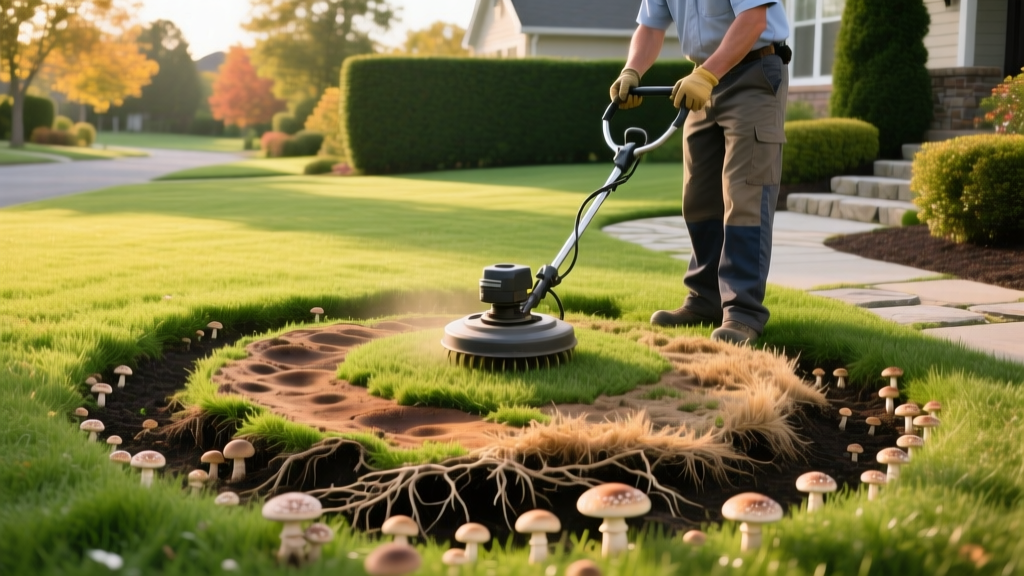
Treating Fairy Ring Grass: Step-by-Step Lawn Recovery Protocol
The Misconception of Fairy Ring Grass
Homeowners frequently search for 'fairy ring grass' seed, mistakenly believing it is a specific turf variety they can plant. In reality, a fairy ring is not a grass species at all. It is a soil-borne fungal disease caused by over 50 species of Basidiomycetes fungi that decompose organic matter in the thatch and soil profile. The 'fairy ring grass' you see is simply your existing turf reacting to the fungal mycelium expanding outward in a circular pattern, typically growing 6 to 12 inches in diameter each year.
According to Penn State Extension, these fungi thrive in soils with high organic matter, thick thatch layers, and low nitrogen availability. Eradicating the fungus entirely is notoriously difficult because the mycelium can penetrate several feet into the soil profile. However, a strict, step-by-step maintenance protocol can suppress the fungus, reverse soil hydrophobicity, and visually mask the symptoms to restore a uniform lawn.
Diagnostic Matrix: Identifying Your Fairy Ring Type
Before applying any treatments, you must correctly identify which type of fairy ring is affecting your lawn. Applying fungicides to a Type II ring without addressing nitrogen levels will yield poor results. Use this diagnostic matrix to determine your protocol:
| Type | Visual Symptoms | Underlying Cause | Primary Treatment Focus |
|---|---|---|---|
| Type I | Ring of dead, brown, or wilting grass; soil is extremely dry and repels water. | Fungal mycelium creates a hydrophobic (water-repellent) barrier in the soil profile. | Soil wetting agents, deep core aeration, and targeted hydration. |
| Type II | Ring of dark green, excessively lush, fast-growing grass. | Fungi decompose organic matter, releasing a massive flush of plant-available nitrogen. | Nutritional masking (fertilizing the rest of the lawn) and moderate fungicide use. |
| Type III | A circle of mushrooms or puffballs appearing in the turf canopy, usually after heavy rain. | Fungal fruiting bodies emerging from the thatch/soil interface. | Physical removal (mowing/raking) and thatch reduction; chemical control rarely needed. |
Step 1: Breaking Hydrophobicity (Type I Focus)
If your lawn features Type I fairy rings, the soil beneath the brown ring is completely hydrophobic. Water from sprinklers or rain will bead up and run off, leaving the grass roots to desiccate. You must break this barrier before any fungicide or fertilizer can be effective.
The Core Aeration and Surfactant Protocol
- Deep Core Aeration: Use a hollow-tine aerator to pull 3-inch to 4-inch soil cores directly over the fairy ring and extend 2 feet beyond its visible edge. This physically fractures the hydrophobic mycelial mat.
- Apply a Penetrant Surfactant: Apply a high-quality soil wetting agent containing alkylpolyglucoside or polyoxyalkylene (such as Cascade Plus or Aquifer). Mix at a rate of 2 to 3 fluid ounces per 1,000 square feet. These specific surfactant chemistries reduce the surface tension of water, allowing it to infiltrate the waxy fungal barrier.
- Syringe Watering: Immediately after surfactant application, apply exactly 1/4 inch of irrigation. Do not overwater, which causes runoff; the goal is to pull the surfactant into the top 2 inches of the soil profile where the mycelium is most dense.
Step 2: Targeted Fungicide Application Strategy
Chemical control is most effective when applied preventatively in the spring, specifically when soil temperatures at a 2-inch depth consistently reach 55°F to 60°F. According to research from the University of Minnesota Turfgrass Science program, curative applications in mid-summer are significantly less effective because the fungus has already established deep, resilient mycelial networks.
Active Ingredients and Application Rates
For severe Type I and Type II rings, rotate between two different chemical classes to prevent fungal resistance:
- QoI Fungicides (Group 11): Azoxystrobin (e.g., Heritage SC) applied at 0.4 oz per 1,000 sq ft, or Pyraclostrobin (e.g., Insignia SC) at 0.7 oz per 1,000 sq ft.
- SDHI Fungicides (Group 7): Flutolanil (e.g., ProStar 70 WP) applied at 2.2 oz per 1,000 sq ft.
Warning: The Watering-In Requirement
Fairy ring fungi live in the thatch and upper soil profile, not on the grass leaves. If you apply a systemic fungicide and do not water it in, the product will remain on the foliage and fail to reach the target pathogen. You must irrigate the lawn with exactly 1/8 to 1/4 inch of water immediately after application to wash the active ingredient into the root zone. Expect chemical control costs to range from $0.08 to $0.15 per square foot for professional-grade products.
Fairy ring fungi live in the thatch and upper soil profile, not on the grass leaves. If you apply a systemic fungicide and do not water it in, the product will remain on the foliage and fail to reach the target pathogen. You must irrigate the lawn with exactly 1/8 to 1/4 inch of water immediately after application to wash the active ingredient into the root zone. Expect chemical control costs to range from $0.08 to $0.15 per square foot for professional-grade products.
Step 3: Nutritional Masking and Recovery
For Type II fairy rings, the dark green circle is caused by a localized nitrogen spike from decomposing thatch. Attempting to kill the fungus will not immediately fix the visual discrepancy. Instead, use nutritional masking to blend the ring into the surrounding turf.
Apply a slow-release, methylene-urea based nitrogen fertilizer to the entire lawn at a rate of 0.75 to 1.0 lb of actual nitrogen per 1,000 square feet. By elevating the nitrogen levels of the surrounding non-affected grass, the entire lawn will achieve the same dark green hue as the fairy ring, effectively hiding the symptom while you concurrently run your aeration and fungicide protocols.
Decision Framework: Cultural vs. Chemical Controls
Not every fairy ring requires expensive chemical intervention. Use this framework to decide your approach based on lawn usage and severity:
- Choose Cultural Controls Only (Aeration, Surfactants, Masking) If: You have Type III mushrooms, the rings are smaller than 12 inches in diameter, or you maintain an organic lawn care regimen. Mushrooms can simply be mowed or raked off, and Type II rings can be hidden with uniform fertilization.
- Choose Integrated Chemical Controls If: You have expansive Type I dead rings exceeding 2 feet in diameter, the hydrophobic soil is causing localized turf death that invites invasive weeds like crabgrass, or you are managing a high-visibility recreational turf area where uniform playability is required.
Frequently Asked Questions
Can I dig up and replace the soil in a fairy ring?
While physically removing the soil to a depth of 12 inches and replacing it with fresh topsoil was a common historical recommendation, it is rarely successful today. The fungal mycelium often extends laterally beyond the visible ring. If you miss even a small fragment of the mycelial mat during excavation, the ring will simply reform within 12 to 18 months. Soil drenching with surfactants and targeted fungicides yields a much higher long-term success rate.
Does applying lime or baking soda kill fairy ring grass?
No. Internet forums often suggest applying baking soda, lime, or dish soap to fairy rings. While dish soap acts as a weak, short-term surfactant that might temporarily help water penetrate Type I soil, it lacks the molecular stability of professional alkylpolyglucoside wetting agents and will break down in the soil within 48 hours. Altering soil pH with lime will not kill the Basidiomycete fungi and may inadvertently lock up essential micronutrients like iron in your turf.
How long does it take for a fairy ring to disappear?
Complete eradication of the fungus is rare; the goal is suppression and visual masking. With a strict protocol of spring preventative fungicides, biannual core aeration, and monthly wetting agent applications during summer heat stress, you can expect the visual symptoms to become unnoticeable within 6 to 9 months. However, you must maintain annual surfactant applications, as the hydrophobic barrier can quickly return during prolonged droughts.

