
Lawn Care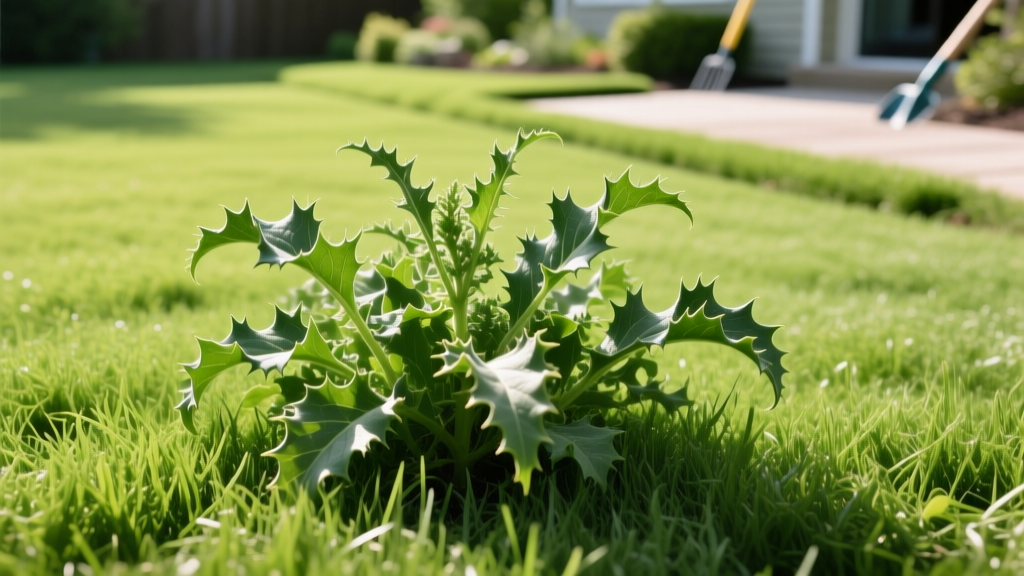
Identifying and Treating Weeds With Jagged Leaves in Your Lawn
When scanning your turf, smooth-edged broadleaves like clover or plantain are easy to spot, but weeds with jagged leaves present a unique set of identification and eradication challenges. Deeply lobed, toothed, or pinnatifid leaf margins are a hallmark of several aggressive taprooted and rhizomatous species. These structural adaptations not only help the plant maximize sunlight capture in dense turf but also complicate chemical control by altering how herbicide droplets interact with the leaf surface.
Successfully eliminating these invaders requires moving beyond generic 'weed and feed' products. This guide provides a precise framework for identifying the most common jagged-leaf weeds, understanding the biophysics of their foliage, and executing targeted spot-treatments that actually reach the root system.
The Usual Suspects: Identifying Jagged-Leaf Intruders
Before selecting a treatment, you must accurately identify the species. Misidentifying a rhizomatous spreader as a taproot weed will lead to rapid reinfection. Consult the matrix below to cross-reference the visual characteristics of the foliage with the plant's underlying root architecture.
| Common Name | Scientific Name | Leaf Margin Profile | Root Structure | Primary Turf Threat |
|---|---|---|---|---|
| Dandelion | Taraxacum officinale | Deeply lobed, pointing toward the center | Thick, brittle taproot (up to 10 inches) | Rapid seed spread, rosette shading |
| Prickly Lettuce | Lactuca serriola | Spiny, jagged margins with a central ridge | Deep taproot with milky latex sap | Bolts rapidly, outcompetes cool-season grass |
| Sow Thistle | Sonchus oleraceus | Irregular, spiky lobes, soft to the touch | Shallow taproot with lateral runners | Aggressive lateral spread in thin turf |
| Wild Carrot | Daucus carota | Fine, fern-like, highly dissected pinnate | Taproot (carrot-scented when crushed) | Tall flower stalks disrupt mowing |
| Yarrow | Achillea millefolium | Finely divided, feathery, soft jagged edges | Aggressive creeping rhizomes | Forms dense, drought-tolerant mats |
For authoritative visual identification, the University of California Integrated Pest Management (UC IPM) database offers high-resolution macro photography of seedling versus mature leaf structures, which is critical since juvenile jagged-leaf weeds often look entirely different from their adult forms.
Why Leaf Topography Dictates Herbicide Success
The physical geometry of jagged leaves directly impacts herbicide efficacy. When you spray a flat, smooth leaf like a plantain, the chemical solution spreads evenly across the cuticle. Jagged, deeply lobed leaves create a phenomenon known in agronomy as 'sinus pooling.'
The Sinus Pooling Effect
When herbicide droplets hit a deeply lobed leaf, surface tension causes the liquid to run off the high points (the lobes) and pool in the deep cuts (the sinuses). Without a high-quality non-ionic surfactant (NIS), these pooled droplets remain highly concentrated, causing rapid localized leaf burn. The leaf tissue in the sinus dies too quickly to translocate the systemic herbicide down to the taproot, resulting in a 'top-kill' where the weed simply resprouts from the crown two weeks later.
To overcome this, your spot-treatment mixture must include a surfactant to break the water's surface tension, allowing the solution to coat the entire complex topography of the jagged leaf rather than just pooling in the crevices.
Targeted Spot-Treatment Protocols
Spot-treating is vastly superior to broadcast spraying for these species, as it minimizes turf stress and reduces chemical costs. Choose your protocol based on your lawn type and environmental constraints.
Chemical Control: The 3-Way Ester Advantage
For cool-season lawns (Fescue, Kentucky Bluegrass, Ryegrass), a 3-way selective herbicide containing 2,4-D, Dicamba, and MCPP or Triclopyr is the gold standard. However, the formulation matters immensely for jagged-leaf weeds.
- Product Selection: Opt for an ester formulation rather than an amine formulation. Esters (like Triclopyr ester) are lipophilic, meaning they penetrate the waxy cuticle of mature prickly lettuce and dandelion leaves much faster than water-soluble amines.
- Mixing Ratio: Combine 1.5 fluid ounces of a professional-grade 3-way ester (e.g., Southern Ag Trimec or Triad Select) per 1,000 square feet of treatment area.
- Surfactant Addition: Add a Non-Ionic Surfactant (NIS) at a rate of 0.25% volume/volume. This equates to roughly 1 teaspoon of NIS per gallon of mixed solution.
- Application Timing: Apply when daytime temperatures are between 65°F and 85°F. Spraying above 85°F causes rapid volatilization, which can drift and damage nearby ornamental shrubs.
Organic and Burn-Down Options
If you are managing a lawn near sensitive waterways or prefer organic inputs, systemic chemical options are off the table. You must rely on contact burn-down herbicides.
- Active Ingredients: Look for products utilizing Pelargonic acid (nonanoic acid) or high-concentration D-Limonene (citrus oil). Products like BurnOut II or Captain Jack's Lawnweed Brew are effective.
- The Caveat: Organic burn-downs only destroy the tissue they touch. Because jagged-leaf weeds like dandelions store massive energy reserves in their taproots, a single application will only burn the top growth. You must commit to a defoliation schedule, reapplying the organic herbicide every 5 to 7 days to starve the root system of photosynthetic energy. Expect to spend 300% more time and product compared to synthetic systemic options.
Mechanical Extraction: Getting the Whole Taproot
For isolated infestations (fewer than 10 weeds per 1,000 square feet), mechanical extraction is highly effective and provides immediate aesthetic relief. The key is removing the entire taproot; leaving even a 1-inch fragment of a dandelion crown in the soil will result in regeneration.
- Hydrate the Soil: Extract weeds 12 to 24 hours after a deep irrigation cycle or a heavy rain. Dry, compacted soil will snap the brittle taproot when pulled.
- Tool Selection: Abandon standard hand trowels. Use a dedicated stand-up weeder with a serrated claw mechanism, such as the Fiskars Stand-Up Weeder (typically priced between $35 and $45). The serrated teeth grip the taproot below the crown, while the leverage bar pops the root out intact.
- The Angle of Attack: Insert the tool at a 15-degree angle to the weed's central stalk, pushing down 3 to 4 inches to bypass the shallow lateral feeder roots and grab the primary taproot.
- Fill the Void: Immediately top-dress the extraction hole with a 50/50 mix of topsoil and compost, then drop 3 to 4 grass seeds into the divot to prevent a new weed seed from claiming the bare soil.
Cultural Controls: Outcompeting the Invaders
Jagged-leaf weeds are heliophytes; they require high light intensity at the soil surface to germinate and thrive. If you are constantly battling dandelions and prickly lettuce, your turf canopy is too thin. According to North Carolina State University Extension, maintaining a dense turf canopy is the most effective pre-emergent strategy for broadleaf weeds.
'A dense, vigorously growing turf is the best defense against weed invasion. Weeds cannot establish if there is no bare soil or thin turf for them to exploit.'
Adjust your mowing height to the upper limit of your grass species' tolerance. For Tall Fescue, this means mowing at 3.5 to 4.0 inches. This extra height shades the soil surface, dropping the soil temperature and blocking the UV light required for jagged-leaf weed seeds to trigger germination. Combine this with a fall aeration and overseeding program to physically crowd out the root zones of any surviving invaders.

