
Lawn Care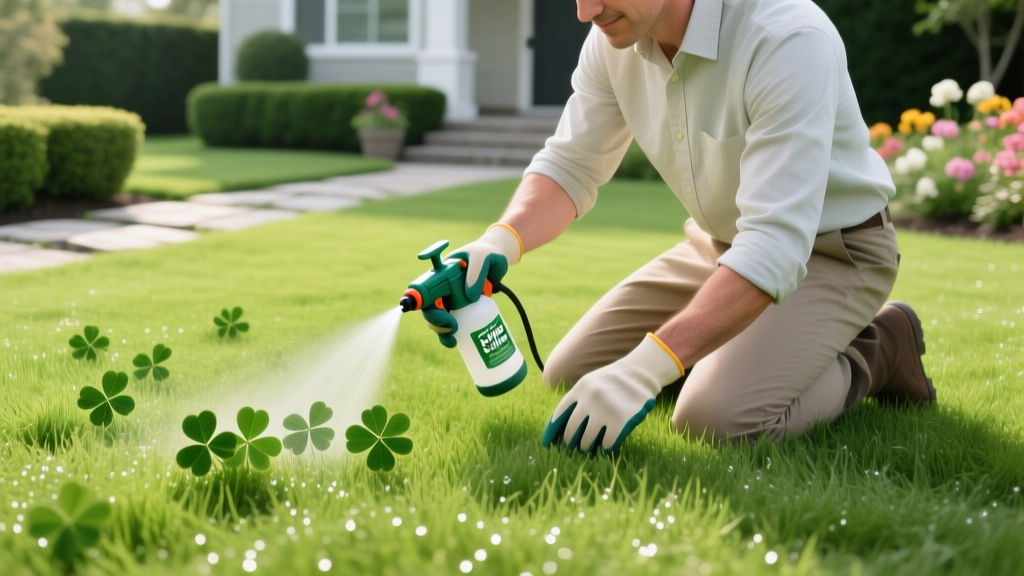
Best Selective Clover Killer for Lawns: Spot-Treatment Guide
The Chemistry of Clover: Why Standard Weed Killers Fail
White clover (Trifolium repens) and red clover (Trifolium pratense) are perennial legumes that aggressively spread through above-ground stolons and deep taproots. Many homeowners purchase generic broadleaf weed killers from big-box stores, spray their lawns, and watch in frustration as the clover merely wilts before bouncing back two weeks later.
The failure of standard clover killer applications usually stems from two biological defenses:
- The Waxy Cuticle: Clover leaves possess a thick, waxy epidermal layer that causes water-based herbicide droplets to bead up and roll off onto the soil.
- The Root Crown Reserve: Clover stores massive energy reserves in its root crown. If the herbicide only burns the foliage (contact action) without translocating to the roots (systemic action), the weed regenerates rapidly.
⚠️ Critical Warning: Never apply products containing 2,4-D or Dicamba when daytime temperatures exceed 85°F. At high temperatures, these active ingredients volatilize (turn into a gas) and drift, causing severe twisting and cupping damage to nearby tomato plants, grapevines, and ornamental shrubs.
Active Ingredients That Actually Translocate
To achieve a complete kill, your clover killer must contain systemic active ingredients that move through the plant's phloem down to the taproot. According to turfgrass research from the University of California Integrated Pest Management Program, combinations of synthetic auxins yield the highest control rates.
| Active Ingredient | Efficacy on Clover | Cool-Season Grass Safety | Warm-Season Grass Safety |
|---|---|---|---|
| Triclopyr | Excellent (Systemic) | Safe (Fescue, Bluegrass, Ryegrass) | Unsafe (Will severely damage Bermuda/Zoysia) |
| Quinclorac | Very Good (Systemic) | Safe | Safe (Bermuda, Zoysia, St. Augustine) |
| Carfentrazone | Good (Contact/Burn-down) | Safe | Safe (May cause temporary bronzing) |
| 2,4-D + Dicamba | Moderate (Needs Surfactant) | Safe | Unsafe for St. Augustine/Centipede |
Top Commercial and Consumer Clover Killer Products
Selecting the right formulation depends on your grass type and budget. As of 2026, professional-grade concentrates remain the most cost-effective route for spot treatments, costing roughly $0.04 per square foot to treat, compared to $0.15 per square foot for pre-mixed consumer sprays.
1. SpeedZone Broadleaf Herbicide (Professional Grade)
Active Ingredients: Carfentrazone, 2,4-D, MCPP, Dicamba.
Best For: Rapid burn-down combined with systemic root kill. SpeedZone is the industry standard for turf managers because the Carfentrazone provides visible wilting within 24 hours, while the auxins finish the root system over 14 days. Expect to pay around $130 for a 1-gallon jug, which treats over 40,000 square feet.
2. Ortho WeedClear for Lawns (Consumer Grade)
Active Ingredients: 2,4-D, Quinclorac, Dicamba.
Best For: Homeowners with warm-season grasses (Bermuda, Zoysia). The inclusion of Quinclorac makes it one of the few consumer products safe for southern lawns while still effectively targeting clover. A 32 oz ready-to-spray bottle costs approximately $18.
3. Monterey Brush and Vine Killer (Triclopyr)
Active Ingredients: Triclopyr (8%).
Best For: Cool-season lawns (Kentucky Bluegrass, Tall Fescue) with severe, deep-rooted clover infestations. Triclopyr is the undisputed champion for leguminous weeds. Note: Do not use on warm-season grasses.
Step-by-Step Spot-Treatment Protocol
Spot-treating saves money and reduces chemical load on your soil. Follow this exact protocol to ensure the herbicide penetrates the waxy cuticle and reaches the root crown.
💡 Pro Tip: The Surfactant Multiplier
You must add a non-ionic surfactant (NIS) to your tank mix. A surfactant breaks the surface tension of the water, allowing the clover killer to spread flat across the waxy leaf rather than beading up. A pint of professional NIS (like Dyna-Gro or Prime Source) costs about $18 and will last an entire season.
You must add a non-ionic surfactant (NIS) to your tank mix. A surfactant breaks the surface tension of the water, allowing the clover killer to spread flat across the waxy leaf rather than beading up. A pint of professional NIS (like Dyna-Gro or Prime Source) costs about $18 and will last an entire season.
- Preparation (Day 1): Mow your lawn to a height of 2.5 inches. Wait 48 hours before spraying. This allows the clover to push out fresh, tender leaf tissue that absorbs herbicide more readily than older, hardened leaves.
- Mixing the Solution: In a 1-gallon pump sprayer, combine:
- 1.5 fluid ounces of your chosen concentrated herbicide (e.g., Trimec Classic or SpeedZone).
- 1 teaspoon (approx. 0.16 fl oz) of non-ionic surfactant.
- Fill the rest with clean water to the 1-gallon mark. Agitate thoroughly.
- Application (Day 3): Spray the clover patches until the leaves are uniformly wet, but not dripping. Dripping causes the chemical to hit the soil, where it is rapidly degraded by microbes and wasted. One gallon of this mix covers roughly 1,000 square feet of spot-treatment area.
- Post-Application: Do not water the lawn for at least 48 hours. Do not mow for 3 days. The herbicide needs this time to translocate from the leaves down into the taproot.
Troubleshooting: Why Did the Clover Turn Yellow but Not Die?
If your clover turns yellow or brown at the edges but sends up new green shoots from the center after three weeks, you have encountered a translocation failure. According to turfgrass specialists at the University of Minnesota Extension, this typically happens for three reasons:
"Herbicide applied to drought-stressed weeds will fail. When clover is deprived of water, it shuts down its phloem transport system to conserve moisture. If the phloem isn't moving sugars down to the roots, it isn't moving the systemic herbicide down to the roots either. Always water the lawn deeply two days before applying a clover killer."
Other common failure modes include:
- Over-mixing: Adding too much herbicide to the tank causes rapid leaf burn (necrosis). The leaf tissue dies before the chemical can travel to the root. Always follow the label's exact fluid-ounce measurements.
- Applying in Cold Weather: Synthetic auxins are highly sluggish in temperatures below 60°F. For optimal metabolic uptake, apply when daytime temperatures are consistently between 65°F and 80°F.
Long-Term Cultural Control: Fixing the Soil
Herbicides are a temporary fix. Clover is a legume, meaning it hosts Rhizobium bacteria in its root nodules, allowing it to pull nitrogen directly from the atmosphere. If clover is outcompeting your turfgrass, it is a massive biological indicator that your soil is nitrogen-deficient.
To prevent clover from returning the following spring, you must alter the soil ecology. Conduct a soil test and apply a high-nitrogen, slow-release fertilizer (such as a 32-0-4 NPK ratio with methylene urea) in the early fall. Apply at a rate of 1.0 lb of actual nitrogen per 1,000 square feet. As the turfgrass thickens and shades the soil surface, clover seeds—which require direct sunlight to germinate—will be naturally suppressed without the need for chemical intervention.

