
Lawn Care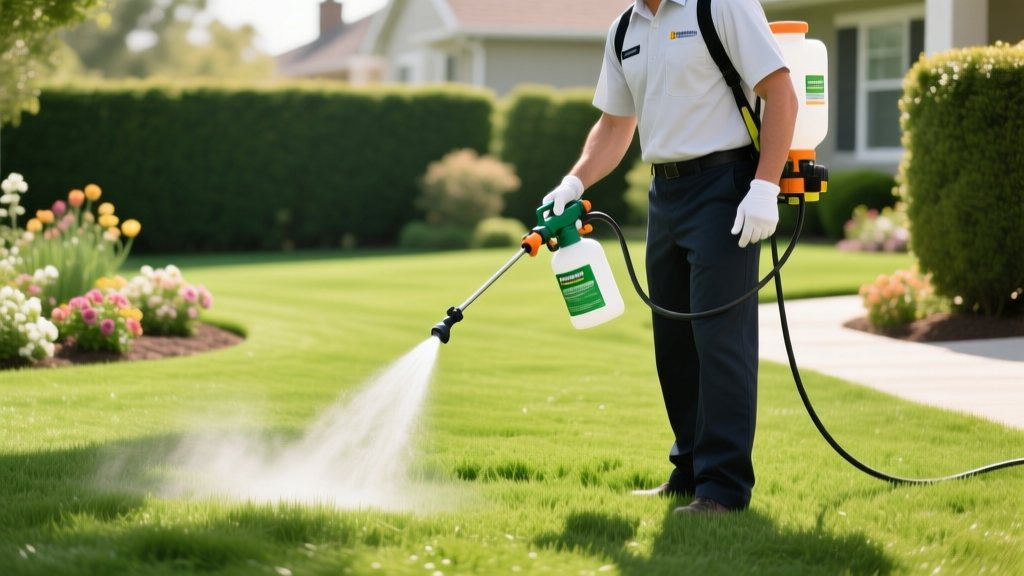
How to Apply a Grass Growth Regulator for a Thicker Lawn
The Science Behind Grass Growth Regulators
A grass growth regulator (PGR) is not a fertilizer, nor is it a weed killer. It is a specialized chemical tool that fundamentally alters the hormonal balance of your turf. Specifically, Class A PGRs like Trinexapac-ethyl inhibit the biosynthesis of gibberellic acid, the primary hormone responsible for vertical cell elongation in plants. By halting vertical growth, the grass redirects its energy into lateral spreading, rhizome development, and deeper root proliferation. The result is a denser, darker, and more drought-resilient turf canopy that requires up to 50% less mowing.
Expert Warning: The Drought Caveat
Never apply a PGR to a lawn experiencing severe drought stress or dormancy. PGRs require active metabolic processes to be absorbed and translocated. Applying them to stressed turf can exacerbate decline and delay recovery when rain finally arrives.
Choosing the Right Active Ingredient
Not all PGRs are created equal. The residential and professional turf market is dominated by two primary active ingredients, each with distinct behavioral profiles. According to research from the Penn State Extension Turfgrass Program, selecting the correct chemistry is critical for your specific grass type.
| Active Ingredient | Brand Examples | Best For | Duration | Mowing Reduction |
|---|---|---|---|---|
| Trinexapac-ethyl (11.3%) | Primo Maxx, T-Nex, Moddus | Warm-season (Bermuda, Zoysia) & Cool-season | 3 to 4 weeks | High (up to 50%) |
| Prohexadione-calcium (27.5%) | Anuew | Cool-season (Tall Fescue, KBG) & Ryegrass | 4 to 6 weeks | Moderate (up to 30%) |
For the vast majority of homeowners and prosumers seeking maximum density and mowing reduction, Trinexapac-ethyl remains the gold standard. The Syngenta GreenCast technical sheet for Primo Maxx highlights its superior foliar absorption and predictable suppression curve, which is why this guide focuses on its step-by-step application.
Step-by-Step Application Procedure
Precision is non-negotiable when applying PGRs. Over-application leads to severe phytotoxicity (yellowing and stunting), while under-application yields negligible results.
Step 1: Calibrate Your Sprayer for 1 Gallon per 1,000 Sq Ft
PGRs require thorough foliar coverage but must not run off the leaf blade into the soil, as Trinexapac-ethyl has minimal soil activity. A carrier volume of 1 gallon per 1,000 square feet is optimal. To calibrate a backpack sprayer, mark off a 18.5 ft by 54 ft area (exactly 1,000 sq ft) on your driveway. Fill your sprayer with a known volume of water, spray the area using your intended walking speed and pump pressure, and measure how much water was used. Adjust your pace until exactly 1 gallon is depleted.
Step 2: Calculate the Exact Chemical Dose
Dosing is based on turf species, not just square footage. Use a digital milliliter scale or a highly accurate syringe for measurement.
- Warm-Season Grasses (Bermudagrass, Zoysia): Apply 0.15 to 0.20 fluid ounces per 1,000 sq ft.
- Cool-Season Grasses (Tall Fescue, Kentucky Bluegrass): Apply 0.10 to 0.15 fluid ounces per 1,000 sq ft.
Pro Tip: If you are applying PGRs for the first time, always start at the lowest label rate. You can increase the dose in subsequent cycles if the suppression is inadequate.
Step 3: Mix with a Non-Ionic Surfactant (NIS)
Because PGRs must penetrate the waxy cuticle of the grass blade, a surfactant is mandatory. Add a Non-Ionic Surfactant (NIS) at a rate of 0.25% v/v. In practical terms, this means adding roughly 1/2 ounce of NIS per gallon of mixed solution. Always fill the tank halfway with water, add the PGR, agitate, add the NIS, and then top off with the remaining water to prevent excessive foaming.
Step 4: Select the Correct Nozzle and Pressure
Ditch the adjustable cone nozzle that came with your backpack sprayer. Cone nozzles produce uneven droplet sizes and erratic coverage. Equip your wand with a TeeJet XR11004 or an AIXR11004 (Air Induction) flat fan nozzle. Maintain a steady pump pressure between 30 and 40 PSI. Keep the nozzle exactly 18 to 20 inches above the turf canopy, walking at a consistent pace of roughly 3 mph.
Step 5: Add Turf Dye to Track Overlaps
Trinexapac-ethyl dries clear. If you lose your place and double-spray a section, that area will receive a double dose, resulting in a dark green, severely stunted streak that lasts for weeks. Add a temporary turf marking dye (like Prime Source Blue Mark) at 1 oz per gallon. The dye will show you exactly where you have sprayed and will wash off the leaf blade after the first rain or irrigation cycle.
Managing the PGR Cycle and the Rebound Effect
The most common mistake homeowners make is treating a PGR as a one-and-done application. Trinexapac-ethyl has a half-life in the plant tissue of roughly 3 to 4 weeks. As the chemical degrades, the turf experiences a phenomenon known as the rebound effect.
The 3D Suppression Curve
- Days 1-3 (Absorption): Vertical growth begins to slow. No visual changes.
- Days 4-21 (Peak Suppression): Vertical growth is reduced by up to 50%. Turf canopy thickens, color deepens due to increased chlorophyll density.
- Days 22-28 (Degradation): Suppression wanes. Mowing frequency slightly increases.
- Days 29-35 (Rebound): Vertical growth surges beyond the untreated baseline as the plant compensates for the hormonal block. This is when you must reapply.
To maintain a consistently thick lawn without the violent growth surges of the rebound phase, you must reapply the PGR every 21 to 28 days during the active growing season. Track your applications on a calendar or use a turf management app to ensure you spray just before the rebound peak occurs.
Cost Breakdown: Is a PGR Financially Viable?
Many homeowners balk at the upfront cost of professional-grade PGRs. A one-gallon jug of generic Trinexapac-ethyl (11.3%) typically retails between $110 and $140 in 2026. However, the per-application cost is remarkably low due to the microscopic application rates.
- Cost per Gallon: $125.00 (128 fluid ounces)
- Application Rate: 0.15 oz per 1,000 sq ft
- Total Coverage per Gallon: ~85,333 sq ft
- Cost per 1,000 sq ft: $1.46
For a standard 5,000 sq ft lawn, each application costs roughly $7.30. When you factor in the reduced fuel consumption for your mower, decreased blade sharpening, and the time saved from mowing 50% less frequently, the return on investment is overwhelmingly positive.
Tank Mixing: Maximizing Efficiency
Because PGR applications require you to drag out the sprayer every three weeks, it is highly efficient to tank-mix compatible products. Trinexapac-ethyl is highly stable and can be safely mixed with:
- Chelated Iron (Fe-EDDHA or Fe-DTPA): PGRs naturally darken the turf; adding liquid iron amplifies this deep blue-green color without pushing excessive nitrogen growth.
- Preventative Fungicides: Mixing with Azoxystrobin or Propiconazole during the humid summer months protects the dense canopy from Brown Patch and Dollar Spot.
- Humic Acids: Fulvic and humic acids can be added to improve overall plant metabolism and stress tolerance.
Crucial Rule: Never tank-mix a PGR with broadleaf herbicides (like 2,4-D or Triclopyr) or heavy emulsifiable concentrate (EC) formulations. The surfactant load and solvent carriers in these herbicides can cause the PGR to burn the leaf tissue upon contact.

