
Lawn Care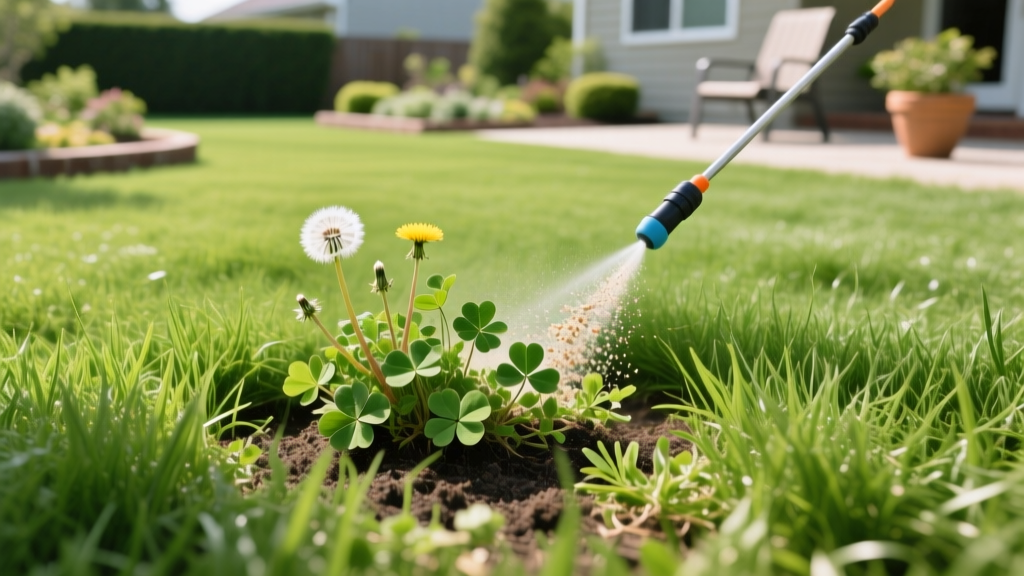
Spot-Treatment Guide for Typical Weeds in Grass Lawns
The Economics and Ecology of Spot-Treating Typical Weeds in Grass
Broadcast spraying an entire lawn to eliminate a 5% weed infestation wastes chemical, damages soil biology, and accelerates herbicide resistance. Spot-treating typical weeds in grass requires a targeted diagnostic approach, precise calibration, and an understanding of weed physiology. According to NC State Extension, targeted post-emergent applications reduce active ingredient usage by up to 85% compared to blanket applications while preserving beneficial soil microbes and earthworm populations.
This guide bypasses generic advice to provide exact active ingredients, surfactant requirements, nozzle specifications, and reseeding timelines for the most顽固 (stubborn) weed species encountered in residential turf.
The Diagnostic Framework: Grass vs. Broadleaf vs. Sedge
Before mixing any chemical, you must classify the weed. Herbicides are highly specific; applying a broadleaf killer to a sedge will yield zero results and waste product. Use this rapid field-identification framework:
- Grassy Weeds: Grow from a single seed leaf (monocot), have parallel veins, and hollow, cylindrical stems with nodes. (e.g., Crabgrass, Poa Annua, Goosegrass).
- Broadleaf Weeds: Grow from two seed leaves (dicot), feature net-like veins, and have solid, often branching stems. (e.g., Dandelion, Clover, Plantain).
- Sedges: Visually similar to grass but possess solid, triangular stems. Remember the botanical rhyme: "Sedges have edges." (e.g., Yellow Nutsedge, Purple Nutsedge).
Top 5 Typical Weeds in Grass and Exact Spot-Treatment Protocols
1. Crabgrass (Digitaria sanguinalis)
Crabgrass is an annual grassy weed that germinates when soil temperatures reach 55°F at a 1-inch depth for three consecutive days. If pre-emergent barriers fail, post-emergent spot treatment requires Quinclorac (e.g., Drive XLR8).
Application Protocol: Mix 0.367 fl oz of Quinclorac per 1,000 square feet. Critical Requirement: Quinclorac requires a Methylated Seed Oil (MSO) or Crop Oil Concentrate (COC) surfactant at 1% v/v to penetrate the waxy leaf cuticle. Non-ionic surfactants (NIS) will result in poor efficacy. Apply when crabgrass is in the 1- to 3-leaf stage; mature tillered crabgrass requires a second application 14 days later.
2. Dandelion (Taraxacum officinale)
Dandelions feature a deep taproot that can extend 18 inches into the soil profile. Pulling them manually almost always leaves a root fragment that regenerates. The University of California IPM recommends systemic herbicides that translocate down to the root tip.
Application Protocol: Use a three-way herbicide containing 2,4-D, MCPP, and Dicamba (e.g., Trimec). Mix at 1.5 fl oz per gallon of water. Add a Non-Ionic Surfactant (NIS) at 0.25% v/v (roughly 1/2 teaspoon per gallon) to break the surface tension on the jagged leaves. Spray until the leaves are uniformly wet but not dripping. Do not mow for 48 hours post-application to allow maximum foliar absorption.
3. Yellow Nutsedge (Cyperus esculentus)
Yellow nutsedge is a sedge that reproduces via underground tubers (nutlets). Standard grassy or broadleaf herbicides will not kill it. You must use Halosulfuron-methyl (e.g., Sedgehammer).
Application Protocol: Dissolve one 1/3 oz water-soluble bag into 1 to 2 gallons of water. Halosulfuron-methyl strictly requires an NIS at 0.25% v/v. Because nutsedge grows faster than surrounding turf, it is highly visible. Spray directly on the foliage. The chemical halts amino acid synthesis, causing the weed to stop growing within 48 hours, though visible yellowing takes 10 to 14 days. Do not disturb the soil, as this can stimulate dormant tubers to germinate.
4. White Clover (Trifolium repens)
Clover thrives in nitrogen-deficient soils and spreads via stolons. While 2,4-D alone suppresses clover, it rarely eradicates it. You need Triclopyr combined with Quinclorac or Dicamba.
Application Protocol: Use a product containing Triclopyr (e.g., T-Zone or a standalone Triclopyr ester). Apply at 1.0 fl oz per 1,000 sq ft. Clover leaves are covered in fine trichomes (hairs) that repel water, making a high-quality surfactant mandatory. Apply in the fall when clover is actively pulling nutrients into its root system for winter storage; this ensures the herbicide is translocated to the stolons.
5. Poa Annua (Annual Bluegrass)
Poa annua is a winter annual that germinates in late summer, thrives in cool weather, and dies in summer heat, leaving brown patches. Post-emergent control in existing lawns is notoriously difficult without damaging cool-season turf.
Application Protocol: For warm-season grasses (Bermuda, Zoysia), Pronamide or Foramsulfuron can be used during winter dormancy. For cool-season grasses (Fescue, Kentucky Bluegrass), post-emergent options are limited; Missouri Extension notes that managing Poa annua relies heavily on late-summer pre-emergent applications (Prodiamine or Dithiopyr) and maintaining a dense turf canopy to shade out germinating seeds.
Herbicide Active Ingredients and Reseeding Timelines
One of the most frequent mistakes homeowners make is overseeding a lawn too soon after spot-treating weeds. Herbicide residual activity will kill germinating grass seed. Review this matrix before planning fall renovations:
| Active Ingredient | Target Weed Type | Example Brand | Avg. Cost per 1k sq ft | Wait Time to Seed |
|---|---|---|---|---|
| Quinclorac | Grassy (Crabgrass) | Drive XLR8 | $0.45 | 28 days (Tall Fescue) |
| Halosulfuron-methyl | Sedge (Nutsedge) | Sedgehammer | $0.80 | 30 days |
| Triclopyr + 2,4-D | Broadleaf (Clover) | T-Zone SE | $0.35 | 21 to 28 days |
| Mesotrione | Broadleaf/Grassy | Tenacity | $0.65 | 0 days (Can seed same day) |
CRITICAL WARNING: Temperature Volatilization
Never apply herbicides containing 2,4-D, Dicamba, or Triclopyr when ambient air temperatures exceed 85°F (29°C). At high temperatures, these chemicals vaporize and drift off-target, causing severe twisting and cupping damage to neighboring ornamental trees, shrubs, and vegetable gardens. Always spray in the early morning when temperatures are below 80°F and winds are under 5 mph.
Never apply herbicides containing 2,4-D, Dicamba, or Triclopyr when ambient air temperatures exceed 85°F (29°C). At high temperatures, these chemicals vaporize and drift off-target, causing severe twisting and cupping damage to neighboring ornamental trees, shrubs, and vegetable gardens. Always spray in the early morning when temperatures are below 80°F and winds are under 5 mph.
Application Mechanics: Nozzle Selection and Calibration
The efficacy of your spot treatment is dictated by your spray nozzle. Most consumer-grade pump sprayers come with a cheap adjustable cone nozzle that produces large, uneven droplets, leading to chemical runoff and soil contamination.
Upgrade to a Flat Fan Nozzle
Replace the factory nozzle with a TeeJet 8002EVS or 9502EVS extended-range flat fan nozzle. These nozzles operate optimally at 20 to 40 PSI and produce a uniform spray pattern that ensures even coverage on the weed leaf surface without excessive overlapping.
The 2-Gallon Calibration Method
To avoid chemical burn from over-application, calibrate your sprayer to deliver exactly 2 gallons of mixed solution per 1,000 square feet.
- Mark off a 20 ft x 50 ft area (1,000 sq ft) on your driveway using chalk.
- Fill your sprayer with exactly 2 gallons of plain water.
- Walk at your normal, steady pace while spraying the marked area, maintaining a constant pumping pressure.
- If you run out of water before finishing the area, you are walking too fast. If you have water left over, you are walking too slow or your nozzle is restricted.
- Once calibrated, mix your herbicide based on the "per 1,000 sq ft" label rate, not the "per gallon" rate, to ensure mathematical accuracy.
Post-Treatment Lawn Recovery and Soil Health
Spot-treating typical weeds in grass leaves small voids in the turf canopy. Once the mandatory reseeding waiting period has passed, fill these voids immediately to prevent new weed seeds from contacting the soil.
Before dropping seed, aerate the specific spot with a manual core aerator or a hand trowel to relieve compaction caused by foot traffic during the spraying process. Apply a starter fertilizer high in phosphorus (e.g., 10-18-10) to promote rapid root development of the new grass seed. If you must seed before the herbicide residual window closes, apply activated charcoal (e.g., Gro-Safe) at 2 lbs per 1,000 sq ft to the treated area; the carbon binds to the herbicide molecules, neutralizing the residual effect and allowing safe germination within 48 hours.

