
Lawn Care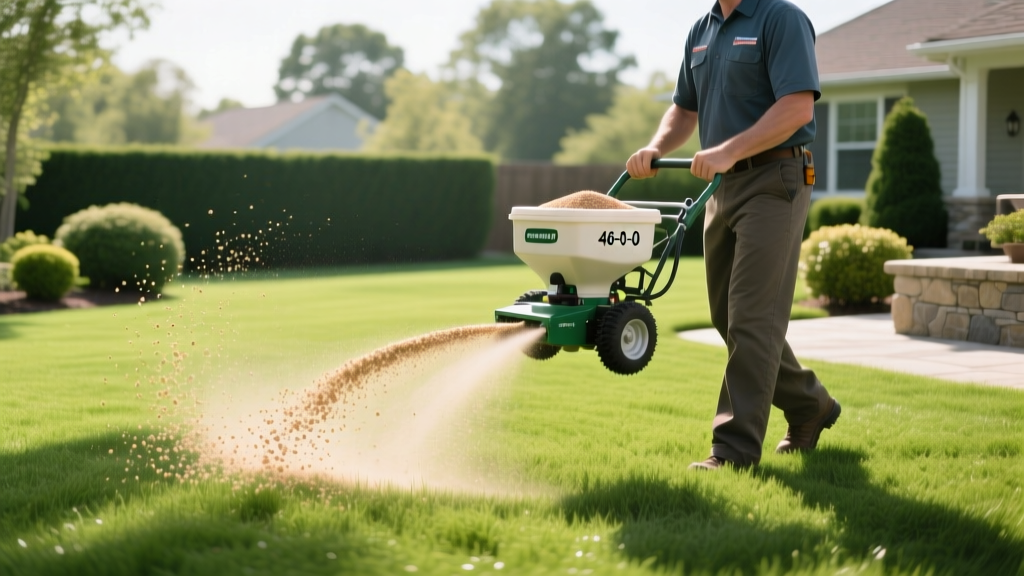
46-0-0 Fertilizer Guide: Urea Application Rates & Timing
The Chemistry of 46-0-0 Urea Fertilizer
46-0-0 fertilizer, universally known in the agronomic industry as urea, is the most concentrated solid nitrogen source available for turfgrass management. Its N-P-K analysis dictates that it contains 46% nitrogen, 0% phosphorus, and 0% potassium. Because of this high analysis, urea is exceptionally cost-effective per pound of actual nitrogen delivered, making it a staple for both commercial turf managers and advanced homeowners. However, its concentrated nature demands precise calibration and strict adherence to watering protocols to avoid severe foliar burn and nitrogen loss.
Unlike ammonium sulfate or nitrate-based fertilizers that are immediately plant-available, urea is an organic compound (CO(NH2)2) synthesized from ammonia and carbon dioxide. When prilled urea hits the soil surface, it does not feed the grass immediately. It must first undergo hydrolysis, a chemical reaction driven by the naturally occurring soil enzyme urease. This enzyme converts urea into ammonium carbonate. If soil moisture is adequate and the product is incorporated into the topsoil, the resulting ammonium (NH4+) binds securely to the soil's cation exchange capacity (CEC), ready for root uptake.
Critical Warning: Ammonia Volatilization
If 46-0-0 urea is broadcast onto dry soil or left on the surface of high-pH turf (pH > 7.0) without being watered in, the urease enzyme converts the ammonium into ammonia gas (NH3). This gas escapes into the atmosphere—a phenomenon known as volatilization. Research from the University of Minnesota Extension indicates that unincorporated urea on alkaline soils can lose 15% to 30% of its total nitrogen value to the atmosphere within just 48 hours, rendering your application financially and agronomically wasteful.
Calculating Exact Application Rates
The most common failure mode for homeowners using urea is miscalculating the product weight versus actual nitrogen weight. Because urea is 46% nitrogen, you must divide your target nitrogen rate by 0.46 to find the required product weight.
The Formula: (Target lbs of N per 1,000 sq ft) ÷ 0.46 = Required lbs of 46-0-0 product per 1,000 sq ft.
For a standard application of 1.0 lb of actual nitrogen per 1,000 square feet, you need exactly 2.17 lbs of 46-0-0 urea product. Applying a full 50 lb bag across a 5,000 sq ft lawn delivers roughly 4.6 lbs of actual nitrogen per 1,000 sq ft, which will cause catastrophic fertilizer burn and potential root death.
| Grass Type | Target N Rate (per 1k sq ft) | 46-0-0 Product Required | Optimal Timing |
|---|---|---|---|
| Kentucky Bluegrass | 0.75 - 1.0 lb N | 1.63 - 2.17 lbs | Early Fall / Late Spring |
| Tall Fescue | 0.5 - 0.75 lb N | 1.08 - 1.63 lbs | Early Fall |
| Bermudagrass | 1.0 - 1.5 lb N | 2.17 - 3.26 lbs | Late Spring / Early Summer |
| Zoysiagrass | 0.5 - 1.0 lb N | 1.08 - 2.17 lbs | Early Summer |
Step-by-Step Application Protocol
To maximize nitrogen uptake and mitigate volatilization, follow this strict operational sequence when applying prilled urea.
- Check Soil Temperature: Avoid applying urea when soil temperatures exceed 80°F. High heat accelerates urease activity, rapidly converting urea to ammonia gas before it can be watered in.
- Calibrate the Spreader: Set your broadcast spreader to deliver the exact product weight calculated above. For a Scotts EdgeGuard broadcast spreader applying 2.17 lbs of urea per 1,000 sq ft, a dial setting between 5.0 and 5.5 is typically required. Always verify by weighing the product dispensed over a measured 100 sq ft test area.
- Apply to Dry Foliage: Never apply urea to wet grass. Moisture on the leaf blade will cause the prills to stick to the foliage, dissolving locally and causing immediate, severe foliar burn (manifesting as black/brown necrotic spots).
- Water In Immediately: According to turfgrass guidelines published by UMass Amherst Extension, urea must be irrigated with 0.25 to 0.5 inches of water immediately after application. This moves the prills off the leaf surface, into the thatch layer, and initiates the hydrolysis process in the soil profile.
46-0-0 vs. Alternative Nitrogen Sources
While urea is the cheapest source of nitrogen per pound, it is not always the correct tool for every scenario. Compare 46-0-0 against other common turfgrass nitrogen sources to determine the best fit for your soil profile.
| Fertilizer Source | N-P-K Analysis | Burn Potential | Volatilization Risk | Best Use Case |
|---|---|---|---|---|
| Urea | 46-0-0 | High | High (if unwatered) | Budget-conscious bulk feeding; irrigated lawns |
| Ammonium Sulfate | 21-0-0 | Very High | Low | Lowering high-pH soils; rapid green-up |
| Methylene Urea (PCU) | 39-0-0 | Low | None | Slow-release summer feeding; non-irrigated sites |
| Milorganite | 6-4-0 | Very Low | None | Organic matter building; clay soil improvement |
Troubleshooting Common Failure Modes
Even with careful planning, environmental variables can disrupt urea applications. Use this diagnostic framework to identify and correct issues.
- Symptom: Distinct brown/black spotting on leaf blades within 48 hours.
Cause: Foliar burn. The urea prills stuck to wet grass blades or the application rate exceeded 0.75 lbs N/1000 sq ft without immediate irrigation.
Fix: Flush the lawn with 1 inch of water immediately to dilute the salt concentration in the thatch. Mow the lawn to remove the necrotic tissue. - Symptom: Faint smell of ammonia (similar to cat urine) post-application.
Cause: Active volatilization. The soil pH is above 7.0, the soil surface was bone dry, and irrigation was delayed beyond 12 hours.
Fix: For future applications on high-pH soils, purchase stabilized urea coated with NBPT (a urease inhibitor) or switch to ammonium sulfate. Water in standard urea within 30 minutes of broadcasting. - Symptom: Rapid green-up followed by severe yellowing (chlorosis) 10 days later.
Cause: Nitrogen leaching. Urea was applied to highly sandy soil with low CEC, followed by heavy rainfall (>1 inch) before root uptake occurred.
Fix: Transition sandy soils to slow-release nitrogen sources like sulfur-coated urea or methylene diurea, which rely on microbial degradation rather than water solubility.
Sourcing and 2026 Pricing Dynamics
As of 2026, agricultural-grade prilled urea (46-0-0) remains heavily influenced by global natural gas prices, as natural gas is the primary feedstock for ammonia synthesis. Homeowners should expect to pay between $45.00 and $65.00 for a standard 50 lb bag at landscape supply distributors like SiteOne, local agricultural co-ops, or specialized turf retailers.
Avoid purchasing urea from big-box hardware stores, where it is frequently overpriced and repackaged in small 5 lb boxes under consumer branding. Instead, visit a local farm supply or landscape wholesale distributor. When purchasing, inspect the bag for excessive dust or crushed prills at the bottom; degraded urea will not flow correctly through a broadcast spreader and will result in uneven striping across your turf canopy.

