
Lawn Care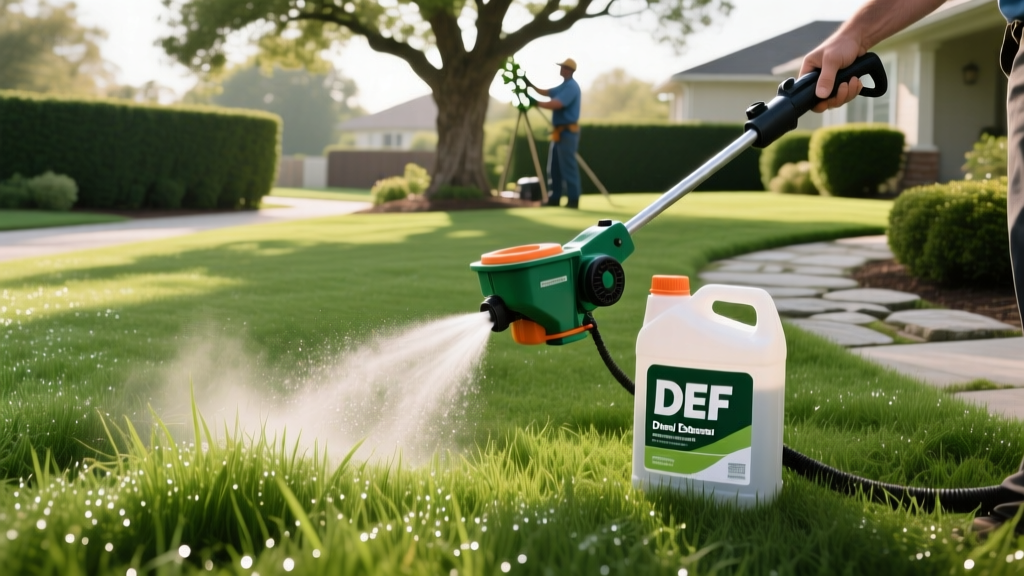
Using DEF for Fertilizer: Is Diesel Exhaust Fluid Safe for Lawns?
A growing trend in online lawn care communities involves bypassing traditional garden center products and heading straight to the truck stop. The question on many homeowners' minds is whether using DEF for fertilizer is a viable, cost-effective hack for achieving a dark green lawn. Diesel Exhaust Fluid (DEF) is essentially a liquid urea solution, and since urea is one of the most common nitrogen sources in commercial agriculture, the logic seems sound on the surface. However, applying automotive chemicals to your turfgrass requires a precise understanding of chemistry, dilution ratios, and potential toxicity risks.
This guide breaks down the exact mathematics of converting DEF into lawn-ready nitrogen, the step-by-step application process, and the hidden edge cases that can turn a money-saving hack into a burned, dead lawn.
The Chemistry: What Exactly is in DEF?
To understand if DEF works as a lawn fertilizer, you have to look at its chemical composition. According to the U.S. Environmental Protection Agency, DEF is a non-toxic, colorless, and odorless liquid consisting of exactly 32.5% high-purity synthetic urea and 67.5% deionized water.
Urea (chemical formula CO(NH2)2) is a highly concentrated nitrogen source. In its dry, prilled form, agricultural urea is rated as 46-0-0, meaning it contains 46% nitrogen by weight. Because DEF is 32.5% urea, the actual nitrogen content of the liquid is approximately 15% nitrogen by weight.
The ISO 22241 Purity Advantage: Unlike cheap agricultural urea, DEF must meet strict ISO 22241 standards to prevent damage to diesel catalytic converters. This means automotive DEF is heavily filtered and contains virtually zero biuret—a toxic byproduct of urea manufacturing that causes severe leaf tip burn in turfgrass. In this specific regard, DEF is actually purer than many budget-grade granular urea fertilizers.
The Application Math: Converting DEF to Lawn Nitrogen
The biggest mistake homeowners make when using DEF for fertilizer is guessing the application rate. Spraying undiluted DEF directly onto grass will result in severe chemical burn due to the salt index of urea. You must calculate the exact fluid ounces needed to deliver a safe dose of nitrogen.
Here is the baseline data for your calculations:
- Weight of DEF: ~9.1 lbs per gallon
- Nitrogen Content: 15% by weight
- Total Nitrogen per Gallon: 1.36 lbs of N per gallon of DEF
- Total Nitrogen per Ounce: 0.0106 lbs of N per fluid ounce of DEF
Nitrogen Source Comparison Matrix
| Fertilizer Type | N-P-K Ratio | Lbs of N per Gallon | Cost per Lb of N (2026 Avg) |
|---|---|---|---|
| Automotive DEF (32.5% Urea) | 15-0-0 (Liquid) | 1.36 lbs | $0.65 - $0.85 |
| Standard UAN 28-0-0 | 28-0-0 (Liquid) | 2.40 lbs | $1.20 - $1.50 |
| Dry Prilled Urea | 46-0-0 (Granular) | N/A (Solid) | $0.90 - $1.10 |
Note: While DEF is cheaper per pound of nitrogen than commercial UAN (Urea Ammonium Nitrate) solutions, it lacks the ammonium nitrate component that provides immediate, weather-independent greening. DEF relies entirely on soil microbes to convert the urea into usable ammonium, a process that takes 2 to 7 days depending on soil temperatures.
Step-by-Step Guide to Spraying DEF on Your Lawn
For a standard cool-season or warm-season lawn, the target application rate for a liquid nitrogen push is 0.5 lbs of Nitrogen per 1,000 square feet. Based on the math above, you need exactly 47 fluid ounces of DEF to achieve this rate per 1,000 sq ft.
- Measure the DEF: Pour 47 oz (roughly 5.8 cups) of DEF into a clean 1-gallon or 2-gallon pump sprayer. Never use a sprayer that previously held herbicides or pesticides, even if you rinsed it.
- Dilute with Water: Fill the rest of the sprayer with clean water. A 1:3 or 1:4 dilution ratio (DEF to water) is ideal to ensure even coverage and prevent localized salt burn.
- Agitate: Seal the sprayer and shake vigorously. DEF and water mix seamlessly, but agitation ensures a uniform solution.
- Spray Evenly: Apply the mixture to your 1,000 sq ft area using a steady, overlapping walking pace. Avoid spraying during the heat of the day; early morning or late evening is best to minimize rapid evaporation.
- Water it In (Crucial): Urea sitting on grass blades will draw moisture out of the leaf tissue, causing necrosis (burn). Immediately after spraying, run your irrigation system or hose for 5–10 minutes to wash the urea off the grass blades and into the soil profile where microbes can break it down.
Critical Risks: Contaminated Bulk Tanks and Salt Burn
WARNING: The Bulk Tank Gamble
While pre-packaged 2.5-gallon jugs of DEF from auto parts stores are highly regulated, bulk DEF dispensers at truck stops are a massive risk for lawn care. If a truck stop's bulk tank is poorly maintained, cross-contaminated with diesel fuel, or topped off with non-deionized tap water, the fluid will contain heavy metals, hydrocarbons, and excess salts. Applying contaminated bulk DEF will poison your soil biology and leave hydrophobic, dead patches in your turf. Always buy sealed, API-certified jugs for lawn application.
While pre-packaged 2.5-gallon jugs of DEF from auto parts stores are highly regulated, bulk DEF dispensers at truck stops are a massive risk for lawn care. If a truck stop's bulk tank is poorly maintained, cross-contaminated with diesel fuel, or topped off with non-deionized tap water, the fluid will contain heavy metals, hydrocarbons, and excess salts. Applying contaminated bulk DEF will poison your soil biology and leave hydrophobic, dead patches in your turf. Always buy sealed, API-certified jugs for lawn application.
The Salt Index Reality
Urea has a salt index of 75 (compared to a baseline of 100 for sodium nitrate). While it is not the highest salt-index fertilizer on the market, it is high enough to cause osmotic stress to grass roots if applied during a drought or without proper watering-in. If your lawn is already suffering from heat stress or lack of rainfall, do not apply DEF. Wait for soil temperatures to drop below 85°F and ensure the soil has adequate baseline moisture.
Final Verdict: Pros and Cons Matrix
Is using DEF for fertilizer a legitimate lawn care strategy, or just an internet gimmick? Here is the objective breakdown for the 2026 lawn care season.
Pros of DEF
- Extremely cost-effective source of liquid nitrogen.
- Zero biuret content (safer for leaf tissue than cheap ag-urea).
- Readily available at almost any gas station or big-box store.
- Leaves no granular residue on the lawn.
Cons of DEF
- Lacks phosphorus, potassium, and essential micronutrients (iron, manganese).
- Requires strict dilution and immediate watering-in to avoid burn.
- Relies on warm soil microbes for conversion (useless in early spring).
- High risk of soil contamination if sourced from dirty bulk truck-stop pumps.
The Bottom Line: DEF is an excellent, budget-friendly emergency nitrogen boost for mid-summer or early fall when soil temperatures are warm and microbial activity is high. However, it should not replace a comprehensive, balanced lawn fertilization program. Use it as a supplemental liquid feed between your primary granular applications, always respect the dilution math, and never skip the post-application watering step.

