
Lawn Care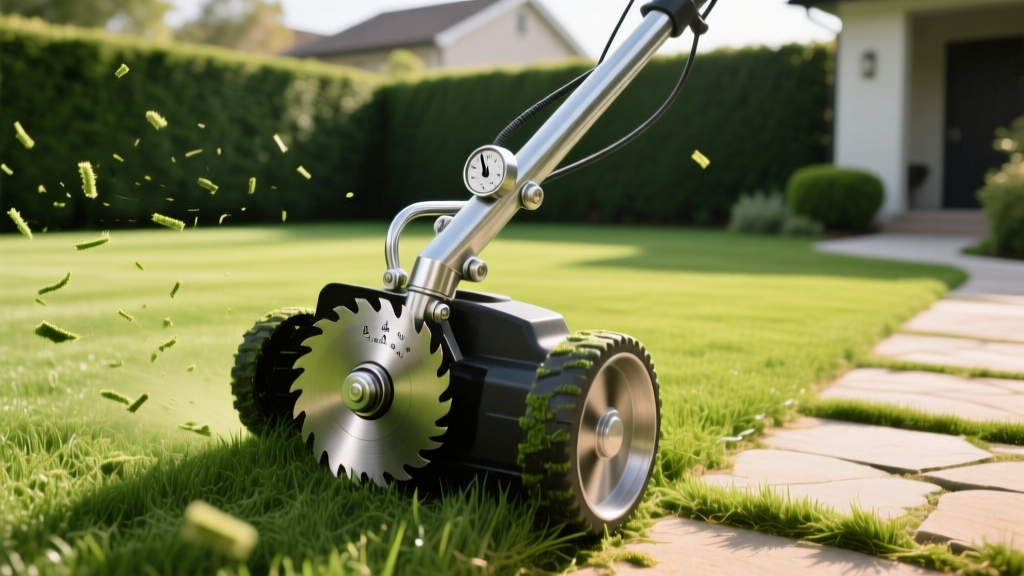
Vertical Mower Selection and Blade Depth Calibration Guide
Thatch accumulation beyond 0.5 inches creates a hydrophobic barrier that blocks water, fertilizer, and air from reaching the root zone. While core aeration relieves soil compaction, it does not adequately remove horizontal thatch layers. This is where a vertical mower (often called a verticutter or dethatcher) becomes essential. Unlike consumer-grade spring-tine dethatchers that merely scratch the surface, commercial vertical mowers use rigid blades to physically slice through the thatch mat and into the soil profile, severing stolons and rhizomes to stimulate lateral growth.
However, improper equipment selection and miscalibrated blade depths can severely scalp a lawn, tearing out healthy crown tissue and leaving turf vulnerable to desiccation and weed invasion. This guide details the exact specifications for selecting a vertical mower, the precise calibration protocols required for different grass species, and the preventative maintenance schedules needed to protect your equipment investment.
Slicing vs. Flailing: Selecting the Correct Vertical Mower Head
Not all vertical mowers operate on the same mechanical principle. The two primary cutting heads are fixed-blade (slicing) and flail (pulverizing). Choosing the wrong head for your specific turfgrass and thatch volume will result in either ineffective thatch removal or catastrophic turf damage.
| Feature | Fixed-Blade (Slicing) | Flail / Spring-Tine (Pulverizing) |
|---|---|---|
| Mechanism | Rigid steel knives on a fixed reel | Loose flails or heavy spring tines on a rotating shaft |
| Primary Use | Severe thatch removal, stolon severing, overseeding prep | Light grooming, leaf mulching, surface debris removal |
| Turf Impact | Clean cuts, minimal crown tearing | Aggressive tearing, high risk of crown damage |
| Blade Spacing | 1-inch to 3-inch adjustable | Fixed, typically 2-inch to 4-inch |
| Example Models | Classen TR-18H, Billy Goat KV600H | Consumer-grade electric dethatchers |
| Price Range | $2,800 - $4,500 (Commercial Walk-Behinds) | $150 - $400 (Residential) |
For professional lawn renovation and deep thatch management, fixed-blade vertical mowers are the only viable option. According to the University of Minnesota Extension, mechanical slicing is vastly superior to flailing for cool-season grasses like Kentucky Bluegrass, as it cleanly cuts rhizomes without ripping the plant crown from the soil.
The Millimeter Rule: Calibrating Blade Depth
The most common failure mode in verticutting is setting the blades too deep, which acts like a rototiller and destroys the turf canopy. Conversely, setting them too high merely polishes the top of the thatch layer without penetrating it. Proper calibration requires a flat, hard surface—never calibrate on soft soil.
Step-by-Step Calibration Protocol
- Locate a Hard Surface: Move the vertical mower onto a concrete driveway or a flat pavement surface. Ensure the machine is turned off and the spark plug is disconnected.
- Lower the Deck: Use the depth micrometer or lever to lower the blade reel until the blades just barely kiss the concrete surface. You should feel slight resistance when spinning the reel by hand.
- Set the Clearance: For standard thatch removal, raise the deck exactly 1/8 inch to 1/4 inch from the concrete using a steel feeler gauge or a calibrated block. This ensures the blades will penetrate the soil surface by that exact margin once moved to the lawn.
- Verify Across the Deck: Check the clearance at the left, center, and right sides of the reel. Uneven wear on the wheels or a bent deck can cause a 1/2 inch variance across a 20-inch cutting path.
Pro Tip: Adjusting for Grass Architecture
Stoloniferous grasses (Bermudagrass, Zoysia, Centipede) grow horizontally above ground. Set your blade depth to slice just below the thatch layer (1/4 inch into soil) and use a tight 1-inch blade spacing to aggressively prune stolons and force vertical growth. Rhizomatous grasses (Kentucky Bluegrass) grow horizontally below ground. Use a wider 2-inch to 3-inch blade spacing and a shallower 1/8 inch depth to avoid severing too many subterranean rhizomes.
Stoloniferous grasses (Bermudagrass, Zoysia, Centipede) grow horizontally above ground. Set your blade depth to slice just below the thatch layer (1/4 inch into soil) and use a tight 1-inch blade spacing to aggressively prune stolons and force vertical growth. Rhizomatous grasses (Kentucky Bluegrass) grow horizontally below ground. Use a wider 2-inch to 3-inch blade spacing and a shallower 1/8 inch depth to avoid severing too many subterranean rhizomes.
Preventative Maintenance: Bearings, Belts, and Blade Replacement
Vertical mowers operate under extreme vibrational stress. The blade reel spins at high RPMs while repeatedly striking soil, rocks, and roots. Neglecting drivetrain maintenance leads to catastrophic bearing failure, which can warp the reel shaft and destroy the deck housing.
| Component | Maintenance Interval | Procedure & Specifications | Estimated Replacement Cost |
|---|---|---|---|
| Reel Bearings | Every 50 hours / Annually | Grease with lithium-complex NLGI #2. Check for lateral play; replace if shaft wobbles >1mm. | $15 - $35 per bearing |
| Drive Belt | Every 25 hours | Check tension. Should have exactly 1/2 inch deflection at the midpoint under 15 lbs of thumb pressure. | $25 - $45 |
| Slicing Blades | Every 10-15 hours | Inspect for rolled edges or chips. Replace, do not sharpen (sharpening alters the factory balance and causes vibration). | $45 - $85 per set |
| Gearbox Oil | Annually / 100 hours | Drain and refill with SAE 90 gear oil. Check for metal flakes indicating internal gear wear. | $15 (Oil) |
When replacing blades, always replace the entire set simultaneously. Mixing new, heavy blades with worn, thin blades creates an unbalanced reel. An unbalanced reel spinning at 2,500 RPM generates harmonic vibrations that will rapidly destroy the reel bearings and fatigue the welds on the mower deck.
Troubleshooting Common Vertical Mower Vibrations
If your vertical mower begins to vibrate excessively or leaves an uneven, scalloped pattern in the soil, the issue is almost always mechanical rather than operational. Use this diagnostic framework to isolate the fault:
- Symptom: High-frequency vibration that worsens with engine RPM.
- Cause: Unbalanced blade reel or debris wrapped around the shaft.
- Fix: Disconnect the spark plug. Clean the shaft entirely. Check for missing blades or bent flails. If all blades are present, the shaft itself may be bent from striking a solid root or rock; this requires professional shop straightening or a $200-$350 shaft replacement.
- Symptom: Squealing noise accompanied by a loss of blade cutting power.
- Cause: Glazed or loose drive belt.
- Fix: Adjust the idler pulley to restore the 1/2 inch deflection specification. If the belt sides are shiny and hardened, the rubber is glazed and must be replaced; tightening a glazed belt will only burn out the engine crankshaft bearing.
- Symptom: Uneven depth of cut (scalping on one side, missing thatch on the other).
- Cause: Asymmetric wheel height adjustment or worn wheel bushings.
- Fix: Measure from the concrete surface to the deck lip on all four corners. Adjust the wheel caster pins. If the wheel wobbles laterally, replace the nylon wheel bushings ($8-$12 each).
Mastering the vertical mower requires treating it as a precision agronomic tool rather than a standard rotary mower. By selecting the correct fixed-blade architecture, calibrating to the millimeter using hard-surface baselines, and adhering to strict bearing and belt maintenance intervals, you ensure optimal thatch removal while preserving the structural integrity of the turfgrass crown. For further reading on integrating verticutting into a broader turf renovation program, consult the Penn State Extension Turfgrass Program resources on seasonal cultural practices.

