
Lawn Care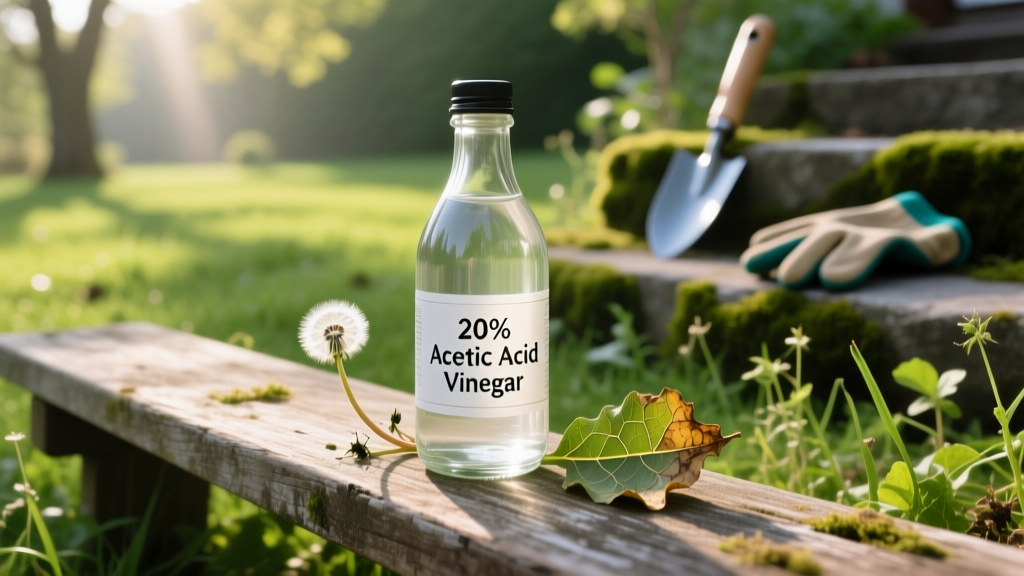
What Kind of Vinegar Kills Weeds? Acetic Acid Explainer
The Short Answer: Acetic Acid Concentration is Key
When homeowners ask what kind of vinegar kills weeds, the answer is not about the brand or the base ingredient, but strictly about the acetic acid concentration. Vinegar is simply a water-based solution of acetic acid. Standard grocery store vinegar contains 5% acetic acid, which is sufficient for culinary use and light household cleaning, but it is fundamentally inadequate for killing established weeds. To achieve actual foliar burn-down and desiccation of mature broadleaf and grassy weeds, you must use horticultural vinegar, which contains between 20% and 30% acetic acid.
According to the University of Minnesota Extension, acetic acid acts as a contact herbicide. It destroys plant cell membranes upon contact, causing rapid leakage of cellular fluids and immediate desiccation. However, because it is strictly a contact killer, it does not translocate to the roots. Understanding this biological limitation is critical before you spend money on bulk acetic acid.
Household (5%) vs. Horticultural (20-30%) Vinegar
The most common failure mode in organic weed control is attempting to use 5% culinary vinegar on mature lawn weeds. Below is a structural comparison of acetic acid concentrations and their real-world efficacy.
| Acetic Acid % | Classification | Target Weeds | Root Kill Capability | PPE Required |
|---|---|---|---|---|
| 5% | Household / Culinary | Very young seedlings (under 2 weeks old) | None (Top burn only) | None |
| 10% | Commercial Cleaning | Young annual broadleaves | Minimal | Safety glasses |
| 20% | Horticultural | Mature annuals, young perennials | Low (Requires repeat apps) | Goggles, chemical gloves |
| 30% | Industrial / Ag-Grade | Mature perennials, tough grasses | Moderate (on shallow roots) | Full face shield, respirator |
⚠️ CRITICAL WARNING: Horticultural vinegar (20%+) is classified as a severe eye and skin irritant. The Environmental Protection Agency (EPA) notes that while acetic acid is a minimum-risk active ingredient at low concentrations, 20%+ solutions can cause irreversible corneal damage and severe chemical burns. Never spray 20% acetic acid on a windy day, and always wear ANSI-approved splash goggles and nitrile-lined chemical gloves.
The Surfactant Factor: Why Vinegar Alone Fails
Pouring pure 20% vinegar directly onto a weed often results in failure. Why? Because mature weeds have evolved a waxy, hydrophobic cuticle on their leaves to prevent water loss. A water-based vinegar solution will simply bead up and roll off the leaf surface, failing to penetrate the plant tissue.
To force the acetic acid through the cuticle, you must add a surfactant (surface-active agent) to break the water's surface tension, and an adjuvant like d-limonene (orange oil) to dissolve the waxy coating. This combination increases foliar uptake by up to 80%.
Exact Mixing Protocol for Maximum Burn-Down
Do not guess your ratios. Use this precise formulation to create a highly effective, fast-acting contact herbicide.
- Base: 1 Gallon of 20% Horticultural Acetic Acid.
- Surfactant: Add 1 oz of liquid dish soap (anionic surfactant) OR 0.5 oz of non-ionic agricultural surfactant (preferred for professional results).
- Cuticle Dissolver: Add 1 oz of cold-pressed orange oil (d-limonene).
- Mixing: Add the soap and orange oil to the vinegar after filling the tank to prevent excessive foaming. Agitate gently.
Equipment Note: Acetic acid at 20% will rapidly corrode metal pump components and degrade standard rubber seals. You must use a sprayer with a high-density polyethylene (HDPE) tank and Viton (fluorocarbon) seals. Standard hardware store pump sprayers will leak and fail within 3 to 5 uses.
Application Windows and Temperature Thresholds
Contact herbicides rely on rapid cellular destruction, a process heavily influenced by environmental conditions. Apply your vinegar mixture only when the following parameters are met:
- Temperature: Ambient air temperature must be above 70°F (21°C). Below this threshold, the chemical reaction slows significantly, and the weed may survive the initial burn.
- Sunlight: Apply between 10:00 AM and 2:00 PM. Direct UV radiation accelerates the desiccation process once the cell membranes are compromised.
- Rainfastness: The mixture requires 2 hours of dry weather to fully penetrate the leaf cuticle. If it rains within 90 minutes, the treatment will wash off and fail.
- Weed Stage: Target weeds before they develop deep taproots. Dandelions and thistles with established taproots will burn to the soil line but will resprout from the root crown within 14 days, requiring a second application.
Cost Analysis: Vinegar vs. Commercial Herbicides
Many homeowners assume vinegar is a cheaper alternative to synthetic herbicides like glyphosate or 2,4-D. When you calculate the cost per square foot of coverage, the economics shift.
Cost Breakdown (Per 2.5 Gallons of Ready-to-Use Solution)
Horticultural Vinegar Mix (20% + Surfactant + Orange Oil): ~$55.00
Commercial Glyphosate Concentrate (Diluted): ~$18.00
Commercial 2,4-D Broadleaf Killer (Diluted): ~$22.00
Analysis: Vinegar is significantly more expensive per application. Furthermore, because vinegar is a contact-only killer, perennial weeds require 2 to 3 applications spaced 10 days apart, multiplying the cost. Synthetic systemic herbicides kill the root in a single application. Vinegar is best reserved for spot-treating weeds in hardscape cracks, driveways, and organic garden beds where synthetic chemical use is prohibited.
Post-Application Soil Recovery and pH Impact
A pervasive myth is that vinegar permanently sterilizes the soil. This is false. While 20% acetic acid has a pH of roughly 1.5, soil possesses a natural buffering capacity driven by calcium carbonate, clay minerals, and organic matter. When the acid hits the soil, it temporarily drops the pH of the top half-inch, causing localized microbial die-off. However, within 30 to 45 days, the soil buffer neutralizes the acid, and microbial populations rebound.
Actionable Rule: Do not overseed or plant new grass seed in an area treated with 20% vinegar for at least 4 weeks. The temporary acidity will inhibit seed germination and burn emerging radicles.
Frequently Asked Questions
Will horticultural vinegar kill my turfgrass?
Yes. Acetic acid is a non-selective herbicide. It does not distinguish between a dandelion and your prized Kentucky Bluegrass. Any turfgrass that receives overspray will suffer severe foliar burn and may die back to the crown. Use a cardboard shield or a bell-sprayer nozzle when treating weeds embedded in a lawn.
Can I use apple cider vinegar instead of white vinegar?
Apple cider vinegar typically maxes out at 5% to 6% acetic acid. It is entirely ineffective against mature weeds and the additional cost of the apple base is wasted. Always use distilled white horticultural vinegar for the highest concentration at the lowest cost.
Does adding salt to vinegar make it stronger?
Adding sodium chloride (table salt) increases the desiccation effect, but it introduces soluble salts into the soil profile. Unlike acetic acid, which breaks down and neutralizes, salt accumulates in the soil, causing long-term osmotic stress that will prevent anything from growing in that spot for years. Never add salt to a vinegar weed killer if you plan to grow plants there in the future.

