
Lawn Care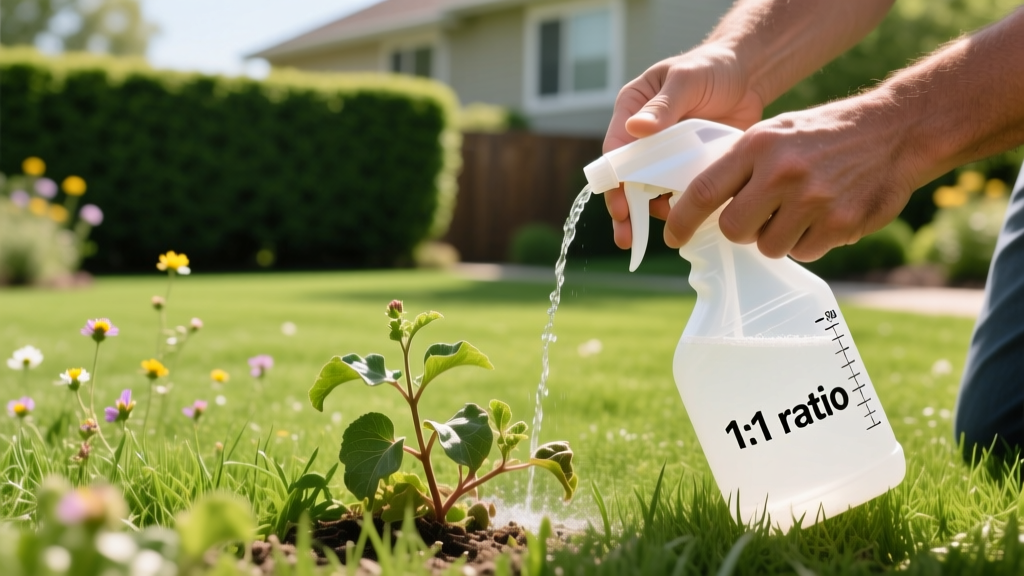
Do You Dilute Vinegar to Kill Weeds? Exact Ratios & Soil Safety
The Short Answer: Dilution Depends on Acetic Acid Concentration
When homeowners ask, "do you dilute vinegar to kill weeds?", the answer is not a simple yes or no. It depends entirely on the starting concentration of acetic acid in the bottle you purchased. Vinegar acts as a contact desiccant, meaning it destroys the cell membranes of plant leaves, causing them to dry out and die within hours. However, its efficacy is strictly tied to its chemical strength.
If you are using standard household vinegar (5% acetic acid), you should never dilute it. Adding water to a 5% solution drops the acidity below the threshold required to break down the waxy cuticle of mature weeds. If you are using horticultural vinegar (20% to 30% acetic acid), you can and often should dilute it to a 10% to 15% working solution for annual weeds, saving money while maintaining high kill rates, while reserving the full-strength mixture for deep-rooted perennials.
The Concentration Matrix: What to Buy and How to Mix
Understanding the commercial grading of acetic acid is critical for formulating an effective organic herbicide. According to research published by Penn State Extension, acetic acid concentrations below 10% often fail to kill the root systems of established broadleaf weeds, resulting in rapid regrowth.
| Vinegar Type | Acetic Acid % | Dilution Ratio (Vinegar:Water) | Target Weeds | Cost per Gallon |
|---|---|---|---|---|
| Household (Grocery) | 5% | Do not dilute (Use straight) | Young annuals, seedling crabgrass | $3.00 - $5.00 |
| Cleaning Grade | 10% | Do not dilute (Use straight) | Established annuals, chickweed | $12.00 - $18.00 |
| Horticultural | 20% | 1:1 (Yields 10% solution) | Mature broadleaf weeds, plantain | $25.00 - $35.00 |
| Industrial/Agricultural | 30% | 1:2 (Yields 10% solution) | Tough perennials, thistle, docks | $35.00 - $50.00 |
Expert Tip: When diluting 30% horticultural vinegar, always add the water to the sprayer tank first, then pour the acid in. This prevents dangerous splashing and reduces the volatilization of acetic acid fumes.
The Surfactant Multiplier: Why Vinegar Alone Fails
Dilution is only half the equation. The primary reason DIY vinegar weed killers fail is the omission of a surfactant (surface-active agent). Broadleaf weeds like dandelions, plantain, and thistle have evolved hydrophobic (water-repelling) waxy cuticles on their leaves. If you spray diluted vinegar without a surfactant, the liquid will bead up and roll off the leaf, wasting the solution and failing to deliver the acid to the plant tissue.
A surfactant breaks the surface tension of the water, allowing the acetic acid to spread evenly across the leaf surface and penetrate the stomata.
Choosing the Right Surfactant
- Non-Degreasing Dish Soap (e.g., Dawn, Palmolive): Use 1 tablespoon per gallon of diluted vinegar. Avoid "heavy-duty degreasing" formulas, as they contain solvents that can leave toxic residues in your soil.
- Liquid Castile Soap (e.g., Dr. Bronner's): A highly effective, biodegradable option. Use 1.5 tablespoons per gallon.
- Commercial Non-Ionic Surfactants (e.g., Hi-Yield Spreader Sticker): The professional choice. Use exactly as directed on the label, typically 0.25 to 0.5 ounces per gallon. Non-ionic surfactants do not react with the acid, ensuring maximum stability.
Step-by-Step: Mixing and Applying Diluted Vinegar
Follow this precise protocol to maximize the desiccation process while minimizing chemical waste and environmental impact.
- Check the Forecast: Acetic acid requires heat and UV light to accelerate cellular destruction. Only apply when temperatures are above 70°F (21°C) and no rain is forecast for at least 24 hours.
- Prepare the Tank: Fill a 1-gallon or 2-gallon pump sprayer halfway with clean tap water. (Do not use hard well water if possible; high calcium levels in hard water can buffer and neutralize the acetic acid).
- Add the Surfactant: Pour in 1 tablespoon of liquid castile soap. Swirl the tank gently to mix without creating excessive suds.
- Add the Acid: Carefully measure and add your horticultural vinegar to achieve your target dilution (e.g., 0.5 gallons of 20% vinegar + 0.5 gallons of water = 1 gallon of 10% working solution).
- Top Off and Pressurize: Add the remaining water, seal the sprayer, and pump to 40-50 PSI.
- Apply to Saturation: Spray the weed leaves until they are visibly wet and dripping. Because vinegar is a contact herbicide and not systemic, complete foliar coverage is mandatory. Any green tissue left unsprayed will continue to photosynthesize and regenerate the root.
Critical Edge Cases: Soil pH and Grass Damage
The most overlooked consequence of repeated vinegar application is soil acidification. The National Pesticide Information Center (NPIC) notes that while acetic acid breaks down rapidly in the environment, the immediate localized effect is a sharp drop in soil pH.
The Soil Buffering Problem
If you are using vinegar to kill weeds in the cracks of a concrete driveway or on a gravel path, soil pH is irrelevant. However, if you are spot-treating weeds in a garden bed or lawn, you must consider your baseline soil chemistry.
- Alkaline Soils (pH > 7.2): Common in the arid Western US. The soil's natural calcium carbonate acts as a buffer, neutralizing the acetic acid quickly. Vinegar use here is generally safe for surrounding soil biology.
- Acidic Soils (pH < 6.0): Common in the US Southeast and Pacific Northwest. Repeated vinegar applications will drive the pH even lower. In highly acidic soils, essential macronutrients like phosphorus, calcium, and magnesium become "locked up" and unavailable to surrounding desirable plants, while toxic levels of aluminum become soluble.
Warning: Non-Selective Herbicide Action
Acetic acid does not distinguish between a dandelion and your prized Kentucky Bluegrass. If you are spot-treating weeds in a turf lawn, you must use a paintbrush or a sponge-tipped applicator to dab the diluted vinegar directly onto the weed leaves. Spraying over the top of your lawn will result in severe, immediate chemical burn to the grass blades.
Acetic acid does not distinguish between a dandelion and your prized Kentucky Bluegrass. If you are spot-treating weeds in a turf lawn, you must use a paintbrush or a sponge-tipped applicator to dab the diluted vinegar directly onto the weed leaves. Spraying over the top of your lawn will result in severe, immediate chemical burn to the grass blades.
Remediating Acidified Soil
If you have historically over-applied vinegar to a specific garden bed and notice surrounding plants exhibiting chlorosis (yellowing leaves with green veins, a classic sign of nutrient lockout), you must raise the soil pH. Apply pelletized garden lime (calcium carbonate) at a rate of 5 lbs per 100 square feet, water it in deeply, and retest the soil pH 30 days later.
Safety Protocols and PPE Requirements
Treating 5% household vinegar as a benign kitchen ingredient leads to dangerous complacency when upgrading to horticultural grades. Solutions containing 20% to 30% acetic acid are classified as corrosive. They can cause severe, irreversible corneal damage and third-degree chemical burns on prolonged skin contact.
Mandatory PPE for mixing and spraying 20%+ acetic acid:
- ANSI Z87.1 rated splash-proof safety goggles (standard reading glasses are insufficient).
- Chemical-resistant nitrile or neoprene gloves (minimum 8 mil thickness).
- Long sleeves and closed-toe shoes.
- N95 respirator if spraying in an enclosed area or on a windy day to prevent inhalation of atomized acid mist.
Frequently Asked Questions
Does adding salt to vinegar make it a better weed killer?
While adding sodium chloride (table salt) increases the desiccation rate, it is highly discouraged for any area where you plan to grow plants in the future. Salt causes soil sodicity, destroying soil structure, preventing water infiltration, and creating a sterile environment where nothing will grow for years. Stick to vinegar and a surfactant.
Will diluted vinegar kill weed roots?
No. Acetic acid is strictly a contact herbicide. It destroys the top growth but does not translocate down into the root system. For shallow-rooted annual weeds, top-kill is sufficient to cause plant death. For deep-rooted perennials like field bindweed or Canada thistle, the roots will survive and push up new shoots within 7 to 14 days, requiring repeated applications to exhaust the root's carbohydrate reserves.
How long does vinegar stay active in the soil?
Acetic acid breaks down very rapidly in soil, typically within 2 to 3 days, as soil microbes metabolize the acetate ions. It does not leave a residual herbicidal barrier. You can safely sow new grass seed or plant garden transplants in a treated area just 48 hours after application.

