
Lawn Care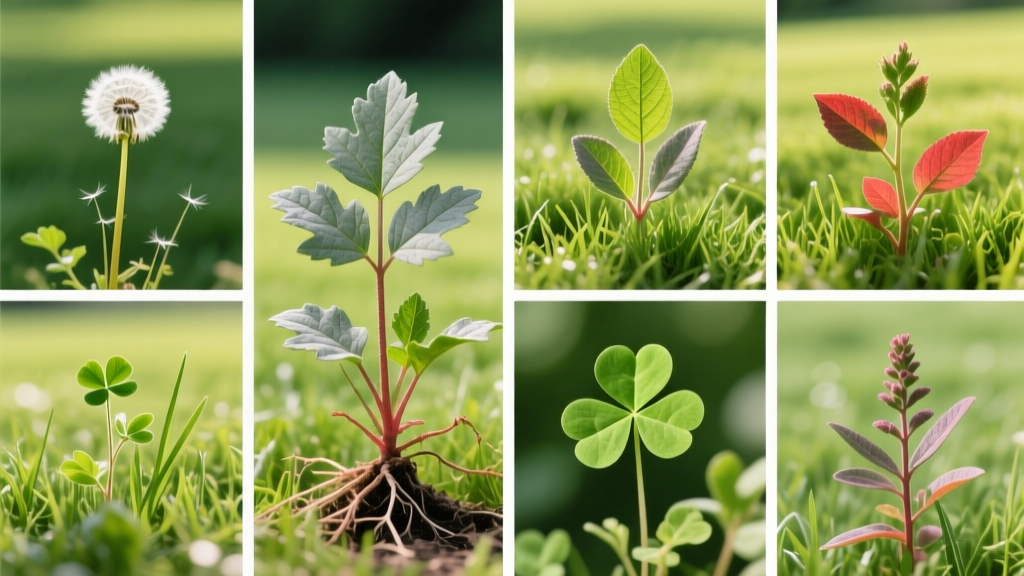
What Do Weed Plants Look Like? A Visual Identification Guide for Lawns
The Botanical Breakdown: Three Main Weed Categories
When homeowners ask, "what do weed plants look like?", the answer requires looking past the generic nuisance label and examining plant biology. In turfgrass agronomy, weeds are not a single species but a diverse group of opportunistic plants categorized into three distinct botanical families: broadleaf weeds (dicots), grassy weeds (monocots), and sedges. Misidentifying the category is the number one reason herbicide applications fail, as the chemical pathways required to kill a dicot are entirely ineffective against a sedge.
1. Broadleaf Weeds (Dicots)
Broadleaf weeds are the easiest to identify because they visually contrast sharply with your turfgrass. They feature wide leaves with net-like (reticulate) venation and often produce showy flowers. Their root systems typically consist of a deep central taproot or a dense, shallow fibrous mat.
- Dandelion (Taraxacum officinale): Recognized by its basal rosette of deeply lobed leaves pointing backward toward the center. When the hollow stem is broken, it exudes a milky white latex sap. The taproot can penetrate 10 to 15 inches into compacted soil, making hand-pulling largely ineffective unless the entire root is extracted.
- White Clover (Trifolium repens): Features trifoliate leaves (three leaflets) often marked with a white chevron or "V" shape. It spreads via above-ground creeping stems called stolons, which root at the nodes, forming dense, circular patches that smother surrounding grass.
- Broadleaf Plantain (Plantago major): Exhibits thick, oval-shaped leaves with prominent parallel ribs running from the base to the tip. It thrives in heavily compacted soils where turfgrass roots struggle to penetrate.
2. Grassy Weeds (Monocots)
Grassy weeds are the most difficult to identify because they mimic the appearance of your desired turf. They possess parallel leaf venation, hollow round stems, and fibrous root systems. To answer what these weed plants look like up close, you must examine their microscopic structures, specifically the ligule (the membrane where the leaf blade meets the sheath) and the collar.
- Crabgrass (Digitaria sanguinalis): A warm-season annual that germinates when soil temperatures consistently reach 55°F. It features a wide, pale green collar and a tall, membranous ligule. The leaf blades are wider and lighter in color than most cool-season turfgrasses, and it grows in a prostrate, star-like pattern.
- Goosegrass (Eleusine indica): Often confused with crabgrass, goosegrass can be distinguished by its folded vernation (leaves emerge folded in the shoot, whereas crabgrass emerges rolled) and a distinct silver-white, flattened stem base.
3. Sedges: The Triangle-Stemmed Invaders
Sedges are neither broadleaf plants nor true grasses. Turfgrass professionals use a simple rhyme to identify them: "Sedges have edges, rushes are round, grasses have nodes from their tips to the ground." If you roll the stem of a suspected weed between your thumb and forefinger and feel a distinct triangular shape, you are dealing with a sedge.
Yellow Nutsedge (Cyperus esculentus) is the most common lawn invader in this category. It features a prominent midrib down the center of the leaf, a sharply pointed tip, and grows up to three times faster than surrounding turf during peak summer heat. Crucially, nutsedge reproduces via underground tubers (nutlets) that can remain dormant in the soil for up to three years, rendering standard pre-emergent herbicides useless.
Diagnostic Matrix: What Your Weeds Reveal About Your Soil
Weeds are ecological indicators. According to the UC Statewide IPM Program, the presence of specific weed species provides a visual diagnosis of underlying soil deficiencies or environmental stressors. Before reaching for an herbicide, use this matrix to correct the environmental conditions inviting the weeds.
| Weed Species | Soil Condition Indicator | Remediation Action |
|---|---|---|
| Prostrate Knotweed | Severe soil compaction; low oxygen | Deep core aeration; topdress with compost |
| White Clover | Nitrogen-deficient soil | Apply 1.5 to 2.0 lbs of Nitrogen per 1,000 sq ft annually |
| Yellow Nutsedge | Poor drainage; chronically wet soil | Regrade low spots; install French drains; reduce irrigation frequency |
| Common Chickweed | Shaded areas with poor air circulation | Prune tree canopies to increase sunlight; overseed with shade-tolerant fine fescue |
| Sheep Sorrel | Highly acidic soil (pH below 5.5) | Apply pelletized limestone based on a professional soil test |
Step-by-Step Field Identification Protocol
To accurately determine what weed plants look like in your specific yard, follow this agronomic identification protocol rather than relying on casual visual estimates.
- Extract the Root Zone: Do not simply yank the plant. Use a weeding fork or soil knife to dig a 4-inch perimeter around the weed and lift it intact. Identifying whether the plant has a taproot, rhizomes (underground horizontal stems), or stolons (above-ground runners) dictates your removal strategy.
- Examine the Ligule and Collar: Purchase a 10x jeweler's loupe. Pull the leaf blade away from the stem and look at the junction. A fringe of hairs indicates a hairy ligule (common in crabgrass), while a thin, translucent membrane indicates a membranous ligule (common in annual bluegrass).
- Perform the Roll Test: Pinch the base of the stem and roll it. If it rolls smoothly, it is a grassy weed. If it catches on sharp edges, it is a sedge.
- Check the Vernation: Cut a cross-section of the newest, unopened leaf shoot at the base. If the leaves are arranged in a circle (rolled vernation), it points toward species like annual bluegrass. If they are folded flat (folded vernation), it indicates goosegrass or Kentucky bluegrass.
Targeted Herbicide Selection Based on Visual ID
Once you have identified the botanical category of the weed, you must select an herbicide with the correct active ingredient. The Penn State Extension emphasizes that using the wrong chemical class will not only fail to kill the weed but can cause severe phytotoxicity to your desired turf.
⚠️ CRITICAL WARNING: Never apply standard broadleaf herbicides (like 2,4-D) to nutsedge. Sedges possess a different metabolic pathway; applying broadleaf killers to nutsedge will merely burn the top growth while stimulating the underground tubers to produce multiple new shoots, worsening the infestation.
- For Broadleaf Weeds: Look for selective systemic herbicides containing a three-way blend of 2,4-D, Dicamba, and MCPP (commonly sold as Trimec). These mimic plant growth hormones, causing the dicot weeds to grow uncontrollably until their vascular systems collapse. Apply when temperatures are between 65°F and 85°F to prevent turf burn.
- For Grassy Weeds: Post-emergent control requires active ingredients like Quinclorac (highly effective on crabgrass) or Fenoxaprop-p-ethyl. Note that Quinclorac can cause temporary yellowing in certain turf species like tall fescue, so check the label for your specific grass type.
- For Sedges: You must use herbicides specifically formulated for Cyperus species. Halosulfuron-methyl (SedgeHammer) or Sulfentrazone are the industry standards. These inhibit the ALS enzyme pathway unique to sedges and certain broadleaves, starving the plant of essential amino acids.
Summary: Observation is the First Line of Defense
Understanding what weed plants look like at a microscopic and structural level transforms lawn care from a guessing game into a precise science. By categorizing invaders as broadleaf, grassy, or sedge, examining their root and stem structures, and interpreting the soil conditions they indicate, you can implement targeted cultural and chemical controls that restore the health and uniformity of your turfgrass canopy.

