
Lawn Care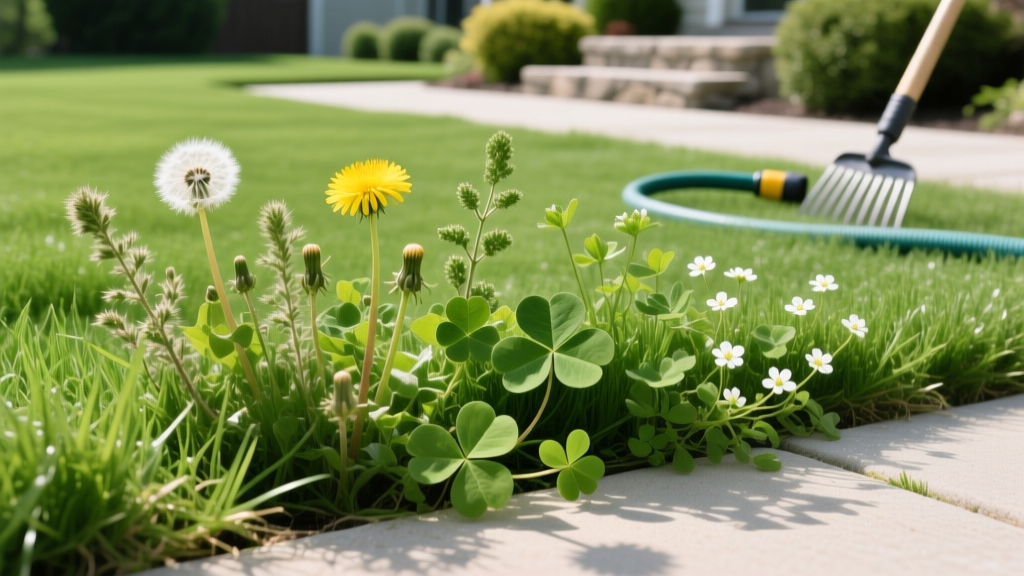
Pics of Weeds in Grass: Visual ID & Spot-Treatment Guide
The Visual ID Framework: Why Pictures Matter Before You Spray
Misidentifying a weed is the most expensive mistake a homeowner can make. Applying a broadleaf herbicide to a grassy weed, or a standard grass-killer to a sedge, results in wasted chemicals, untreated infestations, and potential phytotoxicity to your desirable turf. When analyzing pics of weeds in grass, professionals categorize invaders into three distinct botanical families: Broadleaf, Grassy, and Sedges. Each family requires a completely different mode of action for effective spot-treatment.
Before selecting a chemical, you must visually confirm the weed's structural characteristics. Broadleaf weeds feature net-like veins and wide leaves. Grassy weeds mimic your turf with parallel veins and narrow blades. Sedges possess solid, triangular stems—a trait remembered by the turf industry adage, 'sedges have edges.' Accurate visual identification dictates whether you reach for a synthetic auxin (2,4-D), an ALS inhibitor (Halosulfuron), or an ACCase inhibitor (Quinclorac).
Top 5 Broadleaf Weeds: Visual Cues & Spot-Treatment Matrix
Broadleaf weeds are generally the easiest to spot against a manicured lawn. They disrupt the uniform texture of the turf and often produce vibrant flowers. Below is a diagnostic and treatment matrix for the most common residential broadleaf invaders.
| Weed Species | Visual ID Cues (What to look for in pics) | Active Ingredient | Product Example | Approx. Cost per 1,000 sq ft |
|---|---|---|---|---|
| Dandelion | Deeply lobed, jagged leaves forming a basal rosette; hollow flower stalks exuding milky sap. | 2,4-D + Dicamba + MCPP | SpeedZone Broadleaf | $0.08 |
| White Clover | Three-leaflet leaves with distinct white 'V' shaped crescents; creeping stolons rooting at nodes. | 2,4-D + Dicamba + MCPP | Trimec Classic | $0.05 |
| Ground Ivy (Creeping Charlie) | Scalloped leaf margins, square stems, strong minty odor when crushed; thrives in dense shade. | Triclopyr + 2,4-D | Ortho WeedClear | $0.12 |
| Broadleaf Plantain | Thick, ribbed, oval leaves growing in a tight, low rosette; highly tolerant of compacted soil. | 2,4-D + Mecoprop | SpeedZone Southern | $0.09 |
| Common Chickweed | Prostrate growth, small opposing oval leaves, tiny white star-shaped flowers; thrives in cool, wet springs. | 2,4-D + Dicamba | Lesco Three-Way | $0.06 |
💡 Surfactant Pro-Tip: Never skip the surfactant when treating waxy broadleaf weeds like Plantain and Chickweed. These species will shed water-based herbicide droplets. Adding a Non-Ionic Surfactant (NIS) at 0.25% v/v (approx. 1/2 teaspoon per gallon) breaks the surface tension, ensuring the active ingredient penetrates the leaf cuticle rather than rolling onto the soil.
Grassy Weeds & Sedges: The Hardest Invasives to ID
Grassy weeds and sedges camouflage perfectly within cool-season fescues and warm-season Bermudagrass. Relying on casual observation is insufficient; you must inspect the ligules, auricles, and stem geometry.
Crabgrass (Smooth & Large)
Crabgrass is a summer annual grassy weed. Visually, it exhibits a prostrate, star-shaped growth pattern with a lighter, lime-green coloration than surrounding Kentucky Bluegrass or Fescue. The collar region features a wide, pointed ligule with no auricles. Spot-Treatment Protocol: Quinclorac is the gold standard for post-emergent crabgrass control. Products like Drive XLR8 (1.45 lbs ai/gal) should be applied at a rate of 0.5 to 0.75 fluid ounces per 1,000 square feet. Quinclorac mimics plant hormones, causing severe epinasty (twisting) and necrosis in crabgrass within 7 to 14 days.
Yellow & Purple Nutsedge
Nutsedge is technically a sedge, not a grass. It grows significantly faster than surrounding turf during peak summer heat, creating unsightly yellow-green tufts. To confirm ID, pull a single plant and roll the base of the stem between your fingers; if it feels distinctly triangular, it is nutsedge. Purple nutsedge also features a reddish-purple tint at the stem base. Spot-Treatment Protocol: Standard grass herbicides will not kill nutsedge. You must use an ALS inhibitor like Halosulfuron-methyl (SedgeHammer). Mix one 13.5-gram packet per 10 gallons of water, covering 1,000 sq ft. Expect to see stunting in 48 hours and complete browning in 14-21 days. A second application is almost always required 6 weeks later to exhaust the underground nutlets.
Poa Annua (Annual Bluegrass)
Poa Annua is a winter annual grassy weed characterized by its bright, apple-green color, boat-shaped leaf tips, and aggressive seed head production even when mowed at 2 inches. Spot-Treatment Protocol: Selective post-emergent control in cool-season lawns is notoriously difficult. Mesotrione (Tenacity) is the primary option, applied at 0.33 oz per 1,000 sq ft. Note that Tenacity acts as a bleaching herbicide; the Poa Annua will turn stark white before dying over 2-3 weeks. Avoid using Tenacity on newly seeded lawns or fine fescues.
⚠️ Herbicide Volatility Warning: Avoid applying 2,4-D or Dicamba-based broadleaf products when ambient temperatures exceed 85°F. At high temperatures, these chemicals can vaporize and drift, causing severe cupping, twisting, and necrosis to nearby ornamental shrubs, tomatoes, and garden vegetables.
Spot-Treatment Calibration & Application Mechanics
Buying the right chemical is only 50% of the battle. The delivery mechanism dictates success. For residential spot-treatments, abandon the hose-end sprayer; they lack the precision required for targeted weed control and risk over-applying chemicals to healthy turf.
- Equipment Selection: Use a 1-gallon or 2-gallon polyethylene hand-pump sprayer (e.g., Chapin or Solo). These cost between $20 and $35 and provide a consistent fan-pattern nozzle output.
- Calibration Walk: Fill the sprayer with 1 gallon of plain water. Pump to 40 PSI. Walk at your normal, steady pace and spray a 10x10 foot area (100 sq ft). Measure how much water you used. If you used 1 quart (32 oz) to cover 100 sq ft, your application rate is 3.2 gallons per 1,000 sq ft.
- Mixing Ratios: Adjust your chemical concentrate based on your water volume. If a label calls for 1.5 oz of herbicide per 1,000 sq ft, and your calibration showed you use 3.2 gallons of water to cover that area, you must mix 1.5 oz of herbicide into every 3.2 gallons of water in your tank.
- Application Technique: Spray until the weed leaves are uniformly wet, but not dripping. 'Drenching' the soil does not improve foliar-absorbed herbicides like 2,4-D or Quinclorac; it only wastes product and increases soil leaching risks.
Post-Treatment Lawn Recovery & Overseeding Timelines
Herbicides leave residual effects that can inhibit the germination of desirable grass seed. If your spot-treatment results in bare patches, you must adhere to strict reseeding wait times to avoid wasting expensive turf seed.
- 2,4-D / Dicamba / Triclopyr: Wait a minimum of 3 to 4 weeks before overseeding cool-season turf. These synthetic auxins degrade relatively quickly in the soil profile.
- Quinclorac (Drive XLR8): This chemical has a long soil residual. You must wait at least 8 to 12 weeks before seeding new Kentucky Bluegrass or Tall Fescue, otherwise, the emerging seedlings will suffer severe root pruning and stunting.
- Mesotrione (Tenacity): Tenacity is unique; it is safe to apply at the exact time of seeding for most cool-season grasses (except Fine Fescue), as it suppresses weeds without harming germinating turfgrass.
Frequently Asked Questions
Why did the weed turn red instead of brown after spraying?
Some weeds, particularly crabgrass and certain broadleaf species, produce anthocyanins (red/purple pigments) as a stress response to herbicide exposure before cellular collapse occurs. This is a normal indicator that the active ingredient is translocating through the phloem.
Should I mow before or after spot-treating?
Do not mow for 2 days before and 2 days after application. You need maximum leaf surface area to intercept the herbicide droplets, and you need 48 hours post-application for the chemical to translocate down into the root system before the top-growth is severed by a mower blade.
For comprehensive, region-specific visual databases, homeowners should consult the NC State TurfFiles Weed Identification tool, which offers high-resolution imagery across all growth stages. Additionally, the Purdue Extension Turfgrass Weed Management database provides excellent cultural control matrices, while the UC IPM Weed Management Guidelines remain the premier resource for warm-season turf invasions in arid climates.

