
Lawn Care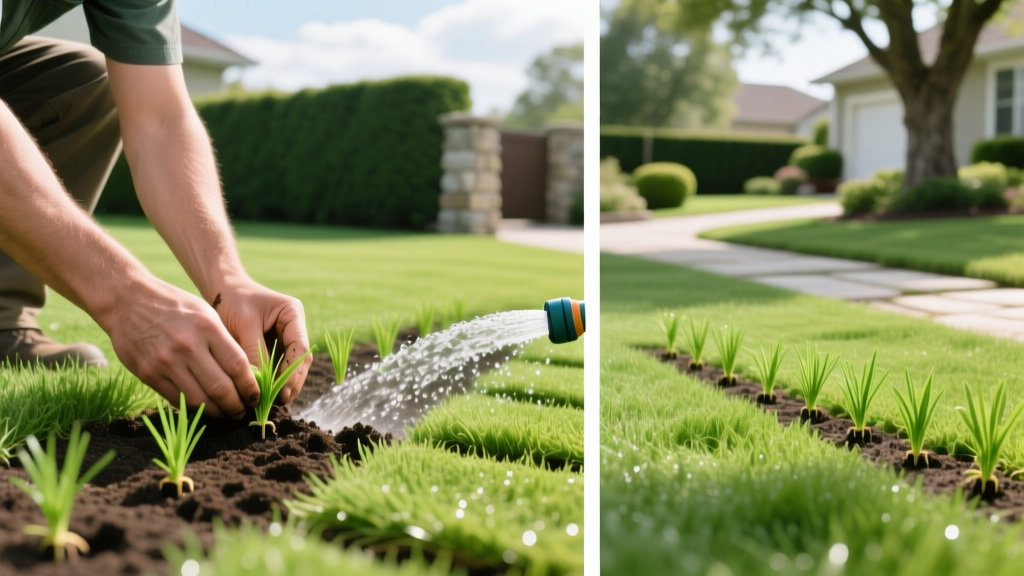
Step-by-Step Guide to Planting and Establishing Lawn Grass Plugs
Establishing a warm-season lawn using lawn grass plugs bridges the gap between the high cost of solid sod and the high failure rate of seeding. Vegetative grasses like St. Augustine, Zoysia, and hybrid Bermuda do not produce viable seeds for commercial propagation, making plugs the most economical method for homeowners to establish or repair these turf types. A standard plug measures 2x2 inches or 3x3 inches and contains a mature, rooted crown ready to spread via stolons and rhizomes.
This guide details the exact agronomic procedures, spacing mathematics, and 60-day maintenance protocols required to transition bare soil into a fully established turf canopy.
The Economics and Agronomy of Grass Plugs
Sod provides an instant lawn but costs between $0.50 and $0.90 per square foot, plus heavy delivery fees and immediate soil compaction risks. Grass plugs typically cost $0.40 to $0.85 per unit. While the initial material cost is lower, the tradeoff is time. Plugs require 60 to 90 days of aggressive maintenance to fill in, depending on the spacing matrix you choose and the ambient soil temperature. According to the North Carolina State University TurfFiles, warm-season grasses require soil temperatures consistently above 65°F at a 2-inch depth to initiate lateral stolon growth. Planting plugs in early spring when soil is still cold will result in stunted root development and high mortality rates.
Agronomic Warning: Never apply pre-emergent herbicides (such as prodiamine or dithiopyr) within 60 days before or after planting lawn grass plugs. Pre-emergents inhibit cell division in root tips, which will completely halt the lateral rooting of your new plugs and cause them to die from drought stress.
Pre-Planting Matrix: Spacing, Quantity, and Cost
The density of your plug layout dictates your total cost and the time required for the lawn to achieve 100% canopy closure. The standard industry recommendation is a 12-inch grid, but high-traffic areas or aggressive grass cultivars (like TifTuf Bermuda) can be spaced wider to save money.
| Spacing Grid | Plugs per Sq. Ft. | Plugs for 500 Sq. Ft. | Estimated Material Cost (500 Sq. Ft.) | Time to Full Canopy Closure |
|---|---|---|---|---|
| 6-inch spacing | 4.0 | 2,000 | $800 - $1,700 | 45 - 60 Days |
| 9-inch spacing | 1.77 | 885 | $354 - $752 | 60 - 75 Days |
| 12-inch spacing | 1.0 | 500 | $200 - $425 | 75 - 90 Days |
| 18-inch spacing | 0.44 | 220 | $88 - $187 | 100+ Days (High Weed Risk) |
Required Tools and Soil Amendments
Attempting to dig individual holes with a hand trowel is inefficient and leads to inconsistent planting depths. Procure the following specific equipment before delivery day:
- Plugger Tool: The ProPlugger 5-IN-1 or Yard Butler P-4000 (approx. $35-$45). These tools extract a precise 2.25-inch soil core and feature a side port to eject the dirt, ensuring uniform hole depth.
- Starter Fertilizer: A high-phosphorus formulation like 10-18-10 or 24-25-4. Phosphorus is critical for early root development. Apply at a rate of 1.0 lb of Nitrogen per 1,000 sq. ft.
- Soil Amendments: Pelletized lime (if soil pH is below 6.0) or elemental sulfur (if pH is above 7.0). Target a pH of 6.0 to 6.5 for optimal nutrient uptake.
- Lawn Roller: A water-fillable poly roller (approx. 24 inches wide) to ensure soil-to-root contact.
Step-by-Step Planting Procedure
- Site Preparation and Tilling: Kill existing vegetation using a non-selective herbicide (glyphosate) 14 days prior. Once brown, rototill the soil to a depth of 4 to 6 inches. Rake the area completely level, removing all rocks and debris larger than 1 inch.
- Soil Moisture Priming: Water the bare soil deeply 24 hours before planting. The soil must be moist but not saturated; this allows the plugger tool to slice cleanly without compacting the clay.
- Core Extraction: Using your plugger tool, extract cores on your chosen grid (e.g., 12 inches apart). Empty the extracted soil cores into a wheelbarrow to use later for topdressing.
- Plug Insertion: Place the lawn grass plug into the hole. Critical Depth Rule: The crown of the grass (where the blades meet the roots) must sit exactly level with the surrounding soil surface. Burying the crown will cause rot; leaving it exposed will desiccate the roots.
- Backfill and Firm: If the plug is slightly loose, crumble the reserved soil around the edges and tamp it down with your heel to eliminate air pockets.
- Rolling: Fill your lawn roller halfway with water and pass over the entire planted area in two perpendicular directions. This forces the plug roots into intimate contact with the native soil.
The 60-Day Establishment Maintenance Schedule
Post-planting care is where most plug installations fail. The root system of a plug is confined to a 2-inch cube; it has zero access to surrounding soil moisture until lateral roots breach the plug boundary.
Days 1–14: Root Anchoring
Watering: 10 to 15 minutes daily, twice a day (morning and early afternoon). The goal is to keep the top 2 inches of soil perpetually damp.
Mowing: None. Do not introduce mower wheels to the area.
Days 15–30: Lateral Spread
Watering: Reduce to once daily, applying 0.25 inches of water per session. Allow the surface to dry slightly between waterings to encourage deeper root chasing.
Mowing: First mow at Day 21 if blades exceed 3.5 inches. Set mower to the highest setting (3.0+ inches) and ensure blades are razor-sharp to prevent uprooting.
Days 31–60: Canopy Closure
Watering: Transition to deep, infrequent watering. Apply 0.5 to 0.75 inches of water twice a week.
Fertilization: Apply a second round of balanced fertilizer (e.g., 16-4-8) at Day 45 to fuel stolon runners as they bridge the gaps between plugs.
Troubleshooting Common Plug Failures
Symptom: Plugs Turning Yellow or Chlorotic
Cause: Overwatering leading to hypoxia (oxygen deprivation in the root zone), or a severe pH lockout preventing iron absorption.
Fix: Pull back on watering frequency immediately. Allow the soil to dry to a depth of 1 inch. If soil is heavy clay, use a liquid chelated iron spray (e.g., Southern Ag Chelated Liquid Iron) as a foliar application to bypass the soil profile.
Symptom: Plugs Easily Pull Out of the Ground
Cause: Planting too shallow, failing to roll the lawn, or grub damage.
Fix: If the plug lacks new white roots after 14 days, the soil-to-root contact was insufficient. Re-roll the lawn. If roots are present but chewed off, treat for white grubs using a curative insecticide containing trichlorfon (Dylox).
Symptom: Weeds Overtaking the Bare Spaces
Cause: Bare soil between plugs is a prime target for wind-blown weed seeds.
Fix: Since pre-emergents are banned during plug establishment, you must use manual extraction or targeted post-emergent herbicides. The Texas A&M Aggie Turfgrass Program recommends spot-treating broadleaf weeds with a 2,4-D based herbicide once the warm-season plugs have firmly rooted (usually Day 30), being careful to avoid direct spray drift onto the young grass blades.
Frequently Asked Questions
Can I plant lawn grass plugs in the fall?
No. Warm-season grasses enter dormancy when soil temperatures drop below 55°F. Plugs planted in early fall will not have time to establish a lateral root network before winter, leading to freeze-heave where the frost literally pushes the unanchored plugs out of the ground.
Do I need to stagger the plug holes?
Yes. Planting in a strict square grid leaves long, continuous corridors of bare soil that invite water runoff and weed invasion. Use a diamond or staggered pattern (equilateral triangles) to ensure the spreading stolons meet uniformly from all directions.
How long can plugs sit in the tray before planting?
Tray plugs (2x2 inches) have minimal soil volume and dry out rapidly. They must be planted within 24 to 48 hours of delivery. Keep them in the shade and mist them with water daily if immediate planting is impossible. Potted plugs (3x3 inches) can survive up to a week if kept watered and shaded.

