
Lawn Care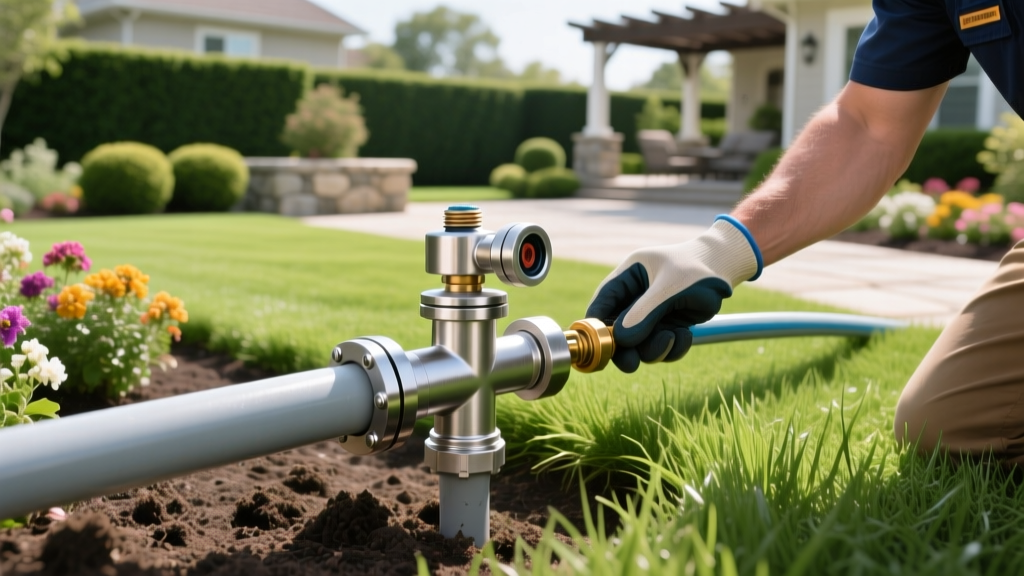
Water Hammer Arrestor for Sprinkler System: Sizing and Install Guide
The Mechanics of Hydraulic Shock in Irrigation
When an automatic sprinkler valve snaps shut, the sudden halt of moving water creates a high-pressure shockwave known as hydraulic shock, or water hammer. In residential irrigation systems, this pressure spike can exceed 400 PSI for a fraction of a second—far beyond the 150 PSI rating of standard Schedule 40 PVC pipes and brass valves. The resulting loud banging noise is the physical manifestation of pipes vibrating against joists or soil, but the unseen damage includes cracked valve diaphragms, fractured PVC fittings, and premature solenoid failure.
A water hammer arrestor for sprinkler system applications acts as a pneumatic shock absorber. It contains a sealed chamber of air or gas separated from the water by a piston or diaphragm. When the valve closes and the shockwave travels back through the mainline, the water is forced into the arrestor, compressing the gas cushion and safely dissipating the kinetic energy.
The Joukowsky Equation
The magnitude of the pressure spike is calculated using the Joukowsky equation: ΔP = ρ × c × ΔV. Where ΔP is the pressure increase, ρ is water density, c is the speed of sound in the pipe material (approx. 1,480 m/s in water, but lower in PVC), and ΔV is the change in fluid velocity. Because modern irrigation valves close in under 0.5 seconds, ΔV approaches the full flow velocity instantaneously, maximizing the shockwave. According to the American Water Works Association (AWWA), keeping pipeline velocity below 5 feet per second is critical to minimizing this baseline shock.
Arrestor Technologies: Piston vs. Diaphragm vs. Air Chamber
Not all arrestors are engineered for the high-cycle, outdoor environment of an irrigation system. Selecting the correct internal mechanism dictates the lifespan of the unit.
| Type | Mechanism | Lifespan | Best Application | Drawbacks |
|---|---|---|---|---|
| Sealed Piston | Stainless steel piston sliding on EPDM O-rings within a copper/brass cylinder. | 15-20+ years | Mainline sprinkler manifolds, high-pressure systems (80+ PSI). | Higher upfront cost; must be installed vertically or horizontally depending on model. |
| Diaphragm | Flexible rubber diaphragm separating water from a nitrogen charge. | 7-10 years | Tight valve boxes, commercial rotors with high flow rates. | Diatphragm can degrade or rupture over time if exposed to UV or extreme heat. |
| Air Chamber (Stub) | Simple vertical pipe extension trapping ambient air. | 1-3 years | Temporary fixes, low-pressure drip irrigation. | Air dissolves into water (waterlogging), requiring frequent draining to recharge. |
For 90% of residential and commercial sprinkler systems, a sealed piston arrestor is the mandatory choice. The Irrigation Association guidelines emphasize that permanent, maintenance-free shock absorption is required for automated zones that cycle multiple times daily.
Sizing Framework: Matching Flow Rates to Arrestor Volume
Undersizing an arrestor is the most common installation error. If the gas volume is too small, the piston bottoms out, and the shockwave reflects back into the pipe. Sizing is dictated by the total flow rate (Gallons Per Minute - GPM) of the zone and the pipe diameter.
Standard Sizing Matrix for Sprinkler Manifolds
| Zone Flow Rate (GPM) | Pipe Diameter | Required Arrestor Size | Typical Model Equivalent |
|---|---|---|---|
| 1 - 4 GPM | 1/2" or 3/4" | Size A (Mini) | Sioux Chief 525-G0 |
| 5 - 10 GPM | 3/4" or 1" | Size B (Standard) | Watts LF150A / Sioux Chief 525-G1 |
| 11 - 20 GPM | 1" or 1.25" | Size C (Large) | Oatey 690-L / Watts LF150B |
| 21 - 40 GPM | 1.5"+ | Size D (Commercial) | Custom flanged manifold arrestors |
Pro Tip: Always calculate the GPM based on the largest zone on the manifold, not the average. If Zone 3 pulls 12 GPM through a 1-inch mainline, you must install a Size C arrestor on the mainline feed before the manifold splits into individual valves.
Step-by-Step Installation Protocol
Proper placement is just as critical as sizing. The arrestor must be located as close to the quick-closing valve as physically possible to intercept the shockwave before it accelerates through the piping network.
- Locate the Point of Origin: Identify the mainline feed entering the sprinkler valve manifold. The arrestor should be installed on the mainline, within 18 inches of the first valve.
- Shut Down and Depressurize: Close the main irrigation shut-off valve. Open a manual drain or activate a zone briefly to bleed residual pressure to zero.
- Cut and Prep the Pipe: Cut a section of the PVC or copper mainline. Deburr PVC edges with a reaming tool to prevent O-ring damage on the arrestor's slip fittings.
- Install a T-Fitting: Solvent-weld (for PVC) or solder (for copper) a T-fitting into the mainline. The branch of the T should point upward or horizontally. Never point the arrestor downward, as sediment accumulation will foul the piston.
- Thread the Arrestor: Wrap the male threads of the arrestor with 3 layers of PTFE tape, followed by a coat of pipe dope. Thread it into a brass drop-ear fitting or a threaded PVC adapter attached to the T-branch. Tighten to 35 ft-lbs using a wrench.
- Secure the Piping: Hydraulic shock causes violent lateral movement. Install heavy-duty pipe straps or hangers within 24 inches of the arrestor to anchor the manifold to a structural joist or concrete pad.
Troubleshooting Persistent Water Hammer
If you have installed a correctly sized piston arrestor and the pipes are still banging, the root cause lies elsewhere in the hydraulic profile.
Warning: Static Pressure Overload
Water hammer arrestors are rated for a maximum working pressure (typically 150 PSI). If your municipal water supply delivers static pressure exceeding 80 PSI at night, the arrestor's internal gas charge is pre-compressed, leaving zero volume to absorb the shockwave. You must install a Pressure Reducing Valve (PRV) upstream of the irrigation backflow preventer to cap static pressure at 65-75 PSI.
Diagnostic Checklist for Lingering Shock
- Check Valve Closure Speed: Some commercial anti-siphon valves feature flow-control screws. If opened too far, they snap shut violently. Adjust the flow control stem to restrict flow slightly, softening the closure rate.
- Inspect for Loose Hangers: If the shock is absorbed but the pipe still rattles, the kinetic energy is transferring to loose structural mounts. Add foam pipe insulation at joist penetrations to dampen acoustic vibration.
- Verify Arrestor Orientation: Consult the manufacturer's spec sheet. While most modern piston arrestors are omnidirectional, older diaphragm models require strict vertical installation to prevent air-pocket migration.
2026 Market Pricing and Top Brand Recommendations
When sourcing components for your sprinkler system, avoid unbranded import models lacking ASSE 1010 certification. Certified units undergo rigorous cycle testing to ensure the pneumatic charge does not leak over time.
- Sioux Chief 525 Series (G0 to G2): The industry gold standard for residential manifolds. Machined from solid brass with a stainless steel piston. Pricing ranges from $32 for the 1/2" mini to $58 for the 1" standard model.
- Watts LF150A (Lead-Free): Excellent for systems tied directly to potable water lines where lead-free certification is legally mandated by local plumbing codes. Retails around $45 to $65 depending on the thread size.
- Oatey 690 Series: A highly accessible, budget-friendly option available at most big-box retailers. Best suited for low-flow drip irrigation zones. Priced between $22 and $38.
Investing $40 to $80 in a high-quality, correctly sized water hammer arrestor for sprinkler system infrastructure prevents thousands of dollars in catastrophic pipe bursts, flooded landscapes, and premature valve replacements. By understanding the physics of hydraulic shock and adhering to strict placement protocols, you ensure your irrigation network operates silently and reliably for decades.