
Lawn Care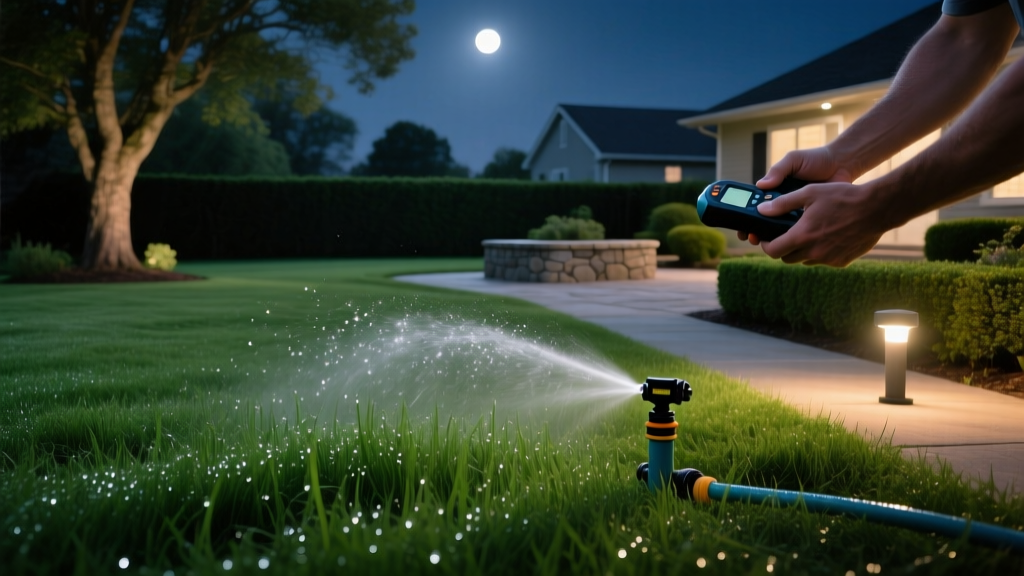
Watering Lawn at Night: Risks, Myths, and Best Irrigation Practices
The debate over watering lawn at night sits at the intersection of water conservation and turfgrass pathology. Homeowners are often told to water after dark to prevent evaporation, yet agronomists warn that nocturnal irrigation is a primary catalyst for devastating fungal outbreaks. The truth is not a simple binary; it requires understanding leaf wetness duration, soil infiltration rates, and microclimate dynamics.
This guide dismantles the myths surrounding nighttime irrigation, providing a science-backed framework for scheduling your sprinkler system to maximize root hydration while minimizing pathogen exposure.
The Pathogen Window: Why Nighttime Moisture Breeds Fungus
To understand why watering late at night is risky, you must understand Leaf Wetness Duration (LWD). Fungal pathogens like Sclerotinia homoeocarpa (Dollar Spot) and Rhizoctonia solani (Brown Patch) require a continuous film of water on the grass blade to germinate and infect plant tissue.
⚠️ The Infection Threshold: Most common turfgrass fungi require 10 to 14 hours of continuous leaf wetness to successfully penetrate the grass cuticle. If your grass remains wet beyond this window, infection is almost guaranteed under favorable temperatures (75°F–85°F).
When you water your lawn at 9:00 PM, the grass blades remain wet through the night and into the next morning until the sun dries them around 10:00 AM. This creates a 13-hour LWD, directly triggering the infection threshold for Brown Patch and Dollar Spot. Conversely, watering at 4:00 AM means the grass is wet for only 4 to 5 hours before the morning sun and rising temperatures dry the foliage, effectively closing the pathogen window.
The Evaporation Myth: Do You Really Save Water at Night?
The primary argument for watering lawn at night is water conservation. The logic dictates that cooler nighttime temperatures and lower solar radiation reduce evaporative loss. While true that evaporation is lower at midnight than at noon, the difference between midnight and early morning is statistically negligible for most residential lawns.
According to research from Texas A&M AgriLife Extension, wind drift is a far more significant factor in water waste than evaporation. Wind speeds typically drop to their lowest points between 3:00 AM and 6:00 AM. Watering during this window ensures that water droplets reach the soil rather than being blown onto driveways or sidewalks, providing the best balance of low evaporation, low wind drift, and minimal fungal risk.
Irrigation Timing Matrix: Risk vs. Reward
| Time Window | Evaporation Rate | Wind Drift Risk | Fungal Infection Risk | Verdict |
|---|---|---|---|---|
| 8:00 PM - 11:00 PM | Very Low | Low | EXTREME (12+ hrs LWD) | Avoid Completely |
| 11:00 PM - 3:00 AM | Very Low | Very Low | HIGH (8-11 hrs LWD) | Not Recommended |
| 4:00 AM - 6:00 AM | Low | Very Low | LOW (3-5 hrs LWD) | OPTIMAL |
| 10:00 AM - 2:00 PM | Very High | High | Very Low | Wasteful |
| 5:00 PM - 7:00 PM | Moderate | Moderate | MODERATE (Evening dew adds to LWD) | Secondary Option |
Smart Controller Scheduling and Soil Infiltration
Setting a start time of 4:00 AM is only half the battle. The duration and cycling of your irrigation zones dictate whether water reaches the root zone or runs off into the storm drain. This is where modern smart controllers like the Rachio 3 or Hunter Hydrawise Pro-HC outperform legacy dial timers.
According to University of Minnesota Extension, turfgrass generally requires 1 to 1.5 inches of water per week during peak summer heat. However, applying 1 inch of water in a single cycle is disastrous for heavy clay soils.
The 'Cycle and Soak' Framework for Clay Soils
Heavy clay and clay-loam soils have a maximum infiltration rate of approximately 0.2 to 0.4 inches per hour. If your sprinkler heads output 1.5 inches per hour (common with standard fixed-spray nozzles), the soil becomes saturated in 15 minutes. Any water applied after that point becomes surface runoff.
💡 Pro-Tip: Program Your Cycle and Soak
If your zone requires 30 minutes of total run time to deliver 0.75 inches of water, do not run a single 30-minute cycle. Instead, program your smart controller for:
If your zone requires 30 minutes of total run time to deliver 0.75 inches of water, do not run a single 30-minute cycle. Instead, program your smart controller for:
- Cycle 1: 10 minutes run time
- Soak 1: 45 minutes delay (allows water to percolate)
- Cycle 2: 10 minutes run time
- Soak 2: 45 minutes delay
- Cycle 3: 10 minutes run time
Upgrading to Rotary Nozzles (like the Hunter MP Rotator or Toro Precision) is another critical intervention. These nozzles reduce the precipitation rate to roughly 0.4 inches per hour, matching the infiltration rate of most soils and often eliminating the need for complex cycle-and-soak programming.
Exceptions to the Rule: When Night Watering is Unavoidable
While the 4:00 AM to 6:00 AM window is the agronomic gold standard for established lawns, there are specific scenarios where watering lawn at night—or multiple times throughout the day—is strictly necessary.
- New Sod Installation: Unrooted sod has zero access to soil moisture and will desiccate within hours in summer heat. New sod requires 10-15 minutes of watering 3 to 4 times a day (including late evening) for the first two weeks to keep the root zone interface constantly moist until knit occurs.
- Hydroseeding: Seed germination requires constant surface moisture. Light, frequent watering throughout the day and early evening is required to prevent the mulch matrix from drying out and pulling moisture from the germinating seed.
- Extreme Heat Mitigation (Syringing): During anomalous heat waves exceeding 100°F, cool-season grasses like Kentucky Bluegrass can suffer from localized dry spot and crown desiccation. A 3-minute 'syringing' cycle at 2:00 PM can cool the canopy via evaporation, though this is a temperature-management tactic, not a deep-watering strategy.
Frequently Asked Questions
Will watering my lawn at night kill it?
Watering at night will not kill the grass directly, but it creates an environment highly conducive to fungal diseases like Brown Patch and Pythium Blight. Over a single season, chronic nighttime watering can lead to severe turf loss that requires expensive fungicide treatments (costing $150–$300 per application for professional services) or total lawn renovation.
Does watering at night attract pests?
Yes. Consistently wet soil and thatch layers attract moisture-loving pests such as earwigs, slugs, and certain species of mosquitoes. Furthermore, overly moist soil conditions encourage the proliferation of earthworms near the surface at night, which can attract foraging wildlife like raccoons and skunks that will tear up your lawn searching for grubs and worms.
How do I know if my lawn is suffering from nighttime watering damage?
Look for circular, tan-colored lesions on the grass blades with distinct dark brown borders (Brown Patch), or small, silver-dollar-sized straw-colored spots (Dollar Spot). You may also notice a white, cobweb-like mycelium on the grass blades in the early morning before the sun burns it off. If you observe these signs, immediately shift your irrigation schedule to 4:00 AM and consider applying a preventative fungicide containing Azoxystrobin or Propiconazole.