
Lawn Care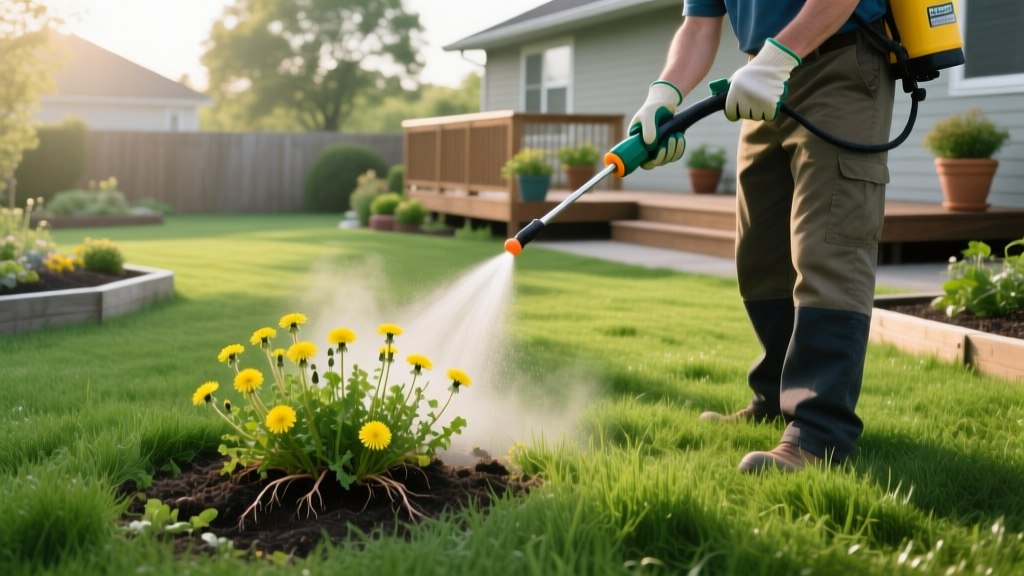
Targeted Weed and Feed Directions for Spot-Treating Stubborn Weeds
Broadcasting granular weed and feed across an entire lawn is a blunt instrument approach that often results in fertilizer burn, chemical runoff, and incomplete weed eradication. While standard weed and feed directions on 36-pound bags instruct homeowners to apply the product uniformly over thousands of square feet, turfgrass professionals rarely use this method for localized infestations. Instead, they decode the active ingredients listed on the granular bag and transition to targeted liquid spot-treatments.
This guide bridges the gap between granular product labels and precise liquid spot-treatment protocols, providing exact mixing ratios, nozzle specifications, and species-specific application strategies to eradicate stubborn weeds without overloading your soil with unnecessary nitrogen.
The Inefficiency of Broadcast Granular Applications
Most commercial granular weed and feed products, such as Scotts Turf Builder Weed & Feed 3, rely on a combination of fast-release nitrogen (often urea or ammonium sulfate) and broadleaf herbicides (2,4-D, Quinclorac, and Dicamba). The fundamental flaw in broadcast application is the delivery mechanism. Granular herbicides require physical contact with wet weed leaves to adhere and initiate systemic absorption. If applied to dry grass, the granules bounce off the target weed and hit the soil, where they are largely ineffective against mature broadleaf species.
💡 The Wet Leaf Mandate vs. Liquid Efficacy: Standard granular weed and feed directions dictate application to wet grass so granules stick to foliage. Spot-treating with liquid herbicides bypasses this requirement entirely. Liquid formulations utilize surfactants to break surface tension, ensuring immediate stomatal penetration regardless of morning dew.
Translating Granular Labels to Liquid Spot-Treatments
To effectively spot-treat, you must identify the active ingredients in your preferred granular weed and feed and purchase their liquid concentrate equivalents. According to Penn State Extension, matching the active ingredient to the specific weed species is the single most critical factor in herbicide efficacy.
| Target Weed Species | Primary Active Ingredient | Liquid Spot-Treatment Rate (per Gallon) | Optimal Temperature Range |
|---|---|---|---|
| Dandelion, Plantain | 2,4-D Amine | 1.5 fl oz | 60°F - 80°F |
| White Clover, Chickweed | Dicamba + MCPP | 2.0 fl oz (3-way mix) | 65°F - 85°F |
| Creeping Charlie (Ground Ivy) | Triclopyr | 1.0 fl oz | 55°F - 75°F |
| Crabgrass (Grassy Weed) | Quinclorac | 1.45 fl oz | 60°F - 85°F |
Species-Specific Spot-Treatment Protocols
Dandelion (Taraxacum officinale) & Broadleaf Plantain
Dandelions possess a deep, brittle taproot that can extend 10 to 15 inches into compacted soil. If the crown is not completely destroyed, the weed will regenerate within 14 days. While granular 2,4-D often fails to coat the narrow, jagged leaves sufficiently, a liquid spot-treatment using a 2,4-D amine concentrate (such as Amine 400) ensures complete foliar coverage.
- Mixing Ratio: 1.5 fl oz of 2,4-D amine per 1 gallon of water.
- Surfactant: Add 0.5 teaspoons of a non-ionic surfactant (NIS) to break the leaf's waxy cuticle.
- Application Technique: Use a flat-fan nozzle to spray the center rosette until the leaves are uniformly wet, but not dripping. Avoid soil drenching, as 2,4-D is primarily a foliar-absorbed systemic herbicide.
White Clover & Creeping Charlie (Ground Ivy)
Clover and Creeping Charlie are notoriously resistant to single-active-ingredient treatments. Creeping Charlie spreads via stolons and possesses a thick, hairy leaf surface that repels standard aqueous solutions. Purdue University Turfgrass Science notes that Triclopyr is vastly superior to 2,4-D for controlling ground ivy, particularly when applied in the fall when the plant is actively storing carbohydrates in its roots.
- Mixing Ratio: 1.0 fl oz Triclopyr + 1.0 fl oz Dicamba per 1 gallon of water.
- Timing: Apply during the fall transition (late September to early October) when soil temperatures drop below 70°F. Spring applications often result in top-growth burn without root kill.
- Mowing Restriction: Do not mow for 48 hours before or 48 hours after application to maximize leaf surface area and allow adequate translocation time.
Yellow Nutsedge (Cyperus esculentus)
Nutsedge is a sedge, not a broadleaf weed or a true grass. Standard weed and feed formulations containing 2,4-D or Dicamba will have zero effect on it. Attempting to use broadleaf herbicides on nutsedge is a common homeowner error that wastes time and chemicals.
- Required Active Ingredient: Sulfentrazone or Halosulfuron-methyl (e.g., Ortho Nutsedge Killer for Lawns or SedgeHammer).
- Spot-Treatment Rate: Follow the specific liquid concentrate label, typically 0.5 to 1.0 oz per gallon depending on the concentrate strength.
- Visual Cue: Treat when the nutsedge is in the 3-to-5 leaf stage (early summer). If the plant has developed mature, purple-tinged seed heads, systemic translocation is severely reduced, and a second application 21 days later will be mandatory.
Equipment Calibration and Mixing Mathematics
Reading the weed and feed directions is only half the battle; delivering the correct dose requires calibrated equipment. A standard 2-gallon Chapin pump sprayer is ideal for residential spot-treatments, but it must be fitted with the correct nozzle.
- Nozzle Selection: Replace the standard cone-spray nozzle with a TeeJet 8002VS flat-fan nozzle. Cone nozzles create fine droplets that are highly susceptible to wind drift, potentially damaging ornamental shrubs and vegetable gardens.
- Pressure Control: Pump the sprayer to exactly 20 to 25 PSI. Higher pressures atomize the liquid into a mist, increasing the risk of inhalation and off-target drift.
- Dye Indicators: Add 1/4 teaspoon of liquid blue turf marker dye to your tank mix. This provides a visual record of exactly which weeds have been treated, preventing accidental double-application which can cause localized turf phytotoxicity.
Temperature Inversions and Volatilization Risks
One of the most critical, yet frequently ignored, warnings in professional herbicide manuals involves temperature inversions and chemical volatilization. Dicamba, a common ingredient in 3-way broadleaf herbicides, is highly volatile. When ambient air temperatures exceed 85°F, Dicamba can vaporize off the target weed leaf and drift as a gas, causing severe cupping and epinasty (twisted growth) in non-target broadleaf plants, including neighbor's tomato gardens and ornamental trees.
⚠️ Volatilization Warning: Never apply Dicamba-based liquid spot-treatments when temperatures are above 85°F, or if temperatures are expected to exceed 85°F within 24 hours of application. Furthermore, avoid spraying during early morning temperature inversions (characterized by still air and heavy dew), as the chemical can become trapped in the low-level air mass and drift laterally across the property.
The EPA Pesticide Labeling Guidelines strictly mandate that applicators follow all environmental hazards listed on the product label. By shifting from broadcast granular applications to precise liquid spot-treatments, you not only save money and protect your soil's microbial ecosystem, but you also drastically reduce the total volume of active ingredients introduced into your local watershed.
Frequently Asked Questions
Can I mix liquid herbicide with liquid fertilizer for a spot-treatment?
It is generally discouraged. Liquid fertilizers (especially those high in nitrogen) can cause rapid foliar burn when combined with systemic herbicides, effectively scorching the weed leaf before the herbicide has time to translocate down to the root system. Keep herbicide and fertilizer applications separated by at least 7 to 10 days.
How long does it take to see results from a liquid spot-treatment?
With proper surfactant use and optimal temperatures (65°F - 80°F), you should observe leaf curling and chlorosis (yellowing) within 48 to 72 hours. Complete root death and plant collapse typically take 14 to 21 days. Avoid the urge to pull the weeds manually during this window, as removing the foliage halts the systemic movement of the chemical.

