
Lawn Care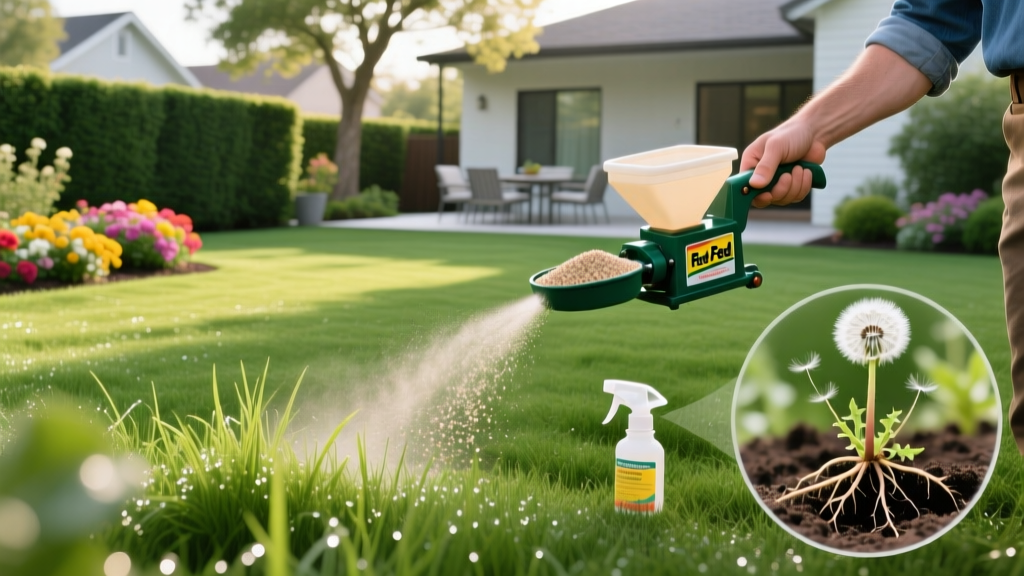
Weed and Feed Fertilizer vs Spot Treatment: A Species Guide
Homeowners frequently purchase bags of granular weed and feed fertilizer to tackle isolated weed outbreaks, only to find the target weeds thriving weeks later. The fundamental disconnect lies in application methodology and herbicide chemistry. Broadcast weed and feed products are engineered for uniform, preventative lawn coverage, not for the aggressive eradication of mature, deep-rooted weed species. When you are dealing with localized infestations of dandelion, white clover, or crabgrass, relying on a blanket weed and feed fertilizer is both economically inefficient and ecologically excessive.
The Broadcast Trap: Why Granular Weed and Feed Misses the Mark
Standard granular weed and feed fertilizer combines fast-release nitrogen (often urea or ammonium sulfate) with broadleaf herbicides like 2,4-D, Dicamba, and MCPP. For the herbicide component to work, the granules must physically adhere to the moist, broad leaves of the target weed and remain there long enough for systemic translocation to occur.
This mechanism creates three critical failure points for spot-treatment scenarios:
- Adhesion Failure: Mature weeds with waxy cuticles (like white clover) or narrow leaf surfaces (like grassy weeds) easily shed granular herbicides, especially if the lawn is dry or windy during application.
- Dosage Inadequacy: A single broadcast application delivers a micro-dose of active ingredient per square foot. A mature dandelion with a 10-inch taproot requires a concentrated, systemic liquid dose to kill the root crown; granular broadcast rates simply do not deliver enough active ingredient to the localized foliage.
- Chemical Limitations: The herbicides in typical weed and feed fertilizer formulations are strictly for broadleaf weeds. They possess zero efficacy against grassy weeds like crabgrass or nutsedge, meaning you are applying unnecessary nitrogen and chemicals to areas where they will not solve the problem.
According to turfgrass researchers at the University of Minnesota Extension, liquid spot-treatments utilizing targeted active ingredients consistently achieve over 90% control of stubborn broadleaf weeds, whereas granular broadcast applications often require multiple re-applications and still fail to eliminate mature taproots.
Weed Species Matrix: Spot-Treatment vs. Broadcast Efficacy
Before selecting a treatment protocol, identify the specific weed species and its growth habit. The following matrix dictates whether a broadcast weed and feed fertilizer is viable or if a dedicated liquid spot-treatment is mandatory.
| Weed Species | Growth Habit | Granular Weed & Feed Efficacy | Optimal Spot-Treatment Chemistry | Surfactant Required? |
|---|---|---|---|---|
| Dandelion | Deep Taproot | Poor (Fails on mature roots) | FeHEDTA (Chelated Iron) or 2,4-D Amine | No |
| White Clover | Stolon Runner | Moderate (Requires wet foliage) | Triclopyr + 2,4-D + Dicamba (3-Way) | Yes (NIS) |
| Crabgrass | Grassy Annual | Zero Efficacy | Quinclorac (Post) or Prodiamine (Pre) | Yes (MSO or NIS) |
| Plantain | Fibrous Rosette | Moderate to Good | Triclopyr + 2,4-D | Yes (NIS) |
Targeted Spot-Treatment Protocols for Stubborn Species
Transitioning from a broadcast weed and feed fertilizer to a liquid spot-treatment regimen requires precise mixing, proper surfactant use, and strict adherence to environmental thresholds. Below are the exact protocols for the three most problematic lawn weeds.
Dandelion (Taraxacum officinale): The Taproot Challenge
Dandelions store massive energy reserves in their taproots. If the top growth is burned off without killing the root crown, the weed will regenerate within 14 days. While standard weed and feed fertilizer granules bounce off the narrow, angled leaves of a mature dandelion, liquid systemic herbicides coat the foliage and translocate downward.
Pro-Tip: Temperature Thresholds
If applying synthetic 2,4-D, ensure daytime temperatures are between 60°F and 85°F. Above 85°F, synthetic herbicides can volatilize (turn into a gas) and drift onto nearby ornamental plants, causing severe twisting and damage. For high-heat spot treatments, switch to FeHEDTA (Chelated Iron), which is safe up to 90°F and causes rapid cell membrane disruption in broadleaf weeds without harming surrounding turf.
If applying synthetic 2,4-D, ensure daytime temperatures are between 60°F and 85°F. Above 85°F, synthetic herbicides can volatilize (turn into a gas) and drift onto nearby ornamental plants, causing severe twisting and damage. For high-heat spot treatments, switch to FeHEDTA (Chelated Iron), which is safe up to 90°F and causes rapid cell membrane disruption in broadleaf weeds without harming surrounding turf.
Mixing Protocol: Combine 1.5 ounces of 2,4-D Amine 4 per gallon of water. Spray the dandelion until the leaves are visibly wet but not dripping (the 'glistening' stage). Expect curling of the leaves within 24 hours and total root necrosis in 10 to 14 days.
White Clover (Trifolium repens): The Waxy Stolon
White clover spreads via above-ground stolons and features a highly waxy leaf cuticle that repels water-based herbicides. This is why granular weed and feed fertilizer applications frequently wash right off clover during the next rainstorm or irrigation cycle.
To penetrate the cuticle, you must use a 3-way herbicide blend (Triclopyr, 2,4-D, and Dicamba) combined with a Non-Ionic Surfactant (NIS). Triclopyr is the critical ingredient here; standard 2,4-D alone struggles to control clover. The NC State Extension specifically highlights Triclopyr's superior efficacy against leguminous weeds like clover and ground ivy.
Mixing Protocol: Mix 1.5 ounces of a commercial 3-way herbicide concentrate with 1/2 teaspoon (0.25% v/v) of NIS per gallon of water. The surfactant breaks the surface tension, allowing the chemical to spread evenly across the waxy clover leaf rather than beading up and rolling off.
Crabgrass (Digitaria sanguinalis): The Grassy Invader
Crabgrass is a monocot, just like your desirable turfgrass. Broadleaf herbicides found in standard weed and feed fertilizer products will not harm it. Attempting to spot-treat crabgrass with broadleaf chemicals is a waste of time and money.
Post-Emergent Protocol: For active crabgrass tillering in early summer, use Quinclorac (e.g., Drive XLR8). Mix at a rate of 0.73 ounces per gallon of water. Quinclorac mimics plant growth hormones, causing the crabgrass to grow itself to death. Note that Quinclorac can cause temporary yellowing in certain turf species, particularly St. Augustine and Centipede grass; always verify turf tolerance on the product label.
The 'Feed' Component: Calculating Spot-Fertilization Needs
If you abandon the blanket application of weed and feed fertilizer in favor of targeted liquid herbicides, you must address the 'feed' component separately to maintain turf density. A dense, vigorously growing lawn is the ultimate biological weed barrier.
Rather than guessing your lawn's nutritional needs based on a pre-packaged weed and feed bag, execute the following localized feeding strategy:
- Soil Testing: Submit a soil sample to your local university extension. This will reveal exact phosphorus, potassium, and pH deficiencies.
- Standalone Nitrogen Applications: Apply a high-quality, slow-release nitrogen fertilizer (such as a 24-0-6 with 50% sulfur-coated urea or methylene urea). Apply at a rate of 0.75 to 1.0 lbs of actual Nitrogen per 1,000 square feet during the turf's peak growing season (early fall for cool-season grasses; late spring for warm-season grasses).
- Organic Spot-Feeding: For isolated thin patches where weeds were recently eradicated, apply Milorganite (5-4-0) at 36 lbs per 2,500 sq ft. The high iron content promotes rapid greening, and the slow-release organic nitrogen will not burn the recovering turf or stimulate immediate weed seed germination.
Frequently Asked Questions
Can I mix liquid spot-treatment herbicide with liquid fertilizer in the same tank?
While technically possible, it is highly discouraged for spot-treatments. Mixing liquid nitrogen (like UAN 28%) with systemic herbicides can cause rapid foliar burn, which destroys the weed's leaf tissue before the herbicide has time to translocate down to the root system. Keep your herbicide and fertilizer applications separated by at least 7 to 10 days.
How long after spot-treating weeds can I apply a standard granular weed and feed fertilizer?
Wait a minimum of 14 days after applying a liquid spot-treatment before applying any granular weed and feed fertilizer. The initial liquid application needs time to fully translocate and kill the root system. Applying a high-nitrogen granular product too soon can stimulate the stressed, dying weed to push out new growth, effectively counteracting the herbicide's systemic action.
Is chelated iron (FeHEDTA) safer than synthetic weed and feed herbicides?
Yes, from an environmental and non-target plant perspective. FeHEDTA (found in products like Fiesta Turf Weeder) specifically targets the metabolic pathways of broadleaf weeds and is highly selective. It does not carry the same volatility risks as 2,4-D ester formulations and breaks down rapidly in the soil, making it an excellent choice for spot-treating weeds near ornamental garden beds where granular weed and feed fertilizer drift is a concern.

