
Lawn Care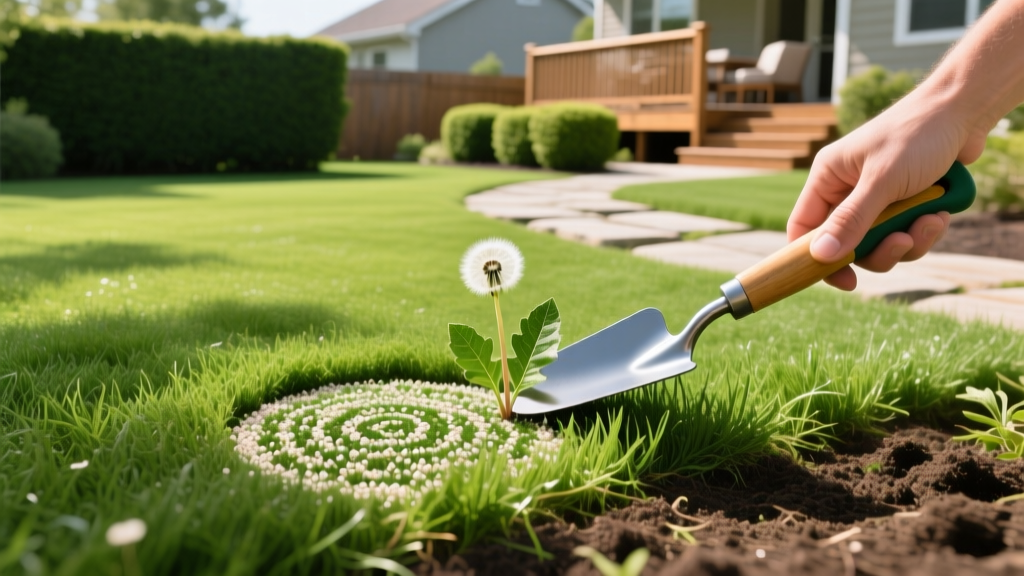
When to Use Weed and Feed on New Grass: Safe Spot-Treatment Guide
The Biological Vulnerability of Seedling Turf
Applying standard broadcast weed and feed on new grass is one of the most common and costly mistakes homeowners make during lawn renovation. Traditional weed and feed products rely on a combination of synthetic fertilizers and systemic broadleaf herbicides—typically a blend of 2,4-D, MCPP, and Dicamba. While highly effective on mature turf, these chemicals act as synthetic auxins (plant growth hormones). When absorbed by immature grass seedlings, they trigger uncontrolled, unsustainable cellular division.
Because seedlings lack the established root mass and carbohydrate reserves of mature grass, this systemic shock rapidly depletes their energy, leading to severe stunting, chlorosis (yellowing), and eventual death. Furthermore, the high-nitrogen fertilizer component in these granular products can cause osmotic burn on tender, newly germinated leaf tissue if the soil is not kept consistently moist.
⚠️ Critical Warning: Never apply standard 2,4-D or Dicamba-based weed and feed products to lawns that have not yet been mowed at least three times. According to Penn State Extension, premature herbicide application is the leading chemical cause of seedling turf failure in residential renovations.
The Safe Timeline: When Can You Apply Weed and Feed?
Timing is dictated by the physiological maturity of the grass plant, not merely the number of days since seeding. Turfgrass experts measure maturity through mowing milestones. Below is the definitive timeline for transitioning from spot-treatments to full broadcast applications.
| Lawn Milestone | Approximate Age | Permitted Weed Control Action |
|---|---|---|
| Germination to 1st Mow | 14–28 Days | Manual hand-pulling only. No chemicals. |
| 1st to 3rd Mow | 30–45 Days | Targeted spot-treatment with seed-safe herbicides (e.g., Mesotrione). |
| 3rd to 4th Mow | 45–60 Days | Post-emergent spot-treatments for specific grassy weeds (e.g., Quinclorac). |
| After 4th Mow (Mature) | 60–90 Days | Safe to apply standard broadcast weed and feed products. |
Spot-Treatment Protocols for Immature Lawns
If weeds emerge during the first 60 days of your lawn's life, you must use targeted spot-treatments. Broadcast applications are entirely off-limits. The following protocols outline the exact chemicals, dilution rates, and target species for safe intervention.
Protocol A: Mesotrione (Tenacity) for Pre/Post-Emergent Control
Mesotrione, commonly sold under the brand name Tenacity, is a rare HPPD-inhibitor herbicide that is explicitly labeled for use at the time of seeding for specific cool-season grasses. It works by inhibiting the HPPD enzyme, which disrupts chlorophyll production in target weeds, causing them to turn stark white and die within 2 to 3 weeks.
- Safe Grasses: Kentucky Bluegrass, Tall Fescue, Fine Fescue, Centipedegrass, and Bermudagrass (only if dormant).
- Unsafe Grasses: Do NOT use on newly seeded Zoysiagrass or active Bermudagrass, as it will cause severe, potentially fatal bleaching.
- Application Rate: Mix 1/2 teaspoon (approx. 2.5 ml) per 1,000 square feet. Use a calibrated 1-gallon pump sprayer for precise spot-treatment of visible broadleaf weeds and crabgrass seedlings.
- Cost: Approximately $65 to $80 for an 8 oz bottle, which treats up to 4 acres, making it highly cost-effective despite the high upfront price.
Protocol B: Quinclorac for Grassy Weed Spot-Treatment
Standard broadleaf herbicides do not kill grassy weeds like crabgrass or foxtail. Quinclorac (found in products like Drive XLR8) is the industry standard for post-emergent crabgrass control. However, its safety on new grass depends heavily on the turf species.
- Safe Grasses: Tall Fescue and Kentucky Bluegrass can tolerate Quinclorac spot-treatments after the second mowing.
- Application Rule: Never broadcast spray. Use a shielded sprayer or a targeted wand to apply Quinclorac strictly to the crabgrass clumps. Add a non-ionic surfactant (0.25% v/v) to ensure the chemical penetrates the waxy cuticle of the crabgrass leaf.
Protocol C: Mechanical and Thermal Extraction
For isolated taproot weeds like dandelions or plantain emerging in a highly vulnerable seedling bed, chemical intervention may carry unnecessary risk. Using a specialized stand-up weeder (like the Fiskars Uproot Weeder, ~$35) allows you to extract the entire taproot without disturbing the surrounding shallow grass roots. Alternatively, careful spot-treatment with a commercial-grade flame weeder can destroy weed tissue instantly, though this requires extreme caution to avoid igniting dry straw mulch often used in seeding beds.
Transitioning to Broadcast Weed and Feed
Once your lawn has passed the 4-mow threshold and the root system has established a firm anchor in the top 4 inches of soil, the turf can metabolize systemic herbicides safely. At this stage, you can transition to a granular weed and feed product.
According to the University of Minnesota Extension, the most effective time to apply a broadcast weed and feed is during active weed growth periods in early fall or late spring. Ensure the grass foliage is slightly damp (from morning dew or light irrigation) so the granular herbicide particles stick to the broadleaf weed surfaces rather than bouncing off into the soil.
Pro Tip for Granular Adhesion: If applying weed and feed to a newly matured lawn, set your spreader to a 50% lower output rate and make two perpendicular passes. This prevents overlapping burn strips, which are highly visible on young, recovering turf.
Edge Cases and Troubleshooting
Even with careful planning, homeowners encounter edge cases when managing weeds in new grass. Here is how to handle the most common anomalies:
- Heavy Nutgrass (Nutsedge) Infestation in Seedlings: Nutsedge thrives in the wet, compacted soil often required for seed germination. Do not use Sulfentrazone on new grass. Instead, manually pull the nutsedge before it produces 5 to 6 leaves (the stage at which it begins forming new nutlets underground). Wait until the lawn is fully mature to apply a dedicated Halosulfuron-methyl treatment.
- Moss Taking Over Shaded Seedbeds: Moss is not a weed; it is an indicator of poor drainage and low pH. Applying weed and feed will not kill moss. Instead, core aerate the area once the new grass is 60 days old and apply pelletized gypsum at a rate of 50 lbs per 1,000 sq ft to improve soil structure and calcium levels without altering pH.
- Herbicide Drift Damage: If a neighbor sprays a volatile ester-based 2,4-D product on a hot day (above 85°F), vapor drift can cause your new grass seedlings to twist and cup. If this occurs, irrigate the lawn heavily immediately to dilute the chemical in the soil profile, and apply a liquid kelp extract (1 oz per 1,000 sq ft) to reduce plant stress and stimulate root recovery.
Mastering weed control in a newly seeded or sodded lawn requires patience and precision. By avoiding premature broadcast applications and utilizing targeted, seed-safe spot-treatments like Mesotrione and mechanical extraction, you protect the long-term viability of your turf. For further reading on turfgrass establishment and chemical safety, consult the resources provided by Purdue University Turfgrass Science and your local cooperative extension office.

