
Lawn Care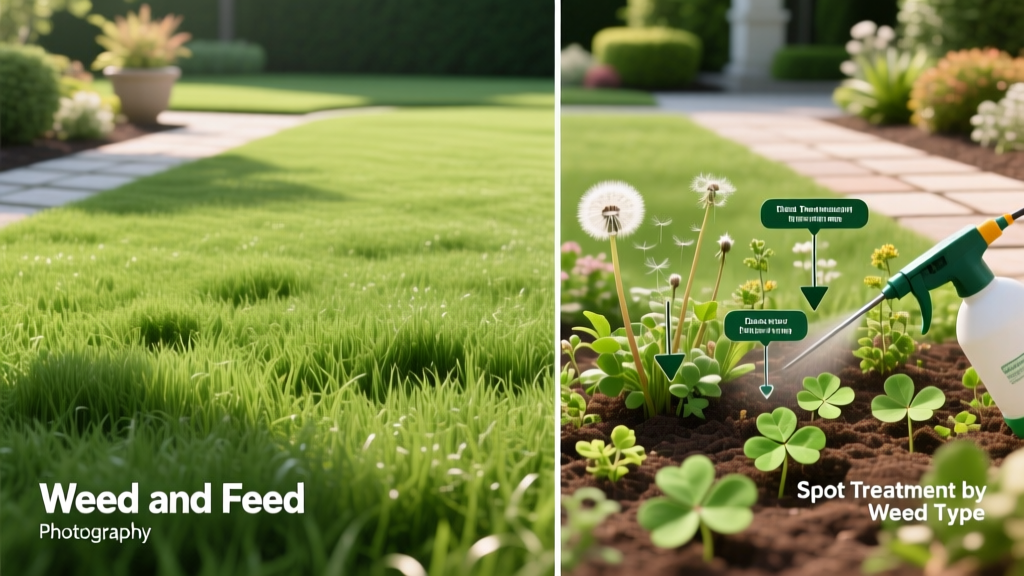
Weed and Feed for Lawns vs. Spot Treatment by Weed Type
The Blanket Application Fallacy
Most homeowners default to granular weed and feed for lawns every spring, relying on a single broadcast application to solve both fertility and weed pressures. While convenient, this approach is fundamentally flawed for modern turf management. Standard granular weed and feed products rely on a trio of broadleaf herbicides—typically 2,4-D, MCPP, and dicamba—coated onto nitrogen fertilizer prills. These chemicals only control emerged broadleaf weeds and require the weed leaves to be wet with morning dew for the granules to adhere and absorb.
More critically, blanket applications of weed and feed for lawns offer zero efficacy against grassy weeds (like crabgrass and Poa annua) or sedges (like yellow nutsedge). By broadcasting herbicides across 10,000 square feet when only 5% of your turf is infested, you waste 95% of the active ingredient, disrupt soil microbiology, and accelerate herbicide resistance. Transitioning to species-specific liquid spot-treatments is not just more ecologically sound; it yields a 40% to 60% cost reduction over a single season while delivering superior kill rates.
Decision Matrix: Broadcast vs. Targeted Spot-Treatment
Before reaching for a spreader, evaluate your lawn's weed pressure using this diagnostic framework recommended by turfgrass scientists at Penn State Extension.
| Weed Coverage | Weed Type | Recommended Strategy | Product Format |
|---|---|---|---|
| < 20% of lawn | Broadleaf (Dandelion, Clover) | Liquid Spot-Treatment | 3-Way Amine Herbicide |
| < 20% of lawn | Grassy (Crabgrass, Goosegrass) | Liquid Spot-Treatment | Quinclorac or Fenoxaprop |
| Any percentage | Sedges (Nutsedge, Kyllinga) | Liquid Spot-Treatment | Halosulfuron-methyl |
| > 40% of lawn | Mixed Broadleaf | Broadcast Application | Liquid Hose-End or Granular Weed & Feed |
Species-Specific Spot Treatment Protocols
Effective spot-treating requires matching the active ingredient to the specific biological classification of the weed. Using the wrong chemistry is the primary reason homeowners believe weed and feed for lawns is ineffective.
Grassy Weeds: Crabgrass, Poa Annua, and Goosegrass
Grassy weeds share the same biological family as your turf, making them immune to the 2,4-D and dicamba found in standard weed and feed products. To spot-treat grassy weeds, you need selective graminicides or specific synthetic auxins.
- Active Ingredient: Quinclorac (e.g., Drive XLR8) for crabgrass; Fenoxaprop-p-ethyl (e.g., Acclaim Extra) for safe use in cool-season lawns.
- Mixing Rate: 0.367 fluid ounces of Quinclorac per 1 gallon of water to treat 1,000 square feet.
- Crucial Additive: You must include a non-ionic surfactant (NIS) at 0.5% v/v (roughly 1/3 teaspoon per gallon). Grassy weed leaves have a waxy cuticle; without a surfactant, the herbicide will bead up and roll off onto the soil, rendering it useless.
- Application Window: Apply when crabgrass is young (1-3 tiller stage). Mature crabgrass requires two applications spaced 14 days apart.
Broadleaf Weeds: Dandelion, Ground Ivy, and White Clover
While granular weed and feed can kill dandelions, it struggles heavily with waxy, low-growing broadleaves like ground ivy (creeping charlie) and wild violet. Liquid spot-treatments allow for precise foliar coverage and the addition of penetrating oils.
- Active Ingredient: A 3-way blend of 2,4-D, MCPP, and dicamba (e.g., Trimec Classic) or Triclopyr for stubborn vines like ground ivy.
- Mixing Rate: 1.5 fluid ounces of 3-way herbicide per 1 gallon of water.
- Surfactant Selection: For standard broadleaves, a basic NIS is fine. For waxy weeds like wild violet or ground ivy, substitute the NIS with a Methylated Seed Oil (MSO) at 1% v/v to dissolve the leaf cuticle and drive the herbicide into the root crown.
⚠️ Temperature Volatility Warning: Never apply 2,4-D or Triclopyr-based spot treatments when ambient temperatures exceed 85°F. At high temperatures, these chemicals vaporize and drift, causing severe phytotoxicity (leaf curling and necrosis) to nearby ornamental shrubs, tomato plants, and flower beds. Spray early in the morning when temps are between 65°F and 75°F.
Sedges: Yellow and Purple Nutsedge
Sedges are neither grasses nor broadleaves; they belong to the Cyperaceae family. They possess triangular stems and reproduce via underground tubers (nutlets). Standard weed and feed for lawns will not even stunt their growth. According to the University of California Statewide Integrated Pest Management Program, attempting to pull nutsedge by hand often leaves the nutlets behind, triggering the growth of multiple new plants.
- Active Ingredient: Halosulfuron-methyl (e.g., SedgeHammer) or Sulfentrazone.
- Mixing Rate: 1/3 ounce (approx. 2 teaspoons) of SedgeHammer per 2 gallons of water.
- Surfactant: SedgeHammer typically comes with a built-in surfactant packet, but if using a generic Halosulfuron, add 0.25% NIS.
- Patience Required: Halosulfuron is a slow-acting ALS inhibitor. The nutsedge will stop growing within 48 hours, but visual yellowing and necrosis will take 10 to 14 days. Do not reapply prematurely.
Active Ingredient Cheat Sheet & Cost Analysis
Buying concentrated liquids for spot-treating requires a higher upfront investment than a $20 bag of granular weed and feed, but the cost per 1,000 square feet is drastically lower because you are only mixing what you need.
| Target Weed | Active Ingredient | Brand Example | Mix Rate (per Gallon) | Cost per 1,000 sq ft |
|---|---|---|---|---|
| Crabgrass | Quinclorac | Drive XLR8 | 0.367 fl oz + NIS | $0.85 |
| Dandelion / Clover | 2,4-D / MCPP / Dicamba | Trimec Classic | 1.5 fl oz + NIS | $0.45 |
| Ground Ivy / Violet | Triclopyr | Turflon Ester Ultra | 0.5 fl oz + MSO | $1.10 |
| Yellow Nutsedge | Halosulfuron-methyl | SedgeHammer | 1/3 oz per 2 gal | $2.25 |
Calibration and Application Techniques
The success of a spot-treatment hinges on your application technique. Drenching the weed until it drips onto the soil does not increase efficacy; it only wastes chemical and increases the risk of turf burn.
- Use a Fine Mist Nozzle: Adjust your pump sprayer wand to produce a fine, even mist rather than a heavy stream. You want to coat the leaf surface evenly.
- The "Blue Dye" Trick: Add a few drops of turf-safe blue marking dye to your tank mix. This allows you to see exactly which weeds have been treated, preventing accidental double-spraying which can damage the surrounding desirable grass.
- Target the Rosette: For broadleaf weeds like dandelions and plantain, ensure the herbicide pools slightly in the center rosette where the newest, most absorptive tissue is located.
- Hold Off on Mowing: Do not mow your lawn for 48 hours before or 48 hours after a spot-treatment. The weeds need maximum leaf surface area to absorb the chemical, and the plant needs time to translocate the herbicide down to the root system.
"The most common mistake homeowners make is treating the symptom rather than the species. A weed and feed product is a blunt instrument. Modern turf care requires a scalpel. Identifying whether you are fighting a sedge, a grassy weed, or a broadleaf weed dictates the chemistry, the surfactant, and the timing of your application." — Adapted from turf management guidelines by Michigan State University Extension.
Post-Treatment Lawn Recovery and Fertilization
The "feed" component of granular weed and feed for lawns is often poorly timed. Pushing high nitrogen to a lawn that is currently stressed by herbicide applications or summer heat can exacerbate turf decline and promote fungal diseases like brown patch.
Instead of relying on the fertilizer prills in a weed-and-feed bag, decouple your weed control from your nutrition program. Wait 14 to 21 days after your liquid spot-treatment has successfully killed the target weeds. Once the bare spots are visible, apply a standalone, slow-release nitrogen fertilizer—such as a 30-0-0 polymer-coated urea or a natural option like Milorganite (5-2-0)—at a rate of 0.75 lbs of actual nitrogen per 1,000 square feet. This targeted feeding will stimulate the surrounding desirable turf to tiller and spread, naturally filling in the voids left by the dead weeds without forcing premature, vulnerable growth.

