
Lawn Care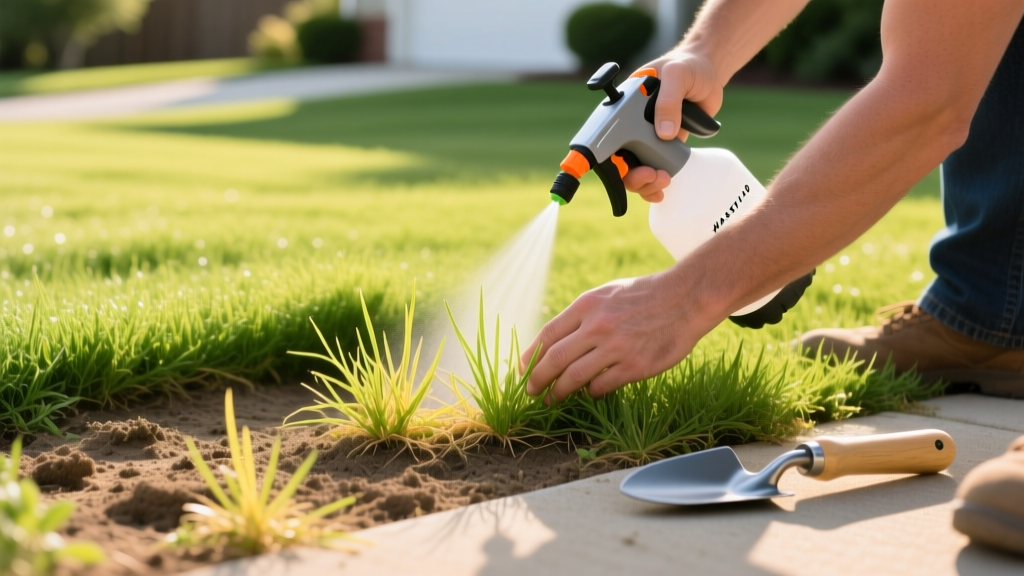
Weed Control: Crabgrass Spot-Treatment and Eradication Guide
Crabgrass (Digitaria species) is an aggressive summer annual that exploits thin, under-fertilized turf. While pre-emergent herbicides are the primary defense, barrier breakdowns, late-spring soil disturbances, and edging work frequently allow crabgrass to breach your lawn by mid-summer. When this happens, broadcast spraying is inefficient and wasteful. Precision spot-treatment targets the invaders without subjecting your entire lawn to unnecessary chemical stress.
This guide details the exact protocols, active ingredients, and surfactant ratios required for effective weed control crabgrass eradication in 2026, moving beyond generic advice to provide actionable, professional-grade application strategies.
Identify Your Enemy: Smooth vs. Hairy Crabgrass
Before mixing any chemicals, confirm the species. The two primary invaders in North American lawns require slightly different management expectations regarding their growth habits and seeding timelines.
| Characteristic | Smooth Crabgrass (D. ischaemum) | Hairy Crabgrass (D. sanguinalis) |
|---|---|---|
| Leaf Sheath | Smooth, no hairs, often purplish-red at the base | Covered in long, distinct hairs |
| Leaf Blade | 1/4 inch wide, smooth or slightly rough | Up to 1/2 inch wide, hairy on both surfaces |
| Growth Habit | Lower growing, roots at nodes, highly branched | Taller, more upright, aggressive lateral spread |
| Seed Head | 2 to 6 finger-like spikes, delicate | 3 to 10 spikes, thicker and stiffer |
The Pre-Emergent Baseline: Why Spot-Treating Requires Context
Spot-treating post-emergent crabgrass is a corrective measure, not a foundational strategy. According to University of Minnesota Extension, crabgrass seeds germinate when soil temperatures at a 1-inch depth reach 55°F to 60°F for consecutive days. If you are spot-treating in July, it means your spring pre-emergent (like Prodiamine or Dithiopyr) either degraded due to excessive rainfall, was applied too late, or was physically broken by aeration or dethatching.
Pro Tip: The Dimension Window
If you use Dithiopyr (Dimension) as your pre-emergent, it offers early post-emergent activity. It can kill crabgrass up to the 1-tiller stage (when the plant has just one main stem and no branches). If your crabgrass is larger than the 1-tiller stage, you must switch to the dedicated post-emergent protocols below.
If you use Dithiopyr (Dimension) as your pre-emergent, it offers early post-emergent activity. It can kill crabgrass up to the 1-tiller stage (when the plant has just one main stem and no branches). If your crabgrass is larger than the 1-tiller stage, you must switch to the dedicated post-emergent protocols below.
Post-Emergent Spot-Treatment Protocols
Successful spot-treatment relies on adhesion, absorption, and environmental timing. Crabgrass leaves possess a thick, waxy cuticle that repels water-based solutions. Follow this exact sequence for maximum kill rates.
- Map the Breakouts: Identify patches exceeding 6 inches in diameter. Isolated single plants can be hand-pulled if the soil is moist, but colonies require chemical intervention.
- Calibrate for Spot Spraying: Use a 1-gallon or 2-gallon pump sprayer. Calibrate it to output roughly 1.5 gallons per 1,000 square feet. Keep pressure low (15–20 PSI) to produce larger droplets and prevent drift onto desirable broadleaf plants.
- Mix the Surfactant First: Fill the sprayer halfway with water. Add your Methylated Seed Oil (MSO) or Non-Ionic Surfactant (NIS) and agitate. Never skip this step.
- Add the Herbicide: Add the precise dose of post-emergent herbicide, then top off with water. Agitate thoroughly.
- Apply to Dry Foliage: Spray the crabgrass until the leaves are visibly wet but not dripping. Avoid watering the lawn for at least 24 hours post-application.
- Delay Mowing: Wait a minimum of 48 hours before mowing to allow the herbicide to translocate down to the root crown.
Active Ingredient Breakdown & Costs
The active ingredient you choose depends entirely on your turfgrass species. Using the wrong chemical will result in severe phytotoxicity (turf death). Below are the industry standards for 2026 residential and prosumer applications.
1. Quinclorac (e.g., Drive XLR8, Quinclorac 75 DF)
Best For: Kentucky Bluegrass, Tall Fescue, Bermudagrass, and Zoysiagrass.
Warning: Highly toxic to St. Augustinegrass and Centipedegrass. Do not use on these warm-season species.
Mix Rate: 0.375 oz to 0.75 oz per gallon of water for spot treatment.
Surfactant Requirement: Mandatory. Use Methylated Seed Oil (MSO) at 1% v/v (1.25 oz per gallon).
Cost: $45–$60 for a 1 lb bag of 75% Dry Flowable (covers multiple acres over time).
2. Mesotrione (e.g., Tenacity)
Best For: Cool-season lawns and St. Augustinegrass (with strict adherence to label rates).
Mechanism: HPPD inhibitor. It blocks chlorophyll production, causing the crabgrass to turn bright white (bleaching) before dying. This visual feedback makes it exceptional for spot-treating, as you can see exactly where you sprayed.
Mix Rate: 0.33 oz (2 teaspoons) per gallon of water.
Surfactant Requirement: Non-Ionic Surfactant (NIS) at 0.25% v/v.
Cost: $65–$80 for a 4 oz bottle.
3. Fenoxaprop-p-ethyl (e.g., Acclaim Extra)
Best For: Cool-season turfgrasses (Fescue, Bluegrass, Ryegrass). Extremely safe on desirable turf.
Mechanism: ACCase inhibitor. Targets grassy weeds specifically without harming broadleaf plants or desirable cool-season grasses.
Mix Rate: 0.4 oz to 0.6 oz per gallon of water.
Surfactant Requirement: Generally includes built-in adjuvants, but adding a crop oil concentrate improves efficacy on mature plants.
Cost: $85–$100 for 2.5 pints.
Troubleshooting: Why Your Spot-Treatment Failed
If your crabgrass turns yellow but recovers, or if your surrounding turf suffers burn, review these common failure modes identified by UC Davis Integrated Pest Management:
- Failure Mode 1: Skipping the Surfactant. Without MSO, water droplets bead up and roll off the waxy crabgrass blade. The herbicide never penetrates the cuticle. Fix: Always add 1.25 oz of MSO per gallon of mixed solution.
- Failure Mode 2: Spraying in High Heat. Applying Quinclorac when air temperatures exceed 85°F causes rapid volatilization (the chemical turns into a gas) and severe burn to your desirable turf. Fix: Spray only in the early morning or late evening when temps are below 80°F.
- Failure Mode 3: Treating Mature, Multi-Tiller Plants. Once crabgrass reaches the 5-tiller stage (usually late August), a single application will only stunt it. Fix: Apply a second treatment 14 to 21 days after the first application to catch the recovery growth.
- Failure Mode 4: Mowing Too Soon. Mowing 12 hours after spraying removes the treated leaf tissue before the chemical translocates to the root crown. Fix: Enforce a strict 48-hour no-mow window.
Frequently Asked Questions
Can I use MSMA for residential crabgrass spot-treatment?
No. MSMA (Monosodium methanearsonate) has been heavily restricted by the EPA and is no longer legally available for residential lawn use due to arsenic toxicity and groundwater concerns. Stick to Quinclorac, Mesotrione, or Fenoxaprop-p-ethyl for safe, legal, and effective results.
Will pulling crabgrass by hand spread the seeds?
If the crabgrass has already developed seed heads (the finger-like spikes at the top of the stems), pulling it can shake thousands of seeds into your soil profile. If seed heads are present, carefully place a plastic bag over the plant before pulling it to contain the seeds. If it is still in the vegetative stage (no seed heads), hand-pulling is highly effective and safe.
How soon can I overseed after spot-treating crabgrass?
This depends on the herbicide. Quinclorac has a long residual soil activity and can prevent desirable grass seed from germinating for up to 8 to 12 weeks. If you plan to overseed your lawn in early fall, avoid using Quinclorac in mid-summer. Instead, use Mesotrione (Tenacity), which is safe to use at the time of seeding and will actually protect your new seedlings from broadleaf weeds.
Effective weed control requires matching the chemistry to the weed's growth stage and your specific turfgrass species. By utilizing the correct surfactant, adhering to temperature limits, and timing your applications to the plant's biological vulnerabilities, you can eradicate summer breakouts and preserve the density of your lawn heading into the fall season. For more localized timing and turf-specific advice, consult your local cooperative extension office.

