
Lawn Care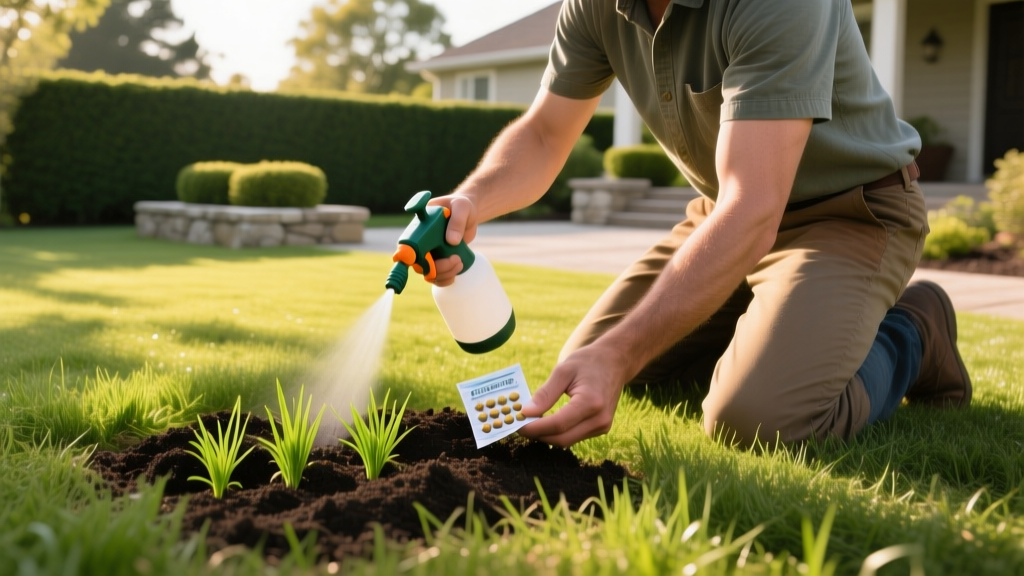
Weed, Feed, and Seed Timing: Spot-Treating Weeds While Seeding
The desire to tackle every lawn problem in a single weekend often leads homeowners to search for a unified weed, feed, and seed solution. However, combining broadleaf weed control, fertilization, and overseeding into a single application window is a fundamental agronomic error. Standard 'weed and feed' products contain active ingredients that are inherently antagonistic to grass seed germination and seedling survival.
To achieve a thick, weed-free lawn, you must understand the chemical conflicts at play and adopt a sequenced approach. This guide details the exact timelines, seed-safe herbicide alternatives, and spot-treatment protocols required to manage weeds without sacrificing your newly planted grass seed.
⚠️ The 4-Week Rule: Never apply standard post-emergent weed and feed within 4 weeks before seeding, or until new grass has been mowed at least 3 to 4 times. Premature application will result in near-total seed failure.
The Chemical Conflict: Why Standard Weed & Feed Kills Grass Seed
Most commercial weed and feed products rely on a combination of synthetic auxins (like 2,4-D, dicamba, and MCPP) for broadleaf control, and pre-emergents (like dithiopyr or pendimethalin) for crabgrass prevention. While highly effective at killing mature weeds, these chemicals disrupt cellular division in germinating grass seeds.
- Post-Emergents (2,4-D, Dicamba): These systemic herbicides are absorbed through the foliage and translocated to the roots. If applied to young grass seedlings that have not yet developed a robust root system or sufficient leaf surface area, the chemicals cause fatal epinasty (uncontrolled, twisted growth) and tissue necrosis.
- Pre-Emergents (Dithiopyr, Pendimethalin): These chemicals create a chemical barrier in the top 1/2 inch of soil that inhibits root initialization. Because grass seed requires root initialization to survive, pre-emergents will kill your lawn seed just as effectively as they kill crabgrass.
According to the University of Minnesota Extension, applying broadleaf herbicides too close to seeding is one of the most common causes of renovation failure in residential turf. The herbicide residues persist in the thatch and soil matrix long after the initial application.
Herbicide Active Ingredients and Seeding Wait Times
Not all weed control chemicals break down at the same rate. Before planning your weed, feed, and seed schedule, identify the active ingredients in your current herbicide inventory and consult the mandatory wait times below.
| Active Ingredient | Common Brand Names | Wait Time Before Seeding | Wait Time After Seedling Mow |
|---|---|---|---|
| 2,4-D / Dicamba / MCPP | Trimec, SpeedZone, Ortho WeedClear | 4 Weeks | 3 Mows |
| Quinclorac | Drive XLR8, Bayer Advanced | 4 to 6 Weeks | 4 Mows |
| Dithiopyr | Dimension | 12 to 16 Weeks | N/A (Pre-emergent) |
| Mesotrione | Tenacity, Scotts Built for Seeding | 0 Weeks (Seed-Safe) | Safe at Emergence |
| Siduron | Tupersan | 0 Weeks (Seed-Safe) | Safe at Emergence |
The Strategic Timeline: Sequencing Weed, Feed, and Seed
Because you cannot safely broadcast standard weed and feed over newly planted grass, you must sequence your lawn care operations. The University of Nebraska-Lincoln Turfgrass Science program recommends aligning these tasks with the natural growth cycles of your specific grass type.
Scenario A: The Fall Renovation (Cool-Season Grasses)
For Tall Fescue, Kentucky Bluegrass, and Perennial Ryegrass, early fall is the optimal seeding window. Your timeline should look like this:
- Mid-August (Weed): Spot-treat or broadcast a standard post-emergent herbicide (like Trimec) to clear out summer broadleaf weeds. This allows 3 to 4 weeks for the chemical to break down.
- Early September (Seed & Feed): Core aerate, spread your grass seed, and apply a high-phosphorus starter fertilizer (e.g., 18-24-12). Do not apply any standard weed control at this stage.
- Late October (Feed): Apply a winterizer fertilizer (high nitrogen, low phosphorus) after the new grass has been mowed 3 times. Weeds can be manually pulled if they emerge.
Scenario B: The Spring Repair (Warm-Season Grasses)
For Bermuda, Zoysia, and Centipede grass, late spring is prime time for seeding or sprigging.
- Early April (Weed & Feed): Apply a pre-emergent and fertilizer to mature areas of the lawn to stop crabgrass. Keep this product strictly away from bare spots designated for seeding.
- Mid-May (Seed): Plant warm-season seed. Because pre-emergents were used nearby, ensure you use seed-safe Mesotrione if broadleaf weeds threaten the bare soil.
Spot-Treatment Alternatives for Seeding Season
If weeds emerge while your grass seed is germinating, you are in a vulnerable window. Broadcasting standard weed and feed will kill your seedlings. Instead, utilize these targeted spot-treatment strategies.
The Seed-Safe Exception: Mesotrione (Tenacity)
Mesotrione is a unique HPPD-inhibitor herbicide that bleaches broadleaf weeds and crabgrass white upon contact but does not harm germinating cool-season grass seed. In fact, it is frequently used as a seed-safe pre-emergent during fall renovations.
- Application Rate: Mix 1/2 to 1 teaspoon of Tenacity concentrate per gallon of water to cover 1,000 square feet.
- Visual Indicator: Add a non-ionic surfactant and blue turf dye to your mix. Weeds will turn stark white within 5 to 7 days, confirming the herbicide is working.
- Cost: An 8 oz bottle of Tenacity costs approximately $65 in 2026 and covers up to 2 acres, making it highly cost-effective for spot-treating renovation zones.
Manual and Thermal Extraction
For isolated, mature weeds popping up in a sea of fragile new seedlings, chemical avoidance is often the safest route. Use a stand-up weeding tool with a serrated claw to extract the taproot without disturbing the surrounding topsoil where grass seed is anchored. Alternatively, targeted thermal weeding (using a propane flame weeder) can desiccate small annual weeds, but keep the flame at least 4 inches away from emerging grass blades to prevent heat stress.
Selecting the Right 'Feed' When Skipping the 'Weed'
When you are in a seeding window, you must drop the 'weed' component and focus entirely on the 'feed'. Standard lawn fertilizers (like a 32-0-10 ratio) are insufficient for seedling establishment because they lack phosphorus, which is critical for root development.
According to Penn State Extension, you must select a dedicated Starter Fertilizer. Look for an N-P-K ratio where the middle number (Phosphorus) is at least 12, such as 18-24-12 or 10-18-10.
💡 Regulatory Note on Phosphorus: Many states (including New York, New Jersey, and Minnesota) legally restrict the use of phosphorus fertilizers to prevent waterway eutrophication. You can legally bypass these restrictions by submitting a soil test to your local cooperative extension proving your soil is deficient in phosphorus. Keep your soil test results on hand when purchasing starter fertilizer at local garden centers.
Troubleshooting Common Timing Mistakes
Q: I already applied a standard weed and feed yesterday, but I need to seed today. What should I do?
A: Do not seed. The herbicide residues are currently bound to the soil organic matter and thatch. Watering heavily will not leach the chemicals deep enough to save the seed. You must wait a minimum of 4 weeks, lightly scarify the top 1/4 inch of soil before planting, and accept a potentially reduced germination rate.
Q: Can I use an iron-based herbicide (FeHEDTA) on new seedlings?
A: Proceed with extreme caution. While FeHEDTA (found in products like Fiesta) is safer for the environment than synthetic auxins, it works via rapid tissue desiccation. If the spray drifts onto newly germinated grass seedlings that lack a mature waxy cuticle, it will burn the grass blades just as severely as it burns the broadleaf weeds. Restrict FeHEDTA to mature turf only.
Q: My pre-emergent (Dimension) was applied in March, but my lawn has bare spots. Can I seed in April?
A: No. Dithiopyr has a long residual soil life. Seeding in April will result in total failure. You must wait until late August or early September to seed, or physically remove the top 2 inches of treated soil in the bare spots, replace it with fresh, untreated topsoil, and then seed.

