
Lawn Care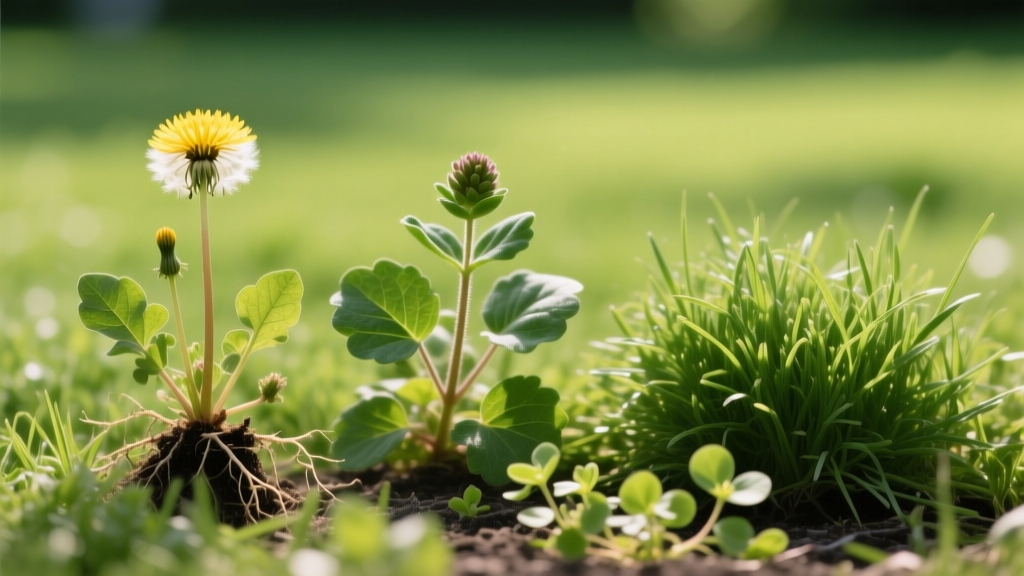
Weed ID Photos: A Visual Guide to Spot-Treating Lawn Weeds
Accurate weed identification is the single most critical step in lawn care before selecting an herbicide. Misidentifying a sedge as a grassy weed, or a mature broadleaf as a winter annual, leads to wasted chemicals, damaged turfgrass, and persistent infestations. Using high-quality weed ID photos to match visual markers against your lawn's invaders allows for precise, targeted spot-treatments that save money and protect your soil health.
This guide breaks down the visual taxonomy of lawn weeds, providing a framework to analyze weed ID photos and immediately deploy the correct active ingredients, mixing ratios, and application protocols for total eradication.
The 3-Point Visual Identification Framework
When comparing a physical weed in your lawn to weed ID photos, amateurs typically only look at the flower or the overall color. Professional turfgrass managers evaluate three specific anatomical zones to confirm the species. Before applying any treatment, ensure your visual inspection covers these three areas:
- The Collar Region (Ligules and Auricles): Pull the leaf blade away from the stem. The collar region is where the blade meets the sheath. Look for a membranous ligule (a thin flap of tissue) or auricles (claw-like appendages). For example, crabgrass has a prominent, toothed membranous ligule, while goosegrass has a folded vernation and a distinct silver-white center stem.
- Leaf Venation and Texture: Broadleaf weeds feature net-like (reticulate) venation, while grassy weeds and sedges have parallel venation. Run your fingers along the blade; grassy weeds like dallisgrass have distinctly rough, serrated edges that catch on skin, whereas smooth brome feels entirely slick.
- Root and Rhizome Structure: Gently pull a sample. Fibrous roots indicate annual grasses (like crabgrass). Taproots indicate broadleaf perennials (like dandelions). If you extract a chain of small, nut-like tubers (nutlets) connected by rhizomes, you are dealing with a sedge.
Critical Warning: Never treat nutsedge with standard grassy weed killers. Sedges belong to the Cyperaceae family, not Poaceae (true grasses). Applying quinclorac or fenoxaprop to nutsedge will fail completely and stress the surrounding turf. Sedges require specific active ingredients like halosulfuron-methyl.
Decoding Weed ID Photos: Broadleaf vs. Grassy vs. Sedge
Use the comparison matrix below to quickly categorize the weed in your photo before moving to the chemical treatment section. This initial triage dictates the class of herbicide you must purchase.
| Weed Category | Visual Markers in Photos | Stem Cross-Section | Common Culprits |
|---|---|---|---|
| Broadleaf | Net-like veins, distinct flower petals, rosette or creeping growth habit | Round or square, solid | Dandelion, White Clover, Broadleaf Plantain, Wild Violet |
| Grassy | Parallel veins, hollow nodes, fibrous root system, no showy flowers | Round, hollow nodes | Crabgrass, Goosegrass, Poa Annua, Dallisgrass |
| Sedge | Parallel veins, glossy yellow-green color, rapid vertical growth, seed heads in umbels | Triangular (solid) | Yellow Nutsedge, Purple Nutsedge, Kyllinga |
According to turfgrass researchers at Purdue University Turfgrass Science, correct identification at the seedling stage via visual markers drastically reduces the volume of post-emergent herbicides required, as younger weeds have thinner cuticles and less developed root reserves.
Targeted Spot-Treatment Protocols Based on Visual ID
Once you have matched your lawn's weed to the correct category using weed ID photos, select the corresponding spot-treatment protocol. Spot-treating (rather than broadcast spraying) reduces chemical costs by up to 80% and minimizes soil microbiome disruption.
Broadleaf Weeds (Dandelion, Clover, Plantain)
Broadleaf weeds are generally the easiest to control, but waxy-leafed varieties like Plantain and Wild Violet require specific chemical combinations to penetrate the cuticle.
- Active Ingredients: A three-way blend of 2,4-D (for general broadleaf), Dicamba (for clover and spurge), and Quinclorac or MCPP (for tough perennials).
- Recommended Product: Ortho WeedClear Lawn Weed and Crabgrass Killer (Ready-to-use) or SpeedZone Southern (Concentrate for warm-season turfs).
- Cost & Yield: Ready-to-use formulations cost roughly $18 to $22 per gallon. Concentrates like SpeedZone cost around $130 per gallon but treat up to 43,000 square feet at a rate of 1.5 oz per 1,000 sq ft.
- Application Rule: Apply when daytime temperatures are between 65°F and 85°F. Temperatures above 90°F cause the ester formulations of 2,4-D to volatilize (turn into gas), which can drift and damage nearby ornamental shrubs and tomato plants.
Grassy Weeds (Crabgrass, Goosegrass, Poa Annua)
Controlling grassy weeds in a desirable turfgrass lawn is chemically complex because the herbicide must kill the weed without killing the surrounding grass. Always verify your turf type (cool-season vs. warm-season) before applying.
- Active Ingredients: Quinclorac (highly effective on crabgrass), Fenoxaprop-p-ethyl (excellent for goosegrass and safe on cool-season turfs), or Sethoxydim (for warm-season centipedegrass).
- Recommended Product: Bayer Advanced Bermudagrass Control (contains Fenoxaprop) or Drive XLR8 (professional-grade Quinclorac).
- Cost & Yield: Bayer Advanced retails for about $22 per 32oz bottle. Drive XLR8 costs roughly $85 for a 1-gallon jug, yielding hundreds of spot-treatment applications at 0.36 oz per 1,000 sq ft.
- Application Rule: Grassy weed herbicides are highly sensitive to turfgrass stress. Do not apply fenoxaprop to lawns suffering from drought stress or within 21 days of applying a nitrogen-heavy fertilizer, as the combination can cause severe phytotoxicity (yellowing and stunting) to the desirable turf.
Sedges (Yellow and Purple Nutsedge)
Sedges thrive in poorly drained, compacted soils. While fixing the drainage is the long-term cure, chemical spot-treatment is required to kill the underground nutlets.
- Active Ingredients: Halosulfuron-methyl or Sulfentrazone.
- Recommended Product: SedgeHammer+ (comes in pre-measured water-soluble packets) or Dismiss South (for warm-season lawns).
- Cost & Yield: SedgeHammer+ retails for approximately $28 for a 5-pack of 13.5-gram pouches. Each pouch treats 1,000 square feet.
- Application Rule: Halosulfuron-methyl is a systemic herbicide that translocates down into the nutlets. It takes 14 to 21 days to see visible necrosis (browning). Do not mow the treated area for at least 48 hours before and 48 hours after application to allow maximum foliar absorption.
The Surfactant Secret: Herbicides like halosulfuron-methyl and 2,4-D often fail on weeds with waxy or hairy leaves because the water droplets bead up and roll off. Always add a Non-Ionic Surfactant (NIS) to your tank mix at a rate of 0.25% v/v (roughly 1/2 teaspoon per gallon of water). This breaks the surface tension, forcing the chemical to spread evenly across the leaf cuticle. The University of Minnesota Extension notes that surfactant use can increase herbicide efficacy by up to 40% on resistant broadleaf species.
Common Photo-ID Pitfalls and Edge Cases
Even with high-resolution weed ID photos, environmental factors can alter a weed's appearance, leading to misidentification and failed treatments.
Immature vs. Mature Morphology
A juvenile dandelion does not look like the iconic yellow-flowered plant seen in most photos. In its seedling stage, it forms a tight, low-growing rosette with deeply lobed leaves that point backward toward the center. If you mistake seedling dandelions for spurge and apply the wrong chemical, the taproot will survive and regenerate.
Seasonal Color Shifts
Poa annua (annual bluegrass) is notoriously difficult to spot in photos during the winter. While your desirable cool-season turf (like Kentucky Bluegrass or Tall Fescue) goes dormant and turns brown, Poa annua remains actively growing and bright green. Conversely, in late spring, Poa annua produces a massive flush of white, boat-shaped seed heads that make the lawn look pale and unkempt. Recognizing these seasonal shifts in your photos prevents you from accidentally spraying a green winter weed with a non-selective herbicide like glyphosate, which would kill your dormant but living desirable turf.
Frequently Asked Questions
Can I use a smartphone app to identify weeds from photos?
Yes, but with caution. Apps like PictureThis or Seek by iNaturalist use AI to analyze weed ID photos and are generally 85-90% accurate on mature, flowering plants. However, they frequently misidentify sterile, immature grassy weeds. Always cross-reference the app's suggestion with a university extension weed gallery to confirm the ligule and collar structures before mixing chemicals.
Why did my spot-treatment kill the weed but leave a brown patch in the lawn?
This is usually a result of herbicide overlap or using a non-selective product. If you used a glyphosate-based product (like Roundup) thinking it was a selective spot-treatment, it will kill any green tissue it touches. Additionally, if you spot-treated crabgrass in late August, the crabgrass was already naturally dying due to its annual life cycle; the brown patch is simply the dead crabgrass skeleton revealing bare soil beneath.
How many spot-treatment applications are required for total control?
For annual weeds (crabgrass, spurge), a single application at the correct rate is usually sufficient. For perennial broadleaf weeds (wild violet, ground ivy) and sedges, expect to apply two treatments spaced 21 to 28 days apart. The first application kills the top growth, and the second application eliminates the regenerating root system or nutlets that survived the initial translocation.

