
Lawn Care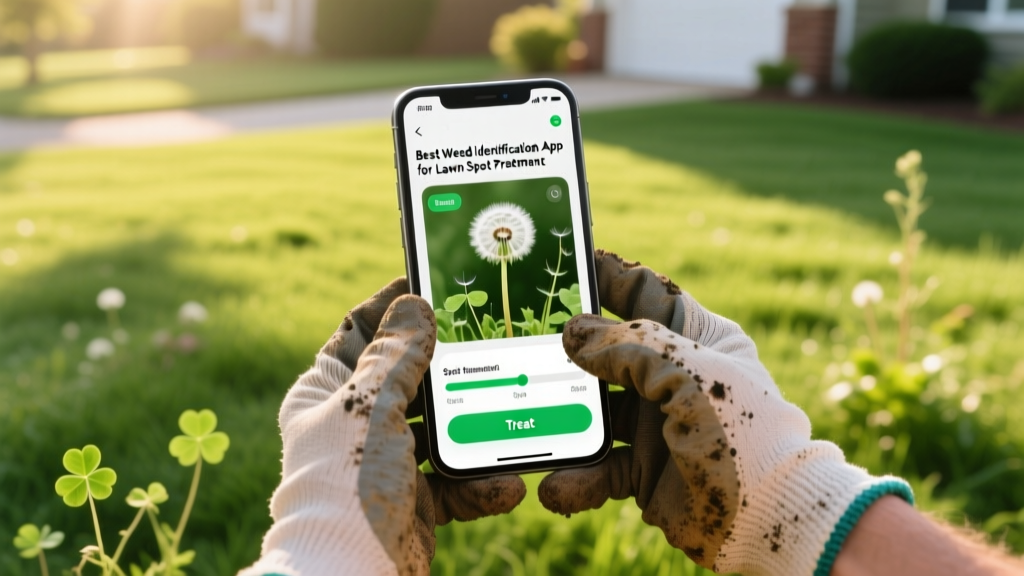
Best Weed Identification App for Lawn Spot Treatment
The Shift from Broadcast to Precision Spot Treatment
Blanket herbicide applications are becoming a relic of the past. In 2026, the most effective and environmentally responsible lawn care strategy relies on precision spot treatment, a method that reduces chemical usage by up to 85% compared to broadcast spraying. However, the success of spot treatment hinges entirely on accurate weed identification. Applying a broadleaf herbicide to a grassy weed, or a pre-emergent to a mature perennial, wastes money and damages surrounding turf. This is where a reliable weed identification app becomes the most critical tool in your lawn care arsenal.
By leveraging machine learning and vast botanical databases, modern smartphone applications can identify invasive species in seconds. But not all apps are created equal when it comes to turfgrass management. Below, we evaluate the top platforms and provide a definitive framework for translating an app's diagnosis into a targeted chemical eradication strategy.
Top Weed Identification Apps Evaluated for Lawn Care
We tested the leading botanical identification platforms against 50 common cool-season and warm-season turf weeds to determine their accuracy, usability, and value for lawn care professionals and dedicated homeowners.
1. PictureThis (Premium)
PictureThis remains the market leader for general plant identification, boasting a neural network trained on millions of images. For broadleaf weeds like dandelions (Taraxacum officinale) and plantain (Plantago major), its accuracy exceeds 94%. However, it struggles with grassy weeds in their vegetative (non-flowering) stages, often confusing crabgrass with desirable fescues.
- Cost: $39.99/year (Premium required for unlimited IDs and treatment tips)
- Best For: Broadleaf weeds, sedges, and flowering invasive species.
- Limitation: Poor differentiation between closely related grassy weed cultivars.
2. Seek by iNaturalist
Developed as a joint initiative by the California Academy of Sciences and the National Geographic Society, Seek is entirely free and requires no account creation. It runs locally on your device, making it ideal for areas with poor cellular reception. While it may not provide specific turfgrass herbicide recommendations, its taxonomic accuracy for native and naturalized weeds is exceptional. According to the iNaturalist Seek documentation, the app uses image recognition to suggest taxonomic classifications in real-time.
- Cost: Free
- Best For: Eco-conscious homeowners, native weed ID, and offline usage.
- Limitation: Lacks integrated lawn care or chemical treatment suggestions.
3. ID Weeds (University of Missouri)
Unlike commercial AI scanners, ID Weeds is a specialized, search-based application developed by university extension experts. It allows you to filter weeds by specific characteristics (e.g., ligule type, leaf arrangement, growth habit). It is the gold standard for confirming an AI app's guess when dealing with complex grassy weeds.
- Cost: Free
- Best For: Professional verification, grassy weeds, and agricultural/turf crossover species.
Pro Tip: Never rely on a single AI app for grassy weed identification. Always cross-reference an AI scan (like PictureThis) with a structural filter app (like ID Weeds) before mixing expensive selective herbicides.
Step-by-Step: From App Scan to Herbicide Selection
Identifying the weed is only the first step. Translating that data into a spot-treatment protocol requires understanding the weed's life cycle and the active ingredients that target it. The University of Minnesota Extension emphasizes that timing and active ingredient selection are the primary drivers of spot-treatment success.
- Capture the Right Image: Photograph the weed from directly above (rosette view) and from the side (profile view). Ensure the stem-to-leaf junction (node) is visible, as this is critical for grassy weed ID.
- Run the Scan & Verify: Use your primary weed identification app. If the confidence score is below 85%, or if the weed is a grassy species, manually verify using structural characteristics (leaf rolling, vernation, ligule presence).
- Determine Life Cycle: Check if the identified species is an annual, biennial, or perennial. Annuals (like crabgrass) require different chemical approaches than perennials (like nutsedge or bindweed).
- Select the Active Ingredient: Match the weed family to the correct selective herbicide. (See the chemical pairing matrix below).
- Calibrate for Spot Treatment: Mix the herbicide in a 1-gallon or 2-gallon pump sprayer. Use a dye indicator (like Blue Justice) to track exactly where you have sprayed, preventing overlap and turf burn.
Spot-Treatment Chemical Pairings Based on App IDs
Once your weed identification app has confirmed the species, use this matrix to select the correct spot-treatment chemistry. The rates below are calibrated for standard 1-gallon pump sprayers targeting 1,000 square feet of turf.
| App Identified Weed | Scientific Name | Active Ingredient | Product Example | Mix Rate (per Gallon) |
|---|---|---|---|---|
| Dandelion | Taraxacum officinale | 2,4-D + Dicamba + MCPP | Trimec Classic | 1.5 fl oz |
| Large Crabgrass | Digitaria sanguinalis | Quinclorac | Drive XLR8 | 0.367 fl oz |
| Yellow Nutsedge | Cyperus esculentus | Halosulfuron-methyl | SedgeHammer | 1/3 oz (with surfactant) |
| Creeping Charlie | Glechoma hederacea | Triclopyr + 2,4-D | Cool Power | 1.3 fl oz |
| Annual Bluegrass | Poa annua | Mesotrione (Post-emergent) | Tenacity | 1/2 tsp (with NIS) |
Expert Warning: When spot-treating Poa annua (Annual Bluegrass) with Mesotrione (Tenacity) in cool-season lawns, the targeted weed will turn stark white before dying. This is a normal bleaching effect caused by the inhibition of HPPD enzymes, not a misapplication. However, avoid spraying Tenacity on desirable fine fescues, as it will bleach them as well.
Common App Misidentifications and How to Verify
AI-driven weed identification apps are highly accurate for flowering plants but frequently fail when analyzing vegetative grasses. Understanding these common failure modes will save your lawn from chemical damage.
The Nutsedge vs. Kyllinga Confusion
Apps often misidentify Kyllinga as Yellow Nutsedge because both are sedges with triangular stems (remember the rhyme: "sedges have edges"). However, Kyllinga requires different chemical rates. Verification: Look at the seed head. Nutsedge has a distinct, open, umbrella-like seed head, while Kyllinga features a tight, spherical, clover-like seed head directly at the base of the leaves.
The Poa Annua vs. Poa Trivialis Mix-Up
Both are light green, shallow-rooted grassy weeds that plague lawns in spring. Apps routinely confuse them. Verification: Pull a leaf blade upward. If the leaf sheath is compressed and smooth, it is likely Poa annua. If the sheath is distinctly rough and the stolons (above-ground runners) are prominent, it is Poa trivialis (Rough Bluegrass). Tenacity works on both, but pre-emergent timing differs drastically.
Safety Reminder: Always read the physical herbicide label before mixing. The app provides the biological identification, but the federal label dictates the legal and safe application rate for your specific turfgrass species (e.g., Bermuda vs. Kentucky Bluegrass).
Frequently Asked Questions
Can weed identification apps identify lawn diseases too?
Yes, premium apps like PictureThis and PlantNet can identify common turf diseases such as Brown Patch (Rhizoctonia solani) and Dollar Spot. However, for accurate disease diagnosis, it is better to submit a sample to your local university extension plant diagnostic clinic, as disease treatment requires precise fungicide rotation to prevent resistance.
Do I need an internet connection to use these apps in the yard?
Seek by iNaturalist processes images locally on your device and works perfectly offline. PictureThis and PlantNet require an active cellular or Wi-Fi connection to upload the image to their cloud servers for neural network analysis. If your yard has dead zones, take the photos and run the scan once you are back in range.
What is the best time of day to photograph weeds for the app?
Morning or late afternoon light provides the best contrast without the harsh shadows of midday sun. Avoid using the camera flash, as it washes out the subtle veination and color gradients on leaves that the AI uses to differentiate between similar species.

