
Lawn Care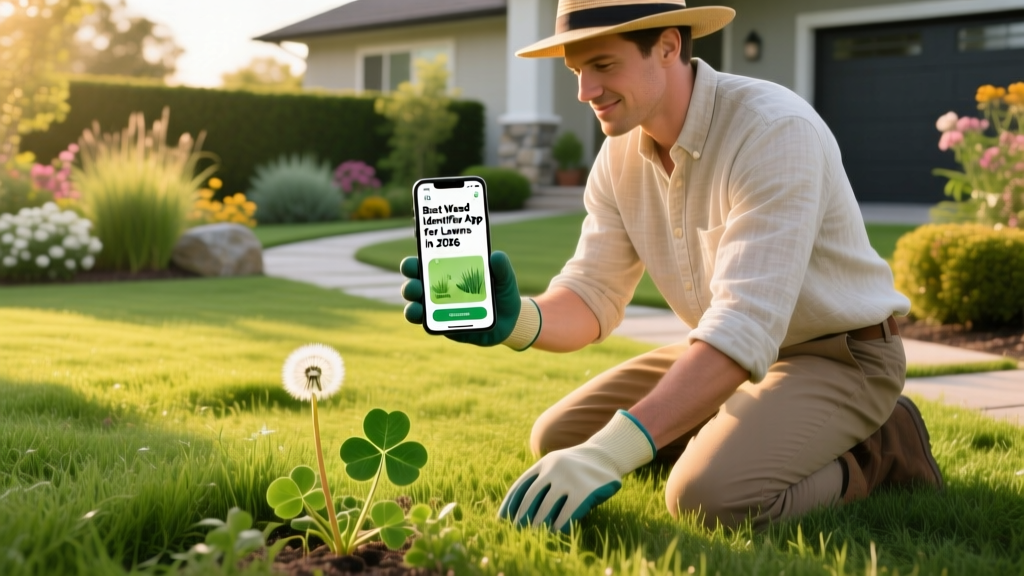
Best Weed Identifier App for Lawns in 2026: Tested
The True Cost of Weed Misidentification
Applying a broadleaf herbicide like 2,4-D to a grassy weed or sedge does more than waste $15 to $25 in chemicals; it delays effective control and risks phytotoxicity to your desirable turf. In 2026, AI-driven plant recognition has matured significantly, transforming the weed identifier app from a novelty into a critical diagnostic tool for precise spot-treatments. However, not all algorithms are trained on turfgrass morphology. An app that easily identifies a houseplant may fail to distinguish between Digitaria sanguinalis (hairy crabgrass) and Paspalum distichum (knotgrass) when intermingled with tall fescue.
To determine which tools actually deliver actionable spot-treatment data, we tested the leading botanical AI models against 50 common turfgrass weeds across cool- and warm-season lawns.
Testing Methodology: Beyond the Broadleaf
Most consumer plant apps boast 95%+ accuracy, but these metrics are heavily skewed toward large-leaf ornamentals and wildflowers. Our testing protocol evaluated apps specifically on turfgrass challenges:
- Grassy vs. Sedge Distinction: Can the app differentiate the triangular stem of yellow nutsedge (Cyperus esculentus) from the flat blade of crabgrass?
- Mature vs. Seedling ID: Weeds like annual bluegrass (Poa annua) look vastly different at the 2-leaf stage compared to maturity.
- Background Noise: Images were taken with the target weed surrounded by dense, healthy turf (Bermuda, Zoysia, Kentucky Bluegrass, and Tall Fescue) rather than isolated on a white background.
- Treatment Actionability: Does the app suggest the correct active ingredient (e.g., Halosulfuron-methyl for sedges) rather than generic "use weed killer" advice?
2026 Weed Identifier App Comparison Matrix
| App Name | 2026 Pricing | Turf Weed Accuracy | Treatment Specificity | Best Use Case |
|---|---|---|---|---|
| PictureThis | $39.99/yr (Premium) | 91% (Grassy), 96% (Broadleaf) | High (Lists active ingredients) | DIYers wanting all-in-one diagnosis & chemical recs |
| Seek by iNaturalist | Free | 78% (Grassy), 89% (Broadleaf) | Low (Taxonomy only) | Eco-conscious users & citizen science data logging |
| ID Weeds (MU Ext.) | Free | 98% (When using filters) | Medium (Links to extension PDFs) | Professionals & precise regional variant ID |
| PlantNet | Free | 72% (Grassy), 85% (Broadleaf) | None | General botanical curiosity, not lawn care |
Deep Dive: The Top Tools for Spot-Treatment Protocols
1. PictureThis (Best Overall for Actionable Treatment Plans)
PictureThis remains the most robust commercial weed identifier app for lawn care because its premium tier bridges the gap between identification and eradication. When you scan a patch of wild violet (Viola sororia), the app doesn't just name it; it flags it as a difficult-to-control broadleaf and recommends herbicides containing triclopyr or fluroxypyr, which are necessary to penetrate the plant's waxy cuticle.
"The integration of chemical active ingredient recommendations directly into the ID flow saves homeowners from buying ineffective, off-the-shelf broadleaf sprays that fail on mature perennials."
Drawback: The free version is heavily restricted. To access the turf-specific care guides and unlimited scanning, the $39.99 annual subscription is mandatory. Furthermore, its AI occasionally misidentifies fine fescue blades as Poa annua if the seed head is not visible.
2. Seek by iNaturalist (Best Free & Scientifically Backed)
Developed in partnership with the California Academy of Sciences, iNaturalist's Seek app uses a massive, community-verified dataset. It is exceptional for identifying broadleaf weeds like dandelion, plantain, and clover. According to turfgrass researchers at the University of Minnesota Turfgrass Science program, accurate identification is the first step in integrated pest management (IPM), and Seek provides reliable taxonomic data without a paywall.
Drawback: Seek stops at the species name. It will tell you that you have Cyperus esculentus (yellow nutsedge), but it will not tell you that you need a halosulfuron-methyl-based herbicide like SedgeHammer to kill it. It requires the user to independently research the spot-treatment protocol.
3. ID Weeds by University of Missouri (Best for Regional Accuracy)
While not a pure "point-and-shoot" AI camera app, the ID Weeds application (and its companion web database via MU Extension) is the gold standard for professionals. Instead of relying solely on a potentially flawed photo, it uses a parametric filter system (e.g., select "grassy weed," "hairy ligule," "rolled vernation").
Drawback: It requires basic botanical knowledge. If you do not know what a "ligule" or "auricle" is, the learning curve is steep compared to AI photo scanners.
From Identification to Spot-Treatment: A 4-Step Protocol
Once your weed identifier app has confirmed the species, follow this exact protocol to ensure the spot-treatment is effective and safe for your surrounding turf.
Step 1: Verify the Growth Stage
Post-emergent herbicides are highly dependent on weed maturity. If your app identifies crabgrass, check the tiller count. Crabgrass with fewer than 3 tillers can be killed with a single application of quinclorac. Mature crabgrass (5+ tillers) requires two applications spaced 14 days apart, or the use of a stronger, non-selective spot treatment like glyphosate (which will also kill the surrounding grass, requiring reseeding).
Step 2: Match the Active Ingredient to the Turf Type
Never apply an herbicide without checking the label for your specific grass. For example, if your app identifies white clover in a St. Augustinegrass lawn, you cannot use standard 2,4-D amine formulations, as they will severely burn St. Augustine. You must select a product formulated with low concentrations of 2,4-D combined with atrazine or penoxsulam.
Step 3: Add a Non-Ionic Surfactant
Many weeds identified by apps—particularly those with glossy leaves like ground ivy or hairy leaves like mouse-ear chickweed—repel water-based herbicide sprays. Adding a non-ionic surfactant (at a rate of 0.25% to 0.5% v/v, roughly 1/2 teaspoon per gallon of mixed solution) breaks the surface tension, allowing the chemical to coat the leaf and penetrate the stomata.
Step 4: Observe the 48-Hour Weather Window
Spot-treatments require 24 to 48 hours of dry weather post-application. Additionally, avoid applying systemic herbicides like quinclorac or triclopyr if daytime temperatures exceed 85°F, as the chemical can vaporize and drift, causing twisting and cupping in desirable broadleaf ornamentals nearby.
⚠️ Warning: The Nutsedge vs. Crabgrass Trap
The most common failure in DIY lawn care occurs when users misidentify yellow nutsedge as crabgrass. AI apps sometimes struggle with this if the image lacks the distinctive purple/yellow seed head. The physical test: Roll the stem between your fingers. If it is distinctly triangular (like a pencil with three flat sides), it is a sedge. Standard crabgrass killers (Quinclorac) will not kill nutsedge. You must switch to a sedge-specific active ingredient like Halosulfuron-methyl or Sulfentrazone.
Frequently Asked Questions
Can weed identifier apps identify pre-emergent weed failures?
Yes. If you applied a pre-emergent like Prodiamine in early spring but see grassy weeds emerging in May, an app can identify if the failure is due to a breakthrough of annual bluegrass (Poa annua), which sometimes exhibits pre-emergent resistance, or if the weed is actually a perennial like dallisgrass that pre-emergents do not control.
Do I need a premium app subscription for lawn care?
If you only deal with common broadleaf weeds like dandelions and clover, free apps like Seek are sufficient. However, if you are battling complex grassy weeds, sedges, or require specific chemical active ingredient recommendations to avoid turf damage, a premium subscription to an app like PictureThis provides a high return on investment by preventing wasted chemical purchases.
Why did the app misidentify my Kentucky Bluegrass as a weed?
Many AI models are trained on agricultural and wildland datasets where Poa pratensis (Kentucky Bluegrass) or Poa annua are classified as invasive or weed species. Always cross-reference the app's output with your local university extension's turfgrass database to confirm if the plant is actually a desirable component of your lawn mix.

