
Lawn Care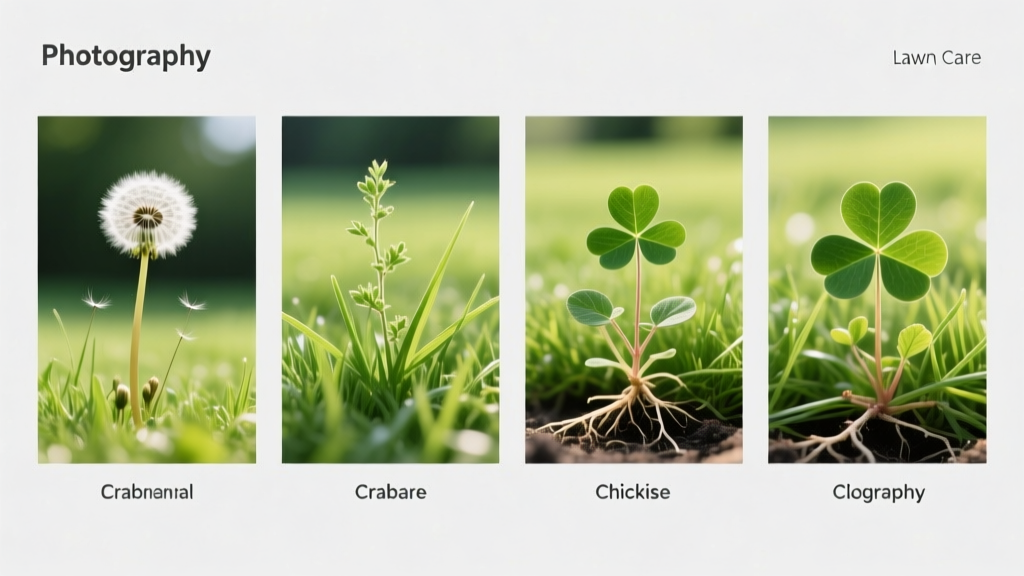
Identify and Treat: Using Images of Weeds for Targeted Spot-Treatment
The Visual Identification Framework
Browsing images of weeds online is the first step in reclaiming your turf, but misidentification is the leading cause of herbicide failure and wasted chemical budgets. A broadleaf herbicide will not touch a grassy weed, and a standard grassy weed killer will fail against sedges. Before mixing any chemicals, you must match the physical characteristics of the invader in your lawn to verified botanical identifiers.
According to the UC Statewide Integrated Pest Management Program, accurate weed identification relies on three vegetative structures: the leaf blade, the collar region (ligule and auricles), and the stem base (vernation). When comparing your lawn to reference images, look for these specific traits:
- Vernation: Is the youngest leaf rolled or folded in the bud? Crabgrass is rolled; goosegrass is folded.
- Ligules: The membrane or fringe of hairs where the leaf blade meets the stem. Dallisgrass has a distinct membranous ligule, while nimblewill has a short, hairy fringe.
- Growth Habit: Does the weed grow upright, form a low rosette, or spread via horizontal stolons and rhizomes?
Broadleaf Weed Spot-Treatment Matrix
Broadleaf weeds are generally the easiest to control, provided you select a multi-active-ingredient formulation to prevent resistance. Single-ingredient products (like pure 2,4-D) often result in partial kills, where the weed's top growth burns off but the taproot survives and regenerates within three weeks.
| Weed Species | Visual Identifier | Active Ingredients Needed | Product Example & Cost | Mixing Rate (per 1,000 sq ft) |
|---|---|---|---|---|
| Dandelion | Deeply lobed leaves forming a basal rosette; hollow stems exuding milky sap. | 2,4-D + MCPP + Dicamba | Trimec Classic (~$35/gal) | 1.5 fl oz |
| White Clover | Trifoliate leaves with white V-shaped chevrons; creeping stolons. | Triclopyr + Clopyralid | Cool Power (~$45/gal) | 1.3 fl oz |
| Broadleaf Plantain | Broad, oval leaves with prominent parallel veins; tough, fibrous root system. | Carfentrazone + 2,4-D | SpeedZone (~$50/pint) | 1.4 fl oz |
| Ground Ivy | Scalloped, round leaves on square stems; emits a minty odor when crushed. | Triclopyr + Quinclorac | Q4 Plus (~$60/gal) | 1.8 fl oz |
Pro Tip: When spot-treating broadleaf weeds, apply the herbicide to the point of runoff (just before the liquid drips off the leaf). Adding a non-ionic surfactant (NIS) at a rate of 0.25% v/v reduces surface tension, allowing the chemical to coat the waxy cuticle of weeds like plantain.
Tackling Grassy Weeds and Sedges
Grassy weeds and sedges are notoriously difficult to spot-treat because they visually blend into your desirable turf. Relying on generic 'weed and feed' granulars is ineffective here; these require targeted liquid post-emergent applications.
Crabgrass vs. Goosegrass
While both are summer annuals, goosegrass features a distinct silver or white center at the base of the plant and a zipper-like seedhead. Purdue University Turfgrass Science notes that goosegrass is highly resistant to standard pre-emergents like prodiamine, making post-emergent spot-treatment critical. Use Drive XLR8 (Quinclorac) at 0.75 fl oz per 1,000 sq ft. Note: Quinclorac can cause temporary yellowing in certain St. Augustinegrass cultivars; always check the label for turf tolerance.
The Sedge Deception
Sedges are not grasses; they are in a separate botanical family. The easiest physical test is the 'stem roll': if you roll the stem between your fingers and feel a distinct triangle, it is a sedge (yellow or purple nutsedge). If it rolls flat, it is a grassy weed. Standard grassy weed killers will not kill nutsedge. You must use a halosulfuron-methyl product like SedgeHammer.
Formulation Insight: SedgeHammer requires a specific chemical environment to penetrate the leaf. You must include the manufacturer-provided NIS surfactant packet in the mix. Furthermore, nutsedge is actively growing and most susceptible when daytime temperatures are consistently above 85°F. Spot-treat when the weed is in the 3-to-5 leaf stage; mature nutsedge with developed nutlets will require a second application 4 to 6 weeks later.
Spot-Treatment Execution Protocol
Proper mixing and application techniques prevent herbicide drift, which can cause phytotoxicity (chemical burn) to your desirable lawn or ornamental shrubs.
- Calibrate the Sprayer: Use a dedicated 1-gallon or 2-gallon pump sprayer. Never use a sprayer that previously held glyphosate or soil sterilants. Mark this sprayer with bright red tape for herbicide use only.
- Mix the Solution: Fill the tank halfway with clean water. Add the required liquid herbicide dose. Add the liquid surfactant. Finally, add the remaining water to ensure proper agitation. Secure the lid and shake vigorously for 30 seconds.
- Add Tracking Dye: For spot-treatments, add 2 to 3 drops of a turf-safe marking dye like Blueprint (~$15 per bottle). This temporarily stains the weeds blue, ensuring you do not double-spray the same plants or miss hidden invaders.
- Select the Nozzle: Switch the sprayer wand to a 'cone' or 'pin-stream' setting rather than a wide 'fan' mist. A narrow stream prevents airborne drift from settling on nearby desirable plants or vegetable gardens.
- Application Timing: Spray during early morning when winds are below 5 mph and temperatures are between 65°F and 85°F. Avoid mowing for 48 hours before and 48 hours after application to maximize leaf surface area and chemical translocation to the roots.
Temperature Warning: Never apply herbicides containing 2,4-D or Dicamba when ambient temperatures exceed 85°F. At high temperatures, these chemicals undergo volatilization—turning into a vapor that drifts onto non-target plants, causing severe twisting and cupping of leaves on nearby trees and ornamentals.
Post-Treatment Monitoring
After spot-treating, monitor the affected areas for 14 to 21 days. Broadleaf weeds will typically show curling, yellowing, and necrosis within 7 days. Grassy weeds and sedges take longer, often requiring 14 days to show stunting and purple discoloration at the stem base. If the weed center remains green after 21 days, the root system has survived. Re-evaluate your identification using reference images, adjust your active ingredient if necessary, and reapply at the maximum labeled rate.

