
Lawn Care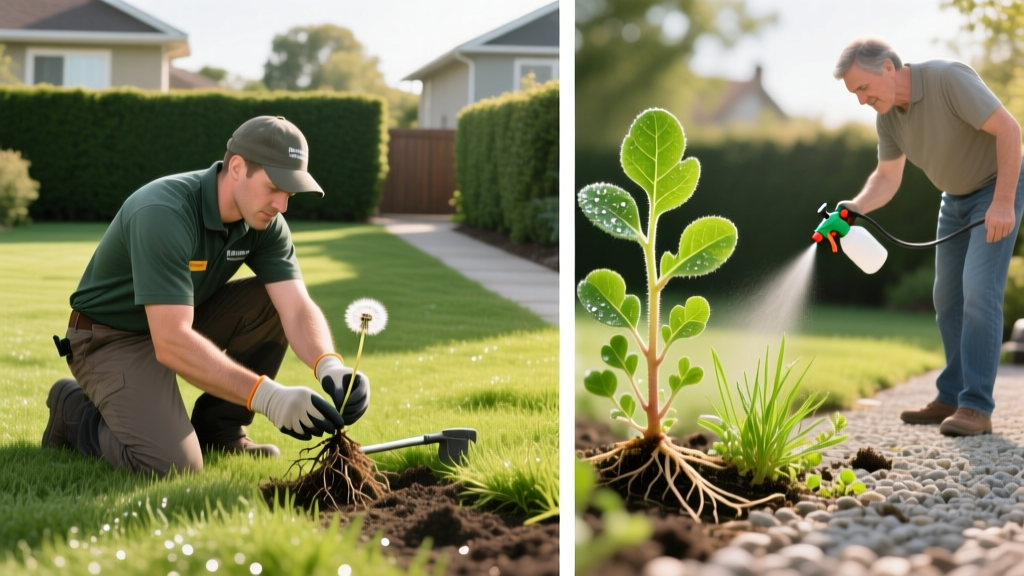
Weed Pulling Service vs DIY Spot Treatment: Species Guide
The Economics of Weed Eradication: Service vs. Spot-Treatment
Homeowners facing a lawn invasion often face a binary choice: hire a professional weed pulling service or grab a bottle of broad-spectrum herbicide. In 2026, the national average rate for a manual weed pulling service ranges from $45 to $85 per hour, or roughly $0.12 to $0.25 per square foot for dense infestations. Conversely, a high-quality DIY spot-treatment kit—featuring a selective post-emergent and a precision pump sprayer—costs between $35 and $60 upfront.
However, calculating the true return on investment requires understanding weed biology. A weed pulling service excels at removing annual weeds with shallow taproots and managing localized organic landscaping beds. But when dealing with deep-rooted perennial grasses and sedges, manual extraction often exacerbates the problem. According to the University of Minnesota Extension, improper manual removal of perennial weeds leaves behind root fragments that rapidly regenerate, turning a $150 service bill into a recurring monthly expense.
Cost-Benefit Threshold: If your lawn has more than 15% coverage of deep-rooted perennials (like bindweed or nutsedge), a weed pulling service will only provide cosmetic relief. Chemical spot-treatment using species-specific active ingredients is mathematically and biologically superior in these scenarios.
Deep-Rooted Perennials: When Hand-Pulling Fails
The most critical mistake homeowners make is applying the same removal logic to all weeds. Perennial weeds store massive energy reserves in subterranean rhizomes, tubers, and deep taproots. When a weeding crew yanks the top growth, the plant simply triggers dormant buds below the soil line.
Species Extraction Efficacy Matrix
| Weed Species | Root System Depth | Weed Pulling Service Efficacy | DIY Spot-Treatment Active Ingredient |
|---|---|---|---|
| Yellow Nutsedge (Cyperus esculentus) | 8-14 inches (plus dormant nutlets) | Low (Pulling spreads nutlets) | Halosulfuron-methyl or Sulfentrazone |
| Field Bindweed (Convolvulus arvensis) | 10 to 20 feet | Very Low (Roots snap easily) | Quinclorac or Triclopyr |
| Dallisgrass (Paspalum dilatatum) | 6-12 inch rhizome network | Medium (Requires deep soil knifing) | Fluazifop-butyl (Spot application) |
| Wild Violet (Viola sororia) | 4-6 inch fleshy rhizomes | Medium-High (If soil is moist) | Triclopyr + 2,4-D ester blend |
Yellow nutsedge is the ultimate test of this matrix. As documented by the University of California Statewide IPM Program, a single nutsedge plant can produce hundreds of subterranean nutlets. When a weed pulling service uses standard mechanical pullers, the tension snaps the stem, leaving the nutlets intact and actually stimulating their germination. Spot-treating with Halosulfuron-methyl (commonly sold as SedgeHammer) translocates down into the nutlet, destroying the reproductive mechanism entirely.
The Professional Weed Pulling Service Playbook
Not all manual extraction is created equal. A premium, specialized weed pulling service does not simply grasp the foliage and pull. They employ a specific agronomic playbook to maximize extraction rates while minimizing turf damage.
- Moisture Timing: Professionals schedule pulls 24 to 48 hours after a 1-inch rainfall or deep irrigation. Dry clay soil creates immense friction, snapping taproots at the crown.
- Tool Selection: Instead of standard trowels, high-end services use Japanese Hori Hori knives or specialized 14-inch stainless steel dandelion diggers to sever the soil column around the root.
- The Lever Technique: The tool is inserted at a 45-degree angle, 3 inches from the weed base, using the soil surface as a fulcrum to lift the entire root ball without tearing the surrounding turfgrass rhizomes.
- Void Filling: After extraction, the resulting void is immediately backfilled with a 50/50 mix of topsoil and compost, then tamped down to prevent opportunistic weed seeds from settling into the depression.
Annual Weeds: Why Spot-Treatment Beats Manual Pulling
While deep-rooted perennials require chemical intervention or highly specialized manual extraction, annual weeds like Crabgrass (Digitaria sanguinalis) and Annual Bluegrass (Poa annua) present a different economic scenario.
Warning on Annual Weeds: Hiring a weed pulling service for mature crabgrass is a misallocation of funds. Crabgrass produces up to 150,000 seeds per plant. By the time the plant is large enough to be easily pulled by hand, it has already dropped viable seeds into the soil profile.
For annuals, the focus must shift from extraction to chemical spot-treatment and pre-emergent barriers. A targeted spray of Quinclorac will kill crabgrass in 7 to 14 days, while a professional application of Prodiamine in early spring prevents germination entirely. Manual pulling of annuals is only recommended when the infestation is limited to fewer than 10 isolated plants in a small ornamental bed.
Soil Compaction and the Hidden Cost of Manual Extraction
An often-overlooked consequence of aggressive weed pulling is soil compaction and turf root shearing. When a worker repeatedly steps on the same 4-square-foot area to gain leverage for pulling stubborn weeds, they compress the soil pores. This reduces oxygen availability to the surrounding desirable grass, leading to localized thinning. The resulting bare patch becomes a prime landing zone for new weed seeds, creating a vicious cycle of extraction and regrowth.
Spot-treatment with a precision wand eliminates foot traffic over the affected area, preserving the soil structure and the delicate root hairs of your Bermuda, Zoysia, or Kentucky Bluegrass turf.
Decision Framework: Should You Call the Pros?
Use this diagnostic flowchart to determine whether to book a weed pulling service or purchase a spot-treatment herbicide:
- IF the weeds are in a mulched landscape bed or vegetable garden THEN hire a weed pulling service (herbicide drift risks are too high).
- IF the weed has a triangular stem or milky sap (nutsedge/spurge) THEN use chemical spot-treatment (pulling guarantees regrowth).
- IF the infestation covers less than 5% of the lawn and consists of broadleaf dandelions THEN either method is viable, but DIY spot-treatment offers a 90% cost savings.
- IF you are preparing a lawn for a real estate listing and need immediate visual perfection THEN hire a service for instant removal, followed by a chemical application to prevent regrowth before closing.
Frequently Asked Questions
Does a weed pulling service guarantee the weeds won't return?
No ethical service will guarantee permanent eradication through manual pulling alone. Weed seeds remain viable in the soil seed bank for up to 30 years. Pulling removes the current generation, but without a follow-up pre-emergent or spot-treatment protocol, new seeds will germinate in the disturbed soil.
Can I use boiling water instead of hiring a service or using chemicals?
Boiling water is an effective organic spot-treatment for weeds growing in driveway cracks or patio pavers. However, applying boiling water to a lawn will instantly kill the surrounding desirable turfgrass and destroy beneficial soil microbes in the top two inches of the soil profile, leaving a dead patch that weeds will quickly recolonize.
How do I verify if a weed pulling service is using proper extraction techniques?
Ask the company what tools their technicians use. If they rely solely on mechanical stand-up weed pullers (which often snap deep taproots) rather than hand-tools like soil knives or deep-root extractors, their efficacy on perennial weeds will be exceptionally low. Request that they demonstrate their extraction method on a single dandelion before authorizing the full property service.

