
Lawn Care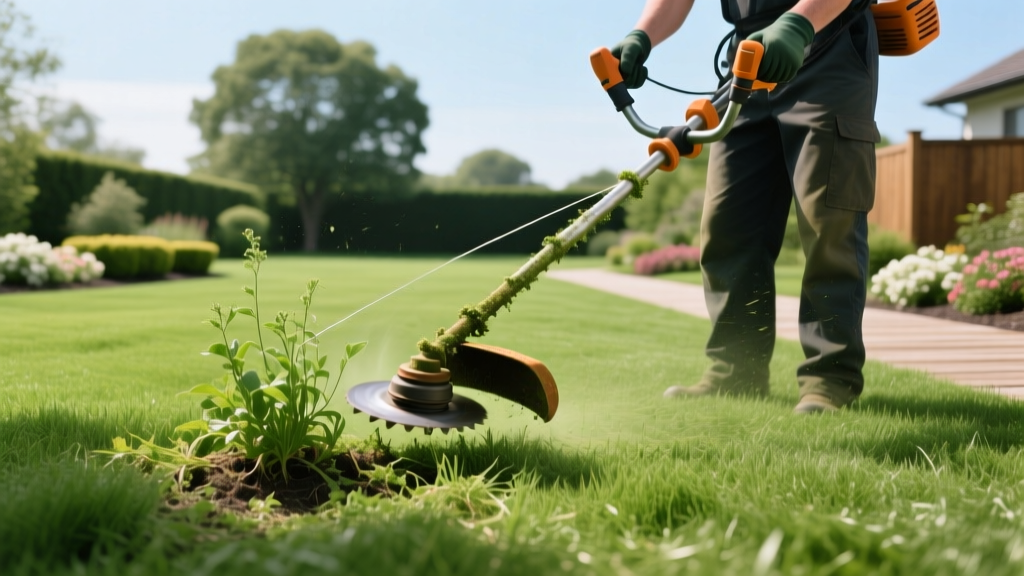
Spot-Treating Tough Weeds: Using a Weed Trimmer Without String
When targeting resilient perennial weeds like Canada thistle (Cirsium arvense), field bindweed (Convolvulus arvensis), or Japanese knotweed (Reynoutria japonica), standard 0.095-inch monofilament string often fails. The nylon line wraps, snaps, or simply bounces off woody, fibrous stalks, leaving the root system intact and triggering aggressive regrowth. According to the University of California Integrated Pest Management (UC IPM) program, mechanical disruption of the vascular system combined with precise cut-stump herbicide applications is critical for long-term eradication of deep-rooted perennials. This is where a weed trimmer without string—utilizing fixed metal blades, rotary cutting heads, or brush cutter attachments—becomes an indispensable tool for targeted spot-treatment.
The Physics of Stringless Weed Eradication
Monofilament trimmer line relies entirely on tip speed (approximately 180 mph at 8,000 RPM) to slice through soft, high-moisture grass tissue. When that same line strikes a lignified (woody) weed stalk, the kinetic energy dissipates, causing the string to deflect or shatter. A weed trimmer without string replaces tip-speed dependency with rotational mass and continuous shear force.
Data Highlight: Cutting Force Comparison
• 0.095" Nylon String: Delivers ~0.5 Joules of impact energy per strike. Bounces off stalks thicker than 3/8".
• 3-Tooth Metal Blade (8,000 RPM): Delivers continuous shear force with ~15 Joules of rotational energy. Slices cleanly through 1.5" woody stems.
• Rotary Mower Head (e.g., Speedweed): Utilizes swinging blades that generate up to 4x the cutting torque of fixed line, mulching fibrous crowns instantly.
• 0.095" Nylon String: Delivers ~0.5 Joules of impact energy per strike. Bounces off stalks thicker than 3/8".
• 3-Tooth Metal Blade (8,000 RPM): Delivers continuous shear force with ~15 Joules of rotational energy. Slices cleanly through 1.5" woody stems.
• Rotary Mower Head (e.g., Speedweed): Utilizes swinging blades that generate up to 4x the cutting torque of fixed line, mulching fibrous crowns instantly.
By cleanly severing the stem rather than bludgeoning it, stringless trimmers expose the fresh cambium layer. This clean cut is a prerequisite for the "cut-and-paint" herbicide protocol, allowing systemic chemicals to translocate directly to the rhizomes before the plant can seal the wound.
Weed Species and Blade Matching Matrix
Not all stringless attachments are suited for every weed species. Matching the blade geometry to the plant's structural defenses prevents equipment damage and ensures the precise cut required for chemical uptake.
| Target Weed Species | Stem Characteristics | Optimal Stringless Attachment | Cut Height for Spot-Treatment |
|---|---|---|---|
| Canada Thistle | Fibrous, hollow, moderately woody base | 3-Tooth Metal Brush Blade | 2 inches above soil line |
| Field Bindweed | Vining, tangled, dense ground mat | Rotary Cutter Head (Swinging blades) | Flush to ground (scalp mat) |
| Japanese Knotweed | Bamboo-like, highly lignified, thick nodes | 8-Tooth Carbide-Tipped Brush Blade | Just below the lowest node |
| Dallisgrass | Thick, bulbous rhizome crown | Fixed Steel Edger Blade | Slice through top 1/2" of crown |
Top Stringless Trimmer Configurations for Spot-Treatment
Selecting the right hardware depends on your property size, the density of the weed infestation, and your existing powerhead ecosystem. Below are the premier stringless configurations currently dominating the professional and prosumer markets.
1. Speedweed Power Head (Rotary Attachment)
Best For: Tangled ground covers like bindweed and dense thistle patches.
Estimated Cost: $45 - $55 (Attachment only)
Pros:
• Fits 90% of standard straight-shaft gas and electric trimmers.
• Swinging blades retract upon hitting hard obstacles (fences, rocks), reducing kickback.
• Exceptional for scalping weed mats without digging into the topsoil.
• Fits 90% of standard straight-shaft gas and electric trimmers.
• Swinging blades retract upon hitting hard obstacles (fences, rocks), reducing kickback.
• Exceptional for scalping weed mats without digging into the topsoil.
Cons:
• Requires a high-torque powerhead (minimum 25cc gas or 56V 2.5Ah+ battery).
• Not designed for precision edging or cutting flush against delicate ornamental bark.
• Requires a high-torque powerhead (minimum 25cc gas or 56V 2.5Ah+ battery).
• Not designed for precision edging or cutting flush against delicate ornamental bark.
2. Husqvarna 525RX with 3-Tooth Metal Blade
Best For: Heavy-duty knotweed and mature thistle eradication.
Estimated Cost: $699 - $750 (Complete system)
Pros:
• 40.1cc commercial engine provides massive torque for 1.5" woody stems.
• Bicycle handle configuration offers superior leverage for precise cut-and-paint targeting.
• Harness system reduces operator fatigue during multi-hour spot-treatment sessions.
• 40.1cc commercial engine provides massive torque for 1.5" woody stems.
• Bicycle handle configuration offers superior leverage for precise cut-and-paint targeting.
• Harness system reduces operator fatigue during multi-hour spot-treatment sessions.
Cons:
• High initial investment and requires routine 2-stroke engine maintenance.
• Metal blade poses a higher debris-throwing risk; requires strict PPE protocols.
• High initial investment and requires routine 2-stroke engine maintenance.
• Metal blade poses a higher debris-throwing risk; requires strict PPE protocols.
3. Worx WG184 Fixed-Blade Edger/Trimmer
Best For: Slicing Dallisgrass crowns and spot-treating along hardscapes.
Estimated Cost: $130 - $150
Pros:
• Fixed steel blade provides surgical precision for exposing weed crowns.
• Lightweight and highly maneuverable for tight landscape beds.
• Zero string-spool maintenance or feeding issues.
• Fixed steel blade provides surgical precision for exposing weed crowns.
• Lightweight and highly maneuverable for tight landscape beds.
• Zero string-spool maintenance or feeding issues.
Cons:
• Limited cutting width; ineffective against broad, tangled weed mats.
• Blade dulls quickly if used to strike soil or pavement.
• Limited cutting width; ineffective against broad, tangled weed mats.
• Blade dulls quickly if used to strike soil or pavement.
The Cut-and-Paint Spot-Treatment Protocol
Mechanical removal alone rarely kills deep-rooted perennials. According to Penn State Extension, combining mechanical cutting with immediate systemic herbicide application (the cut-stump method) yields an 85% to 95% eradication rate for species like knotweed and thistle. Follow this precise protocol to maximize translocation to the root zone.
- Prepare the Herbicide: Mix a 20% solution of glyphosate (for knotweed and grasses) or triclopyr (for woody broadleaves like thistle and bindweed) with water. Add a non-ionic surfactant and a blue dye marker to track treated stems.
- Execute the Cut: Using your stringless trimmer, sever the weed stalk cleanly. For hollow-stemmed weeds like thistle, cut exactly 2 inches above the soil line. For knotweed, cut just below the lowest visible node to create a "cup" that holds the chemical.
- The 60-Second Rule: You have exactly 60 seconds before the plant's vascular system begins to seal the wound with sap. Immediately apply the herbicide to the fresh cambium ring using a sponge applicator, wick, or targeted spray bottle.
- Target the Hollows: For Japanese knotweed, use a syringe or dropper to inject 5ml of the 20% solution directly into the hollow internode cavity left by the stringless blade cut.
- Monitor and Repeat: Wait 14 days. If new shoots emerge from the rhizome network, repeat the stringless cut and paint process. Do not pull the dead stalks; leave them in place to allow the chemical to fully translocate and degrade the root mass.
Safety Parameters and Debris Mitigation
Operating a weed trimmer without string introduces severe projectile and kickback hazards that monofilament users rarely encounter. Metal blades do not snap upon impact; they transfer kinetic energy directly into the obstacle, which can result in violent machine deflection or the launch of high-velocity shrapnel.
⚠ Critical Safety Directives for Stringless Trimming
- Mandatory PPE: You must wear a polycarbonate face shield (not just safety glasses), heavy-duty leather chaps, and steel-toe boots. A 3-tooth blade spinning at 8,000 RPM can launch a severed thistle stalk or hidden rock at speeds exceeding 120 mph.
- Kickback Zone Avoidance: Never use the upper-left quadrant (between 12 o'clock and 3 o'clock) of a rotary metal blade. Striking a solid object in this zone causes the trimmer to violently kick back toward the operator's legs.
- Perimeter Sweeping: Before engaging the blade, walk the spot-treatment zone and remove rocks, wire, and debris. Metal blades will instantly shred hidden wire fencing, turning it into lethal projectiles.
- Blade Balancing: If your metal blade strikes a rock and chips, stop immediately. An unbalanced blade operating at high RPM will destroy the trimmer's gearbox bearings and cause severe vibration fatigue in your hands and arms.
Transitioning from a standard string trimmer to a stringless, blade-based system fundamentally changes your approach to lawn care. By leveraging the sheer cutting force of metal and rotary blades, you can execute precise, surgical strikes on the most stubborn perennial weeds, setting the stage for highly effective chemical translocation and permanent root eradication.

