
Lawn Care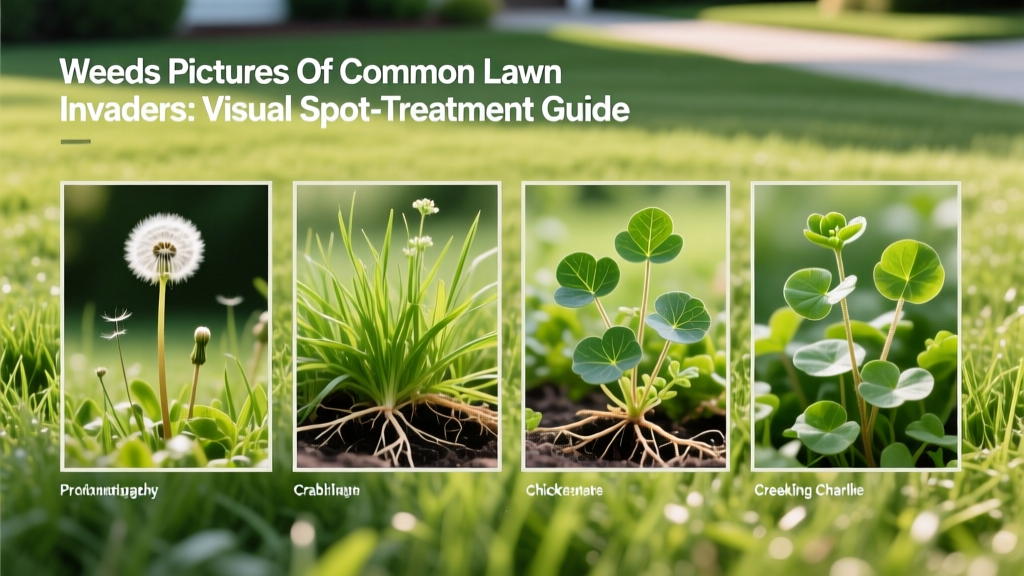
Weeds Pictures Of Common Lawn Invaders: Visual Spot-Treatment Guide
Accurate identification is the single most critical step in lawn weed management. Misidentifying a grassy weed as a broadleaf, or a sedge as a grass, leads to wasted chemicals, damaged turfgrass, and persistent infestations. When homeowners search for weeds pictures of stubborn invaders, they are usually looking for confirmation before mixing expensive herbicides. This visual guide pairs definitive morphological identifiers with professional-grade spot-treatment protocols, specific active ingredients, and exact mixing ratios to eradicate the most common lawn weeds without harming your turf.
Broadleaf Weeds: Visual Identifiers and Chemical Protocols
Broadleaf weeds are dicots, meaning they have net-like veins and wide leaves. Because they are biologically distinct from monocot turfgrasses, selective herbicides can target them safely.
Dandelion (Taraxacum officinale)
Visual ID: Deeply lobed, jagged leaves that form a basal rosette. The hollow, milky sap-filled stem supports a solitary bright yellow flower that matures into a white puffball. The taproot can extend 10 to 15 inches deep.
Spot-Treatment Protocol: Use a formulation containing carfentrazone-ethyl combined with 2,4-D and dicamba (e.g., SpeedZone Herbicide). Carfentrazone provides rapid burn-down (visible wilting in 24 hours), while the systemic 2,4-D travels down the taproot to kill the plant entirely.
- Mixing Rate: 2.2 fl oz of SpeedZone per 1 gallon of water (covers approx. 1,000 sq ft).
- Surfactant: SpeedZone contains built-in emulsifiers; no additional surfactant is required.
White Clover (Trifolium repens)
Visual ID: Creeping stolons that root at the nodes. Leaves are composed of three elliptical leaflets, often featuring a distinct white 'V' shaped watermark. Produces small, spherical white-to-pink flower heads.
Broadleaf Plantain (Plantago major)
Visual ID: Broad, oval, dark green leaves with distinct parallel veins running from the base to the tip. Leaves grow in a tight, low rosette and produce tall, slender, rat-tail-like seed spikes. Highly tolerant of compacted soils.
Spot-Treatment Protocol for Clover & Plantain: Triclopyr is the most effective active ingredient for clover and plantain, as they possess waxy cuticles that repel standard 2,4-D. Use a product like Ortho WeedClear or a professional concentrate containing Triclopyr + Fluoroxypyr.
- Mixing Rate: 1.5 to 2.0 fl oz per gallon of water per 1,000 sq ft.
- Pro-Tip: Apply when clover is actively growing in early fall. Spring applications often fail because the plant is pushing energy upward for flowering rather than pulling herbicides down to the roots.
Grassy Weeds: Mimics and Management
Grassy weeds are monocots, sharing the same biological family as your lawn. Selective control is notoriously difficult because the herbicide must distinguish between the weed and the turf.
Crabgrass (Digitaria spp.)
Visual ID: Light green, coarse-textured grass that grows in clumps. The leaf collar is broad, and the seed head resembles a turkey foot with 3 to 7 radiating spikes. It thrives in thin turf and hot, dry soil edges.
Spot-Treatment Protocol: Quinclorac (e.g., Drive XLR8) is the gold standard for post-emergent crabgrass control in cool-season lawns and Bermudagrass.
⚠️ Critical Mixing Requirement: Quinclorac requires a Methylated Seed Oil (MSO) surfactant to penetrate the waxy leaf cuticle of mature crabgrass. Do not use standard Non-Ionic Surfactants (NIS) or dish soap, as they will result in treatment failure.
- Rate: 0.73 fl oz Drive XLR8 + 1.5 fl oz MSO per 1 gallon of water (per 1,000 sq ft).
Goosegrass (Eleusine indica)
Visual ID: Often confused with crabgrass, but goosegrass has a flattened, silver-white stem base and a zipper-like seed head. It is highly resistant to Quinclorac.
Spot-Treatment Protocol: Use Fluazifop (e.g., Ornamec) for warm-season lawns, or Fenoxaprop-p-ethyl (e.g., Acclaim Extra) for cool-season lawns. These aryloxyphenoxypropionate herbicides specifically target goosegrass without harming desirable turf.
Sedges: The Triangle-Stemmed Invaders
Sedges are neither broadleaves nor true grasses. They belong to the Cyperaceae family. The easiest way to identify them is by feeling the stem: 'Sedges have edges' (triangular stems), while grass stems are round.
Yellow Nutsedge (Cyperus esculentus)
Visual ID: Grows significantly faster than surrounding turf, creating light-green patches. The stem is distinctly triangular. Leaves are thick, stiff, and arranged in groups of three at the base. Produces golden-brown seed heads.
Spot-Treatment Protocol: Standard broadleaf and grassy weed killers will not touch nutsedge. You must use Halosulfuron-methyl (e.g., SedgeHammer) or Sulfentrazone.
- SedgeHammer Rate: 0.9 grams (one pre-measured water-soluble packet) per 1 to 2 gallons of water per 1,000 sq ft.
- Surfactant: Requires a Non-Ionic Surfactant (NIS) at 0.25% v/v (approx. 1/3 teaspoon per gallon).
- Timing: Apply when nutsedge is young (3 to 5 leaf stage). Once the plant produces underground tubers (nutlets), multiple applications spaced 4 weeks apart are required.
Active Ingredient Matrix: Turfgrass Safety Guide
Applying the wrong herbicide to the wrong grass species will result in severe phytotoxicity (chemical burn) or complete turf death. Consult this matrix before mixing your tank.
| Active Ingredient | Target Weed | Safe on Cool-Season (Fescue, KBG, Rye) | Safe on Warm-Season (Bermuda, Zoysia, St. Augustine) |
|---|---|---|---|
| 2,4-D + Dicamba + MCPP | Broadleaf (Dandelion, Plantain) | Yes | Yes (Use reduced rates on St. Augustine) |
| Triclopyr | Tough Broadleaf (Clover, Violet) | Yes | NO (Severe damage to St. Augustine/Bermuda) |
| Quinclorac | Crabgrass, Broadleaf | Yes | Yes (Avoid during Bermuda spring green-up) |
| Halosulfuron-methyl | Nutsedge | Yes | Yes |
| Fluazifop | Goosegrass, Dallisgrass | NO (Kills cool-season turf) | Yes (Safe on Bermuda/Zoysia) |
Source reference for turfgrass safety parameters aligns with data published by the NC State TurfFiles weed management database.
The Professional Spot-Treatment Protocol
Having the right chemical is only half the battle. Professional applicators achieve superior results through precise equipment calibration and environmental awareness.
- Calibrate the Nozzle: Swap the adjustable cone nozzle on your pump sprayer for a TeeJet 8002VS flat fan nozzle. This delivers a uniform, 80-degree spray pattern that prevents overlapping and chemical pooling.
- Maintain Pressure: Pump your tank sprayer to exactly 40 PSI. Higher pressures create fine mist droplets that drift onto desirable plants; lower pressures produce heavy droplets that bounce off waxy weed leaves.
- Mowing Prep: Do not mow for 48 hours before or 48 hours after spot-treatment. The weed needs maximum leaf surface area to absorb the herbicide, and the plant needs time to translocate the chemical to its roots before being severed.
- Temperature Limits: Never apply ester-based herbicides (common in many commercial 2,4-D formulations) when temperatures exceed 85°F. At high heat, esters volatilize (turn into a gas) and drift, causing cupping and twisting in neighboring trees, shrubs, and desirable turf. Switch to amine formulations during summer months.
💡 Expert Insight: The 'Wick' Method for Grass-to-Grass Weeds
If you are fighting a grassy weed like Dallisgrass or Rescuegrass in a cool-season Fescue lawn, selective chemical control is nearly impossible without damaging the turf. Instead of spraying, use the 'glove of death' method. Wear a nitrile glove, pull a cotton gardening glove over it, dip your fingers in a 2% glyphosate solution, and physically wipe the weed blades. The grassy weed absorbs the non-selective herbicide, while your turf remains unharmed.
If you are fighting a grassy weed like Dallisgrass or Rescuegrass in a cool-season Fescue lawn, selective chemical control is nearly impossible without damaging the turf. Instead of spraying, use the 'glove of death' method. Wear a nitrile glove, pull a cotton gardening glove over it, dip your fingers in a 2% glyphosate solution, and physically wipe the weed blades. The grassy weed absorbs the non-selective herbicide, while your turf remains unharmed.
Frequently Asked Questions
Why did my weed turn red instead of dying after spraying Quinclorac?
Quinclorac mimics plant auxins (growth hormones), causing rapid, uncontrolled cellular growth. In mature crabgrass, this stress response often manifests as deep purple or reddish discoloration before the plant's vascular system collapses. If the weed turns red but doesn't die within 14 days, it has likely developed resistance, or the application lacked the required MSO surfactant.
Can I mix SedgeHammer and SpeedZone in the same tank to save time?
Yes, tank-mixing Halosulfuron-methyl (SedgeHammer) with a 3-way broadleaf herbicide (SpeedZone) is a standard professional practice to control nutsedge and broadleaves simultaneously. However, you must ensure the pH of your water is between 5.5 and 6.5. High alkalinity in tap water will rapidly degrade the halosulfuron molecule, rendering the nutsedge control useless. Use a water conditioning agent like Ammonium Sulfate (AMS) if your local water is hard.
How do I prevent herbicide from killing my lawn's surrounding grass?
Use a dye marker (like Blue Spray Indicator) in your tank mix. This temporarily stains the weed and soil, allowing you to see exactly where you have sprayed and preventing accidental double-application, which is the leading cause of localized turf phytotoxicity. For more advanced turf safety guidelines, consult the Purdue University Turf Science extension resources.

