
Lawn Care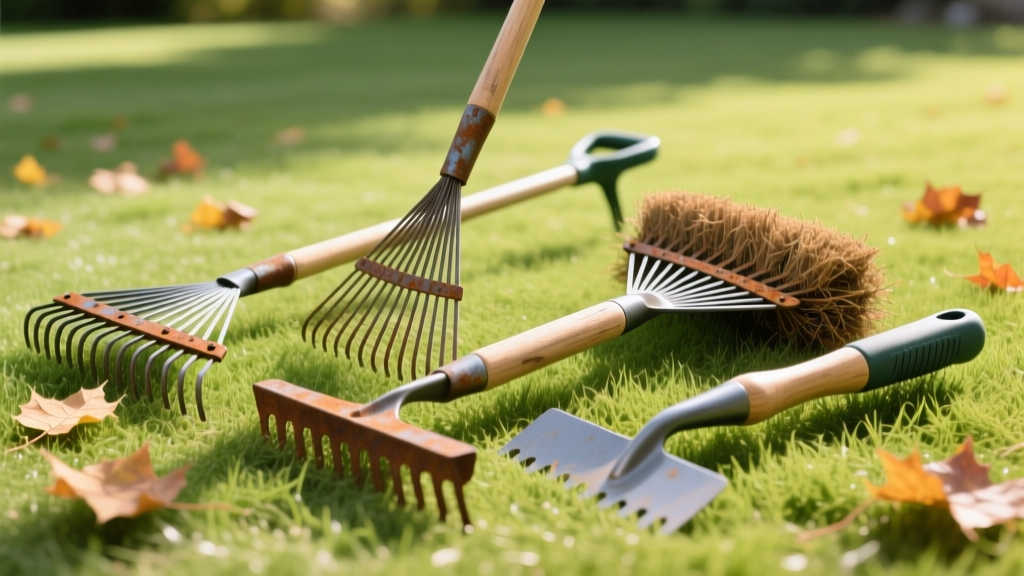
What Are Rakes? A Complete Guide to Lawn and Garden Rake Types
When homeowners ask what are rakes in the context of professional turf management, the answer extends far beyond simple autumn leaf gathering. In lawn care, a rake is a precision implement designed for canopy penetration, soil leveling, thatch extraction, and seed-to-soil contact optimization. Using the incorrect rake profile for a specific agronomic task is one of the most common causes of mechanical turf damage, crown tearing, and uneven seed germination.
This identification guide breaks down the exact anatomy, material science, and application parameters for the five primary rake categories used in modern lawn maintenance.
The Core Anatomy of a Lawn Rake
Before selecting a tool, understand the structural components that dictate its performance and leverage:
- Shaft (Handle): The primary lever. Standard lengths range from 48 to 60 inches. Fiberglass and steel shafts resist warping under heavy lateral loads, while ash wood absorbs shock.
- Grip: The terminal end, often featuring an angled D-grip or a cushioned straight grip to reduce carpal tunnel strain during repetitive pulling motions.
- Head (Crossbar): The horizontal bar connecting the tines to the shaft. The width of the head determines the tool's footprint (e.g., a 24-inch head covers more area but requires more torque to pull through dense debris).
- Tines (Teeth): The working elements. Tine spacing, curvature, and thickness dictate whether the tool will glide over turf crowns or aggressively penetrate the soil profile.
The 5 Essential Rake Types for Turf Management
1. The Poly Leaf Rake (Fan Rake)
Designed exclusively for lightweight surface debris. The tines are wide, flat, and highly flexible, allowing them to glide over the grass canopy without uprooting the turf crowns. High-quality poly rakes, such as the Ames True Temper 24-tine model, feature a 24-inch spread and cost between $15 and $25. They are mandatory for post-mowing cleanup and light autumn leaf removal on delicate grasses like fine fescue or newly seeded lawns.
2. The Steel Bow Rake (Garden Rake)
If you need to know what are rakes used for soil manipulation, the bow rake is the answer. Featuring 14 to 16 rigid, flat steel tines spaced roughly an inch apart on a 16-inch head, this tool is engineered for leveling topsoil, spreading gravel, and breaking up compacted dirt clods prior to overseeding. The 'bow' refers to the curved steel arms connecting the head to the shaft, which absorb the shock of striking buried rocks. Expect to pay $30 to $50 for a commercial-grade fiberglass-handled bow rake.
3. The Dethatching Rake (Thatch Rake)
Thatch is a layer of dead and living shoots, stems, and roots that develops between the zone of green vegetation and the soil surface. While a thin layer (under 0.5 inches) is beneficial, excessive thatch blocks water and fertilizer penetration. According to the University of Minnesota Extension, mechanical dethatching is required when this layer exceeds half an inch. A manual thatching rake features sharp, curved steel blades spaced 1.5 inches apart, designed to slice through the mat and pull it to the surface without severing the living root system.
4. The Shrub Rake
A miniaturized version of the leaf rake, featuring a narrow 9- to 12-inch head. It is specifically engineered to reach beneath low-hanging ornamental shrubs, foundation plantings, and fence lines where standard 24-inch rakes cannot maneuver. The narrow profile prevents the tines from catching on landscape edging or ripping delicate groundcovers like creeping thyme.
5. The Hand Rake (Cultivator)
A short-handled (12 to 16 inches) tool with three to four rigid steel tines. In lawn care, hand rakes are utilized for precise spot-treatments: scratching bare patches to prepare a seedbed for localized overseeding, or extracting deep-rooted tapweeds like dandelions and plantain from ornamental beds without disturbing surrounding mulch.
Material Matrix: Poly vs. Steel vs. Bamboo
Choosing the wrong tine material will either result in tool failure or turf destruction. Use this matrix to match the material to your specific lawn profile:
| Material | Best Application | Turf Safety | Durability & Cost |
|---|---|---|---|
| Extruded Poly | Dry leaves, grass clippings, light debris | High (Glides over crowns) | Moderate ($15-$25). UV degrades over 3-5 years. |
| Spring Steel | Wet leaves, matted thatch, heavy debris | Medium (Can scalp if pressed hard) | High ($25-$40). Prone to rust if stored wet. |
| Hardened Steel | Soil leveling, gravel, thatch extraction | Low (Will tear turf if used for leaves) | Very High ($35-$60). Indestructible under normal use. |
| Bamboo | Light leaves, delicate moss lawns | Very High (Extremely lightweight) | Low ($10-$18). Tines snap under lateral pressure. |
Ergonomic Sizing: The Armpit Rule
Back strain is the leading cause of tool abandonment in lawn care. To determine the correct shaft length for your height, utilize the 'Armpit Rule'. Stand barefoot on a flat surface and hold the rake handle vertically against your body. The top of the grip should rest exactly in your armpit. For a person who is 5'9", a 54-inch handle is optimal. If the handle is too short, you will naturally hunch, increasing lumbar disc pressure by up to 40%. If you are over 6 feet tall, invest in a 60-inch extended shaft or an ergonomic angled-shaft model, which alters the pulling vector to reduce lower back torque.
Critical Raking Mistakes That Damage Turf
Warning: The Scalping Effect
Never use a rigid steel bow rake or a metal spring-tine rake to clear leaves from a dormant or early-spring lawn. The stiff tines will catch the fragile grass crowns, ripping them entirely out of the soil profile—a phenomenon known as scalping. This exposes the soil to weed seed germination and delays spring green-up by several weeks.
Avoid raking when the turf is saturated. Wet soil lacks structural integrity; dragging a thatching rake through a waterlogged lawn will cause severe soil compaction and tear the root mass. According to Penn State Extension, lawn renovation and aggressive raking should only occur when the soil is moist but crumbly, typically 48 hours after a moderate rainfall. Furthermore, avoid 'over-raking' during overseeding. Once grass seed is broadcast, a single, light pass with a poly leaf rake (flipped upside down) is sufficient to work the seed into the top 1/8 inch of soil. Aggressive raking will clump the seed, resulting in patchy, uneven germination.
Frequently Asked Questions
Can I use a leaf blower instead of a rake?
While leaf blowers are faster for moving dry debris across hardscapes, they cannot extract thatch, level soil, or work grass seed into the soil profile. Rakes provide essential mechanical friction required for turf renovation and soil health management that pneumatic tools cannot replicate.
How often should I use a dethatching rake?
Manual dethatching should only be performed when the thatch layer exceeds 0.5 inches. For cool-season grasses (Kentucky bluegrass, fescue), this is typically done in early fall. For warm-season grasses (Bermuda, Zoysia), dethatch in late spring just as the grass breaks dormancy. Over-dethatching stresses the root system and opens the canopy to invasive weeds.
What is the difference between a thatching rake and a lawn broom?
A thatching rake uses rigid, curved steel blades to physically cut and pull matted organic matter from the soil surface. A lawn broom features flexible, wire-like tines designed to stand up matted grass after snow melt or heavy foot traffic without penetrating or cutting the thatch layer.

