
Lawn Care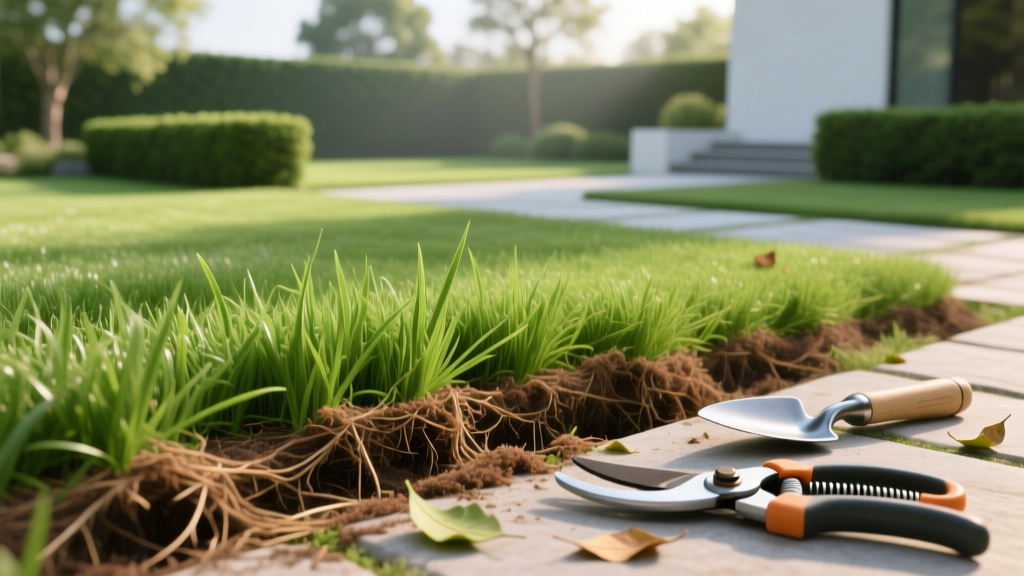
What Does Thatch Mean for Your Lawn? Identification Guide
Understanding What Thatch Means for Your Lawn's Health
When homeowners ask, what does thatch mean in the context of lawn care, the answer lies in turfgrass anatomy. Thatch is the tightly intermingled layer of living and dead organic matter—primarily stems, roots, rhizomes, and crowns—located between the green vegetation and the soil surface. It is a natural byproduct of turfgrass growth, but it becomes a critical problem when the rate of organic matter production exceeds the rate of microbial decomposition.
A common misconception is that grass clippings cause thatch. In reality, clippings are composed mostly of water and easily decomposable cellulose. True thatch is heavily composed of lignin, a complex organic polymer found in the structural tissues of turfgrass stems and roots that resists rapid microbial breakdown. According to University of Minnesota Extension, turfgrass species that produce high amounts of lignin-rich rhizomes and stolons are the most susceptible to severe thatch accumulation.
The Biological Breakdown Process
Healthy soil relies on a robust population of bacteria, actinomycetes, and fungi to decompose lignin. When soil becomes compacted, overly acidic (pH below 6.0), or saturated with synthetic nitrogen, these microbial populations crash. The thatch layer then thickens, creating a physical barrier that repels water, traps fertilizer, and harbors turf diseases like brown patch and dollar spot.
The Thatch Threshold: Good vs. Bad Accumulation
Not all thatch is detrimental. A thin layer provides insulation and resilience. The table below outlines the functional differences between acceptable and problematic thatch depths.
| Thatch Depth | Classification | Impact on Turfgrass | Required Action |
|---|---|---|---|
| 0 to 1/4 inch | Optimal | Insulates soil, reduces evaporation, provides cushioning. | None; maintain current cultural practices. |
| 1/4 to 1/2 inch | Tolerable | Adequate microbial breakdown is occurring; minor water resistance. | Monitor annually; apply compost topdressing. |
| 1/2 to 3/4 inch | Excessive | Roots grow into thatch instead of soil; high drought stress risk. | Core aeration and biological amendments. |
| Over 3/4 inch | Severe | Water/fertilizer runoff, shallow root systems, severe disease risk. | Mechanical dethatching (power raking/verticutting). |
How to Accurately Measure Your Thatch Layer
Visual inspection from the surface is highly inaccurate because thatch compresses underfoot. To determine exactly what thatch means for your specific yard, you must extract a physical cross-section.
Pro-Tip: The Trowel Test
Use a sharp, flat-edged garden trowel or a dedicated soil probe to cut a 3-inch deep, V-shaped wedge into the turf. Pull the wedge out and measure the distinct, spongy, light-brown layer situated directly above the dark mineral soil and below the green grass blades. Do not include the green crown tissue in your measurement.
Use a sharp, flat-edged garden trowel or a dedicated soil probe to cut a 3-inch deep, V-shaped wedge into the turf. Pull the wedge out and measure the distinct, spongy, light-brown layer situated directly above the dark mineral soil and below the green grass blades. Do not include the green crown tissue in your measurement.
- Select Multiple Zones: Take samples from at least three different areas of your lawn, including high-traffic zones and shaded areas, as moisture levels dictate localized microbial activity.
- Identify the Boundary: Look for the transition point where the fibrous, tangled brown matter meets the granular, dark topsoil.
- Measure with Calipers or a Ruler: Record the depth to the nearest 1/8th of an inch. If your average depth exceeds 1/2 inch, intervention is required.
Grass Species and Thatch Susceptibility
The genetic makeup of your turf dictates its baseline thatch production. Rhizomatous and stoloniferous grasses are the primary offenders.
- Kentucky Bluegrass (Poa pratensis): Highly aggressive rhizome producer. Prone to rapid thatch buildup if over-fertilized with synthetic nitrogen.
- Bermudagrass (Cynodon dactylon): Produces dense stolons and rhizomes. Commonly requires annual verticutting in southern climates.
- Zoysiagrass (Zoysia japonica): Notorious for developing a dense, woody thatch layer that feels like walking on a mattress when left unmanaged for 2-3 years.
- Tall Fescue (Festuca arundinacea): Bunch-type grass. Produces minimal thatch; issues here are usually related to soil compaction rather than organic accumulation.
Mechanical Removal: Dethatching Equipment and Costs
When biological breakdown fails, mechanical removal is necessary. The term 'dethatching' encompasses several different mechanical processes, and choosing the wrong one can destroy your lawn.
Power Raking vs. Vertical Mowing (Verticutting)
Power rakes use flexible, spring-loaded tines to aggressively pull up surface debris. They are highly destructive to healthy turf and are generally only recommended for severe thatch removal on dormant warm-season grasses. Vertical mowers (verticutters) use rigid, evenly spaced steel blades that slice down through the thatch and into the soil, pulling up cores and slicing rhizomes to stimulate new growth.
According to Penn State Extension, mechanical dethatching should only be performed when the turf is actively growing and can recover quickly. For cool-season grasses, this means early fall; for warm-season grasses, late spring to early summer.
2026 Equipment and Pricing Data
If you are renting equipment or hiring a professional, expect the following market rates for the 2026 season:
- Classen TR-22 Dethatcher Rental: $110 to $150 per day from local hardware stores. This 22-inch walk-behind unit features adjustable blade depths and is the industry standard for residential verticutting.
- Billy Goat PR550 Power Rake Rental: $95 to $130 per day. Best suited for heavy, matted debris rather than deep thatch extraction.
- Professional Dethatching Services: $0.15 to $0.25 per square foot. For a standard 5,000 sq. ft. lawn, expect a total invoice between $750 and $1,250, which typically includes debris hauling.
Biological Management: Feeding the Microbes
Mechanical removal is a reactive fix. Long-term management requires accelerating the biological decomposition of lignin. You can achieve this by modifying your soil environment to favor actinomycetes and fungi.
Actionable Biological Interventions
Warning: Avoid High-Nitrogen Spikes
Applying more than 1 lb of soluble nitrogen per 1,000 sq. ft. in a single application forces rapid, lush top growth while simultaneously inhibiting the fungal networks required to break down thatch. Switch to slow-release, organic nitrogen sources like feather meal or milorganite.
Applying more than 1 lb of soluble nitrogen per 1,000 sq. ft. in a single application forces rapid, lush top growth while simultaneously inhibiting the fungal networks required to break down thatch. Switch to slow-release, organic nitrogen sources like feather meal or milorganite.
- Compost Topdressing: Apply a 1/8-inch layer of screened, high-quality compost immediately after core aeration. The compost introduces diverse microbial inoculants directly into the thatch layer.
- Liquid Humic Acid: Applying liquid humic and fulvic acids (at a rate of 3 oz per 1,000 sq. ft.) chelates nutrients and stimulates native microbial populations, speeding up lignin degradation.
- Adjust Soil pH: Thatch-decomposing fungi thrive in a pH range of 6.2 to 6.8. If a soil test reveals a pH below 6.0, apply pelletized calcitic lime at the rate of 40 lbs per 1,000 sq. ft. to raise the pH and unlock microbial activity.
Preventative Maintenance Framework
Once you understand what thatch means for your turf's longevity, implementing a preventative matrix is straightforward. Follow these cultural practices to ensure organic matter production never outpaces decomposition:
- Mowing Height: Never remove more than 1/3 of the grass blade in a single mowing. Scalping stresses the plant, causing it to push out excessive rhizomes to survive, which accelerates thatch formation.
- Deep, Infrequent Watering: Watering daily for 10 minutes keeps the thatch layer perpetually moist but the soil dry, promoting shallow roots and fungal diseases. Water deeply (1 inch per week) to force roots into the mineral soil.
- Annual Core Aeration: Pulling 3-inch soil cores and leaving them on the lawn surface introduces soil microbes directly into the thatch matrix, acting as a natural biological inoculant.
For further reading on sustainable turf management and reducing chemical reliance in lawn care, consult the EPA's guidelines on lawns and gardens, which emphasize soil biology over synthetic inputs.

