Lawn Care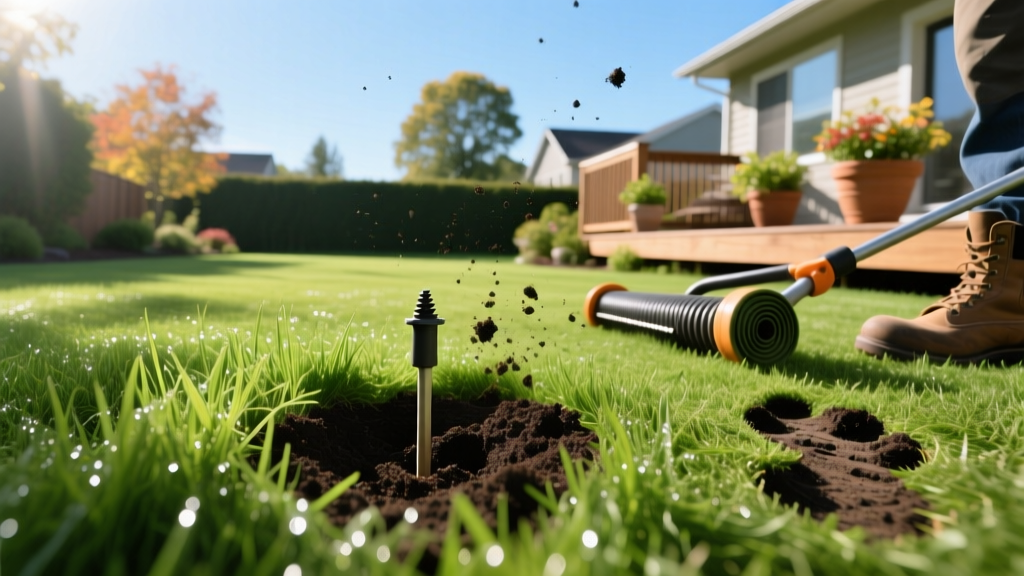
What to Do After Aerating Grass: The 14-Day Recovery Plan
The Biological Countdown: Why the First 48 Hours Matter
The moment the tines of your core aerator pull out of the ground, a biological countdown begins. Core aeration removes 2-to-3-inch plugs of soil, reducing bulk density and creating direct channels for oxygen, water, and nutrients to reach the root zone. However, these open channels are highly susceptible to collapsing from foot traffic, heavy rain, and natural soil settling. According to turfgrass researchers at the University of Minnesota Extension, the physical benefits of aeration degrade rapidly if the soil surface is not immediately utilized for seed-to-soil contact or deep nutrient penetration. To maximize your return on investment, you must execute a precise 14-day post-aeration protocol.
Pro Tip: The Core Crumble Rule
Never rake up or remove the soil cores left on your lawn. As they dry over the next 5 to 7 days, they will naturally break apart. When you eventually mow, the mower blades will pulverize these cores, redistributing beneficial soil microorganisms and organic matter back into the turf canopy.
Never rake up or remove the soil cores left on your lawn. As they dry over the next 5 to 7 days, they will naturally break apart. When you eventually mow, the mower blades will pulverize these cores, redistributing beneficial soil microorganisms and organic matter back into the turf canopy.
Phase 1: Immediate Action (Hours 0 to 48)
1. Overseeding into the Open Channels
If you are renovating or thickening your lawn, the 48-hour window post-aeration is the optimal time to overseed. The aeration holes act as pre-dug micro-beds, protecting seeds from wind and birds while providing direct root access to moisture. Apply seed using a broadcast spreader at the following rates, depending on your grass type:
- Tall Fescue: 5 to 6 lbs per 1,000 square feet.
- Kentucky Bluegrass: 2 to 3 lbs per 1,000 square feet (relies on rhizome spread).
- Perennial Ryegrass: 4 to 5 lbs per 1,000 square feet.
- Bermudagrass (Warm-Season): 1 to 2 lbs of hulled seed per 1,000 square feet.
2. Applying Starter Fertilizer
Standard lawn fertilizers are high in nitrogen, but newly germinating seeds and recovering root systems require phosphorus to stimulate root development. Apply a starter fertilizer with an NPK ratio heavily weighted in the middle number, such as 18-24-12 or 10-18-10. Apply at a rate of 1 lb of actual nitrogen per 1,000 square feet. Regulatory Note: States like Michigan, Minnesota, and New York restrict phosphorus applications unless a recent soil test indicates a deficiency or you are actively establishing new seed. Keep your receipt and seed bag as proof of establishment if questioned.
3. Deep Hydration
Immediately after seeding and fertilizing, water the lawn to a depth of 1 inch. This settles the soil around the seed, activates the granular fertilizer, and prevents the exposed soil channels from drying out and hardening.
Phase 2: Germination and Moisture Management (Days 3 to 14)
Once the initial deep watering is complete, your strategy must shift from deep-soaking to frequent, light misting. Grass seed will fail to germinate if the top half-inch of soil dries out, even if the subsoil is moist. The exact watering frequency depends heavily on your soil composition, as drainage rates dictate how quickly the seed bed desiccates.
| Soil Type | Watering Frequency | Duration per Session | Drainage Characteristic |
|---|---|---|---|
| Heavy Clay | 2 times daily | 10-15 minutes | Retains moisture; prone to pooling. |
| Loam | 1 to 2 times daily | 10 minutes | Ideal balance; drains moderately. |
| Sandy | 3 times daily | 5-8 minutes | Rapid drainage; dries out quickly. |
According to Clemson University Home & Garden Information Center, maintaining consistent surface moisture is the single most critical factor in post-aeration overseeding success. Adjust your schedule based on daily evaporation rates; if the seedbed looks pale or dry, add an extra watering cycle.
Phase 3: Mowing, Traffic, and Chemical Restrictions
As the new seed begins to germinate (typically days 7 to 14 for fescue and ryegrass, up to 21 days for bluegrass), the lawn becomes highly vulnerable. You must strictly manage physical and chemical stressors.
The 3-Inch Mowing Rule
Do not mow the lawn until the new grass reaches at least 3.5 to 4 inches in height. When you do mow, ensure your mower blades are freshly sharpened to prevent tearing the delicate new shoots. Never remove more than one-third of the grass blade in a single pass. Set your mower deck to a minimum of 3 inches to shade the soil, which reduces evaporation and suppresses weed seed germination.
Warning: Herbicide Blackout Period
Do not apply broadleaf weed killers (containing 2,4-D, Dicamba, or Quinclorac) for at least 28 days after seed germination. These chemicals will severely stunt or kill young grass seedlings. If you must use a pre-emergent to stop crabgrass during a spring aeration, the only active ingredient safe for use at the time of seeding is Mesotrione (commonly sold as Tenacity). All other pre-emergents will inhibit your new grass seed from sprouting.
Do not apply broadleaf weed killers (containing 2,4-D, Dicamba, or Quinclorac) for at least 28 days after seed germination. These chemicals will severely stunt or kill young grass seedlings. If you must use a pre-emergent to stop crabgrass during a spring aeration, the only active ingredient safe for use at the time of seeding is Mesotrione (commonly sold as Tenacity). All other pre-emergents will inhibit your new grass seed from sprouting.
Troubleshooting: Identifying Post-Aeration Failures
Even with meticulous planning, environmental variables can disrupt recovery. Use this diagnostic framework to identify and correct common post-aeration issues:
- Symptom: Seed Washout and Bare Patches.
Cause: Watering too heavily with a high-pressure hose nozzle, causing surface runoff that carries seeds into low-lying areas.
Fix: Switch to an oscillating sprinkler or a misting nozzle. For existing washouts, top-dress the low areas with a 50/50 mix of compost and topsoil before re-seeding. - Symptom: Yellowing Existing Grass.
Cause: Fertilizer burn. Applying granular starter fertilizer to a dry lawn without immediately watering it in causes salt accumulation, which draws moisture out of the grass blades.
Fix: Flush the soil immediately with 1.5 inches of water to leach the excess salts below the root zone. - Symptom: Aeration Holes Filled with Weeds.
Cause: Delayed overseeding. If you aerate but wait more than 48 hours to drop seed, wind-blown weed seeds (like Poa annua or crabgrass) will colonize the empty, nutrient-rich aeration holes.
Fix: Spot-treat with a selective herbicide once the surrounding desirable grass has been mowed three times, and apply a pre-emergent in the following season.
Long-Term Soil Health Monitoring
The physical relief provided by core aeration is temporary. To prevent the soil from re-compacting within six months, integrate liquid soil conditioners containing humic and fulvic acids into your monthly maintenance routine. These organic acids chelate soil particles, promoting flocculation (the clumping of soil particles), which naturally maintains soil porosity between mechanical aerations. Pair this with an annual top-dressing of 1/4 inch of screened compost to permanently increase the organic matter percentage of your soil profile, ensuring the results of your aeration last well into the next growing season.