
Lawn Care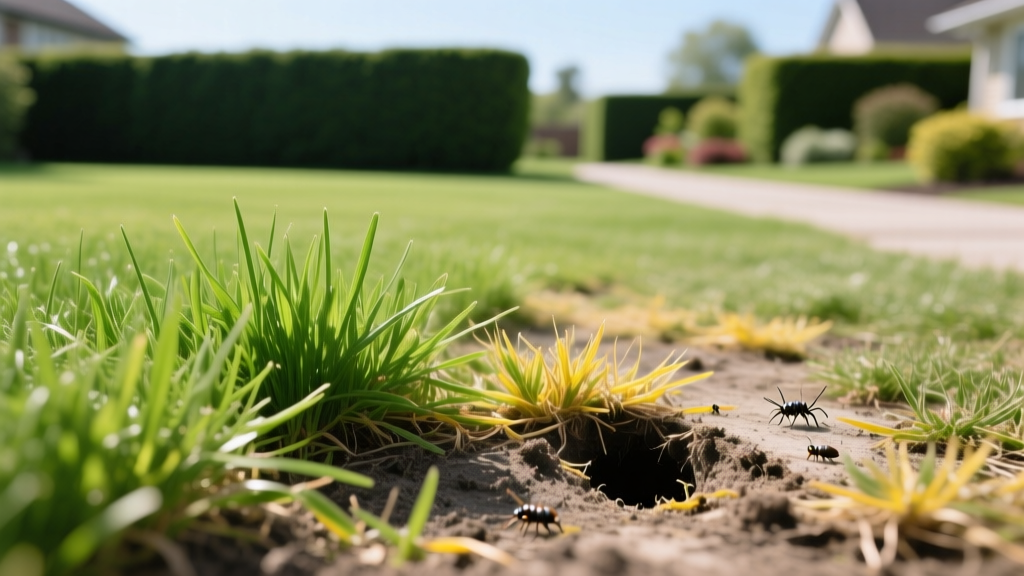
What's Wrong With My Grass? Step-by-Step Diagnostic Guide
The 4-Step Lawn Diagnostic Protocol
When you look out at your yard and ask, "what's wrong with my grass?", the answer is rarely a single, obvious issue. Lawn decline is usually a cascade of compounding stressors—poor soil health inviting pests, or improper mowing opening the door to fungal pathogens. According to turfgrass pathology experts at NC State TurfFiles, misdiagnosis leads to wasted chemical applications and further turf stress. To accurately pinpoint the failure point, you must move beyond surface-level observations and conduct a systematic field audit.
Step 1: The Blade and Lesion Inspection
Fungal diseases manifest on the grass blade before they kill the crown. Equip yourself with a 10x jeweler's loupe or a macro-lens smartphone attachment. Pull a single blade from the margin of the damaged area (where green grass meets brown grass).
- Frog-Eye Pattern: If the center of the brown patch is green while the outer ring is dead, you are likely dealing with Dollar Spot (Clarireedia jacksonii). This thrives in low-nitrogen environments with heavy morning dew.
- Smoke Rings: A dark, smoke-like ring at the advancing edge of a brown patch in the early morning indicates Brown Patch (Rhizoctonia solani), common in tall fescue and ryegrass when night temperatures exceed 65°F with high humidity.
- Tip Dieback: If only the very tips of the grass blades are bleached white or brown, this is often mechanical damage from a dull mower blade tearing the tissue, leaving it vulnerable to desiccation.
Step 2: The Root Zone and Thatch Audit
If the blades look healthy but the turf is thinning or yellowing, the problem is subterranean. Use a standard 6-inch flathead screwdriver to test soil compaction. Push it into moist soil. If you cannot easily sink it to the handle, your soil bulk density is too high, choking roots of oxygen and preventing water infiltration. Next, cut a 3-inch deep triangular wedge of turf with a spade and measure the thatch layer (the spongy, brown organic matter between the green grass and the mineral soil). A thatch layer exceeding 0.5 inches will harbor chinch bugs and prevent liquid fertilizers from reaching the root zone.
Step 3: The Tug Test for Subsurface Pests
Grasping the brown, declining turf at the base, pull upward with moderate force. If the grass lifts and rolls back like a freshly laid carpet, the roots have been severed. This is the definitive field test for white grubs (Japanese beetle or masked chafer larvae). The economic threshold for treatment is generally 8 to 10 grubs per square foot, as noted by the University of Minnesota Extension.
Symptom-to-Cause Diagnostic Matrix
Use this rapid-reference table to cross-check your field observations before purchasing treatments.
| Visual Symptom | Pattern & Distribution | Primary Suspect | Confirmatory Test |
|---|---|---|---|
| Irregular yellow/brown patches | Scattered, merging into large areas | White Grubs | Tug test; turf rolls back easily |
| Circular brown spots (1-5 ft) | Distinct borders, 'smoke ring' at dawn | Brown Patch Fungus | Blade inspection for lesions |
| Uniform yellowing (chlorosis) | Entire lawn or low-lying wet areas | Iron Deficiency / Poor Drainage | Soil pH test (pH > 7.2 locks up iron) |
| Streaked, chewed blades | Patches of ragged, shredded grass | Armyworms or Sod Webworms | Soapy water flush (2 tbsp/gallon) |
| Purple/Red tint at crown | Generalized thinning, slow growth | Phosphorus Deficiency / Cold Stress | Standard N-P-K soil laboratory analysis |
Targeted Treatment Formulations and Costs
Once you have isolated the variable, apply the correct active ingredient. Avoid broad-spectrum 'weed and feed' products when diagnosing stress, as the 2,4-D herbicide component will further shock an already compromised root system.
Fungal Pathogen Eradication
For Brown Patch and Dollar Spot, contact fungicides are insufficient. You need a systemic xylem-mobile fungicide. Look for products containing Azoxystrobin (23.0%) or Propiconazole (14.3%). Apply at a rate of 2.0 to 4.0 fluid ounces per 1,000 square feet. Expect to pay between $45 and $65 for a 16oz concentrate bottle, which is enough to treat 5,000 to 8,000 sq ft. Rotate between these two chemical classes (FRAC Group 11 and FRAC Group 3) every 21 days to prevent pathogen resistance.
Subsurface Insect Control
If the tug test confirms grubs, timing dictates your chemical choice. For active, feeding grubs in late summer or early fall, use a fast-acting contact kill like Trichlorfon (Dylox 6.2), costing roughly $35 for a 10lb bag. If you are applying a preventive treatment in early summer before eggs hatch, use Imidacloprid (Merit), which costs about $50 for a granular spreader pack but requires watering in to activate the systemic protection.
CRITICAL WARNING: Never apply high-nitrogen synthetic fertilizers to a lawn actively suffering from Brown Patch or Pythium Blight. Nitrogen forces rapid, succulent top-growth, which creates a dense, humid canopy at the soil level—exactly the microclimate these fungi need to double their infection rate overnight.
The 30-Day Recovery Timeline
Fixing the problem is only half the battle. The Environmental Protection Agency (EPA) emphasizes integrated pest management, which includes cultural recovery practices to ensure the lawn outcompetes future invaders. Follow this strict 30-day rehabilitation schedule:
- Days 1-3 (Triage): Apply the targeted fungicide or insecticide based on your diagnostic matrix. Hand-water only the treated areas with exactly 0.25 inches of water to move the chemical into the thatch/soil profile without creating surface runoff.
- Days 4-7 (Aeration & Relief): If the screwdriver test failed, rent a walk-behind core aerator. Pull 3-inch deep plugs on 2-inch centers. Leave the plugs on the lawn to break down naturally; they contain the microbacteria necessary to decompose thatch.
- Days 8-14 (Nutritional Reset): Apply a gentle, organic-based fertilizer (such as a 4-1-2 ratio milorganite or feather meal blend) at half the standard label rate. This provides slow-release nitrogen without spiking soil salts, which can burn recovering roots.
- Days 15-30 (Canopy Management): Raise your mower deck to the maximum recommended height for your grass species (e.g., 3.5 to 4.0 inches for Tall Fescue, 2.5 inches for Bermuda). Taller grass shades the soil, reducing evaporation and suppressing weed seed germination in the bare spots.
"A lawn is a living ecosystem, not a static carpet. When grass fails, it is communicating a deficiency in its environment. The most effective maintenance procedure isn't a chemical application; it is the willingness to test the soil, measure the thatch, and listen to what the root zone is telling you."

