
Lawn Care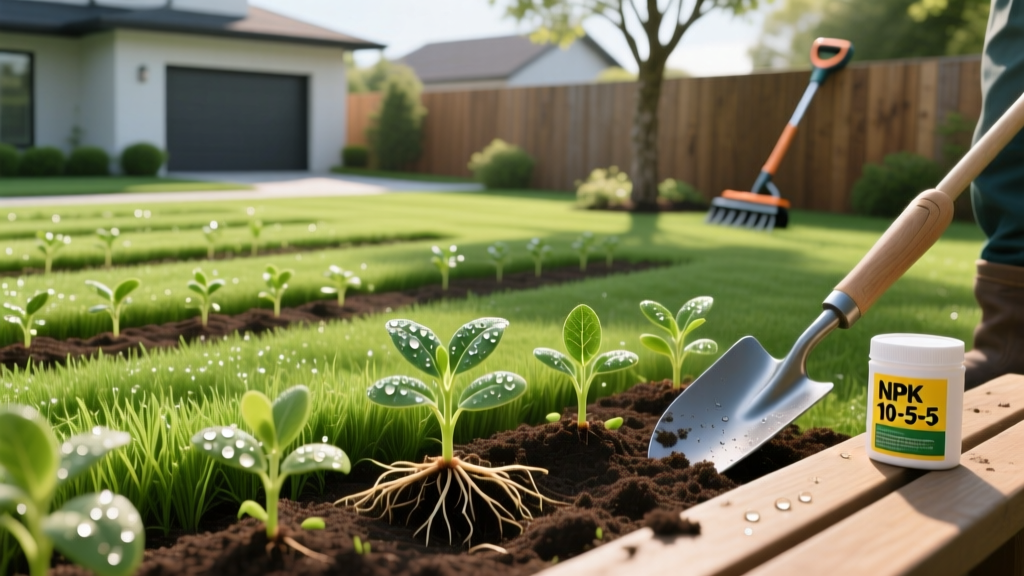
When to Fertilize Seedlings: Regional Lawn Timing & NPK Guide
The Biology of Grass Seedling Nutrition
Understanding when to fertilize seedlings requires looking beneath the soil surface. A grass seed contains an endosperm—a built-in energy reserve that fuels germination and the development of the first two to three leaves. For most cool-season and warm-season turfgrasses, this endosperm depletes entirely between 21 and 28 days after germination. Once this internal battery dies, the seedling must rely on its developing root system to scavenge exogenous nutrients from the soil. If the soil lacks available nitrogen and phosphorus at this exact developmental stage, the seedling will stall, turn chlorotic (yellow), and become highly susceptible to environmental stress and fungal pathogens like Pythium blight.
The 3-Mow Rule: Never apply high-nitrogen, quick-release fertilizer to grass seedlings until they have been mowed at least three times. Early heavy nitrogen diverts energy away from critical root development and forces fragile top-growth, severely increasing drought susceptibility and fertilizer burn risk.
The Two-Phase Fertilization Strategy
Professional turf managers do not view seedling fertilization as a single event. It is a two-phase protocol designed to match the plant's shifting metabolic demands.
- Phase 1: The Starter Application (Day 0). Applied at the time of seeding or immediately after. This formulation is high in phosphorus (the middle number in the NPK ratio) to stimulate rapid root hair development and anchor the seedling into the soil profile.
- Phase 2: The Seedling Boost (Weeks 4-6). Applied after the endosperm depletes and the grass has been mowed 2 to 3 times. This application shifts the NPK ratio to favor nitrogen, fueling tillering (the production of new lateral shoots) and canopy density.
Regional Calendars: When to Fertilize Seedlings by Climate Zone
Timing your Phase 1 and Phase 2 applications depends entirely on your regional climate and whether you are growing cool-season or warm-season turf. According to the University of Minnesota Extension, applying fertilizer outside the optimal biological window not only wastes money but increases nutrient runoff into local watersheds.
| Region | Primary Grass Type | Seeding Window | Phase 1 (Starter) | Phase 2 (Boost) |
|---|---|---|---|---|
| Northeast / Midwest | Kentucky Bluegrass, Tall Fescue | Mid-Aug to Mid-Sept | At seeding (Aug/Sept) | Late Oct (before frost) |
| Transition Zone | Tall Fescue, Zoysia | Early Sept or Mid-April | At seeding | 4-6 weeks post-germination |
| Deep South | Bermudagrass, Centipede | Late May to Early July | At seeding (May/June) | Mid-July to Early Aug |
For cool-season grasses, fall seeding is vastly superior to spring seeding. The soil retains summer warmth, which accelerates germination, while the cooler autumn air reduces heat stress on the young seedlings. If you must seed in spring, ensure your Phase 2 boost is applied before summer heat dormancy sets in.
Selecting the Right Starter Fertilizer (NPK & Formulations)
The UC Davis Integrated Pest Management program emphasizes that new lawns have distinctly different nutritional requirements than established turf. You must select a product specifically labeled as a 'Starter Fertilizer'.
Top Product Recommendations for 2026
- Scotts Turf Builder Starter Food for New Grass (24-25-4): The industry standard for residential DIY. The high phosphorus (25) drives root mass. A 15 lb bag covers 5,000 sq ft and retails for roughly $45. Spreader setting: 5 on Scotts Rotary.
- Lesco Professional Starter Fertilizer (18-24-12): A professional-grade option often found at SiteOne or John Deere Landscape stores. It includes a balanced potassium (12) payload to improve early drought tolerance. A 50 lb bag covers 12,500 sq ft and costs around $38.
- Milorganite (5-4-0): For homeowners in municipalities with strict synthetic fertilizer blackouts. It is a slow-release, biosolid-based organic option. Because it relies on microbial breakdown, it will not burn seedlings, but it takes 2-3 weeks longer to show visible greening.
Phosphorus Legislation Warning: States like New York, Minnesota, and Washington have banned the sale of phosphorus-containing fertilizers to prevent aquatic eutrophication. However, most of these laws include a specific exemption for 'newly established lawns' or 'starter fertilizers.' Always verify your local county ordinances before purchasing high-P products.
Step-by-Step Application Protocol for New Grass
Applying fertilizer to seedlings requires precision. The root systems are shallow (often less than 1 inch deep), meaning surface-applied salts can easily dehydrate the plant tissue through reverse osmosis.
- Measure the Area: Calculate the exact square footage of the seeded area. Over-applying starter fertilizer by even 10% can cause severe salt burn on tender cotyledons.
- Calibrate the Spreader: Use a broadcast (rotary) spreader rather than a drop spreader to ensure even distribution. Walk at a consistent pace of 3 feet per second.
- Apply in a Grid Pattern: Spread half the required granules walking North-South, and the other half walking East-West. This eliminates striping and missed gaps.
- Water Immediately: Apply exactly 0.1 to 0.15 inches of water immediately after application. This dissolves the prills and moves the nutrients into the top 1-inch soil zone where the seedling roots reside. Avoid heavy watering that causes pooling or seed displacement.
- Monitor for Tillering: Within 7 to 10 days of the Phase 2 application, you should notice the grass blades widening and new lateral shoots (tillers) emerging from the crown.
Troubleshooting Seedling Fertilizer Burn & Deficiencies
Even with precise timing, environmental variables can alter nutrient uptake. Here is how to diagnose common seedling fertilization failures:
- Symptom: Brown, crispy leaf tips appearing 48 hours after feeding.
Diagnosis: Fertilizer burn (salt index toxicity).
Fix: Flush the area with 1 inch of water immediately to leach excess salts below the root zone. Suspend all feeding for 3 weeks. - Symptom: Uniform yellowing (chlorosis) starting at the oldest leaves.
Diagnosis: Nitrogen deficiency, often caused by applying slow-release fertilizer in cold soil (below 55°F) where microbial activity is too low to mineralize the nitrogen.
Fix: Apply a fast-acting liquid nitrogen source, such as a 20% urea solution, at a highly diluted rate of 0.1 lbs N per 1,000 sq ft. - Symptom: Purple or reddish tint on the lower leaves.
Diagnosis: Phosphorus deficiency or cold-induced phosphorus lockout.
Fix: If soil temperatures are below 50°F, wait for natural warming. If soil is warm, apply a liquid kelp extract to stimulate root uptake.
Mastering when to fertilize seedlings is less about calendar dates and more about observing the biological milestones of the grass plant. By aligning your NPK inputs with the depletion of the seed's endosperm and the regional climate windows, you transition fragile sprouts into a dense, drought-resilient turf canopy.

