
Lawn Care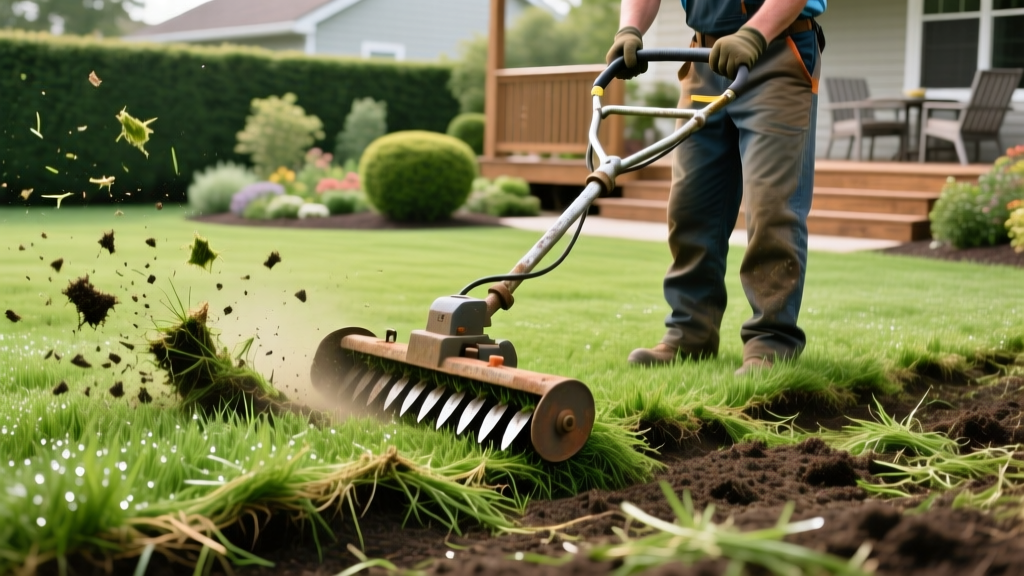
When and How to Dethatch Your Lawn for Healthy Growth
Marcus ReevesPublished
What Is Lawn Thatch and Why It Matters
Thatch is a layer of dead grass stems, roots, and organic debris that accumulates between the soil surface and living grass blades. A thin layer — less than 1/2 inch — actually benefits your lawn by insulating roots and reducing water evaporation.
When thatch exceeds 1/2 inch, however, it becomes a barrier that blocks water, fertilizer, and air from reaching the root zone. The University of Georgia Extension found that lawns with thatch layers over 3/4 inch showed 30% reduced water infiltration and significantly higher drought stress.
How to Measure Your Thatch Thickness
The Core Sample Method
Use a garden trowel or soil probe to cut a small V-shaped wedge from your lawn, about 3 inches deep. Measure the brown, spongy layer between the green grass and the dark soil. This is your thatch layer. Take samples from 3-4 representative areas — high-traffic zones often have thicker thatch.
Visual and Tactile Signs
If your lawn feels spongy when you walk on it, you likely have excessive thatch. Other warning signs include: grass that looks healthy but wilts quickly after watering, increased pest activity (thatch harbors insects), and brown patches that don't respond to watering or fertilizing.
Grass Types and Their Thatch Tendencies
| Grass Type | Thatch Production | Recommended Dethatch Frequency | Best Season |
|---|---|---|---|
| Kentucky Bluegrass | High — spreads by rhizomes | Every 1-2 years | Early fall |
| Bermuda | High — aggressive stolons | Annually | Late spring |
| Perennial Ryegrass | Low — bunch-type growth | Every 3-4 years | Early fall or spring |
| Tall Fescue | Moderate | Every 2-3 years | Early fall |
| Zoysia | High — dense mat formation | Annually | Late spring |
| Centipede | Moderate to High | Every 2-3 years | Early summer |
Best Time to Dethatch Your Lawn
Cool-Season Grasses (Bluegrass, Fescue, Ryegrass)
The optimal window is late August to early October. This timing gives grass 4-6 weeks of active growth to recover before winter dormancy. Spring dethatching (April-May) is the second choice, but avoid doing it during peak summer heat.
Warm-Season Grasses (Bermuda, Zoysia, St. Augustine)
Dethatch in late spring to early summer (May-June), right when these grasses enter their fastest growth phase. This ensures rapid recovery. Never dethatch warm-season grasses in fall — they won't have time to fill in before cold weather.
Tools for Dethatching
Manual Thatch Rake
For small lawns under 3,000 sq ft, a thatch rake like the Fiskars 16-Inch Steel ($35) works well. The sharp, curved tines slice through the thatch layer and pull it to the surface. Expect 30-45 minutes of work per 1,000 sq ft.
Power Dethatcher (Dethatching Machine)
For larger lawns, rent or buy a power dethatcher. The RYOBI 13-inch Electric Dethatcher ($180) handles lawns up to 5,000 sq ft on a single charge. Commercial-grade models like the Agri-Fab Pro Push Dethatcher ($400) are built for heavy-duty use.
Set blade depth to 1/4 inch into the soil — too shallow and you miss the thatch; too deep and you damage living roots. Make parallel passes in one direction, then a second set perpendicular to the first.
Verticutter / Vertical Mower
More aggressive than a standard dethatcher, a verticutter has blades that actually slice vertically through the thatch and soil. Professional lawn services use these on severely compacted lawns. Available for rent at most equipment rental yards for $50-80 per day.
Step-by-Step Dethatching Process
- Day 1-2 before: Mow your lawn to 1.5 inches and water thoroughly. Moist soil makes thatch removal easier and reduces stress on grass crowns.
- Day of dethatching: Run your dethatcher in straight, overlapping passes. Overlap each pass by 2-3 inches to avoid missing strips. The machine will pull up large amounts of brown, fibrous material — this is normal.
- Immediately after: Rake up all loosened thatch debris. Leaving it on the lawn defeats the purpose — it will simply settle back into the same layer.
- Same day: Apply a light fertilizer (1/2 lb nitrogen per 1,000 sq ft) to support recovery. Water deeply to help the grass bounce back.
- Day 3-7 after: Keep soil consistently moist but not saturated. Avoid foot traffic on dethatched areas for at least a week.
What to Do With the Removed Thatch
Thatch debris can be composted, but in large quantities it decomposes slowly due to its high lignin content. For lawns under 10,000 sq ft, bag the material and add it to your municipal green waste. For larger properties, consider spreading thin layers (no more than 1 inch) over garden beds where it will break down over a growing season.
Note from the National Turfgrass Evaluation Program: "Regular dethatching improves fertilizer efficiency by 15-25%. When thatch is removed, nutrients reach the root zone where they actually benefit the grass, rather than being absorbed by the dead organic layer."
Dethatching Mistakes to Avoid
Dethatching when soil is wet: Saturated soil tears easily under dethatcher blades, damaging the root crown. Wait until the soil is moist but firm — if your foot sinks more than 1/2 inch, wait another day.
Dethatching new lawns: Lawns less than 1 year old rarely have significant thatch. Dethatching too early damages young root systems that haven't established properly. Wait until your second full growing season before assessing thatch levels.
Skipping post-dethatch care: Dethatching is stressful for grass. Without proper watering and light fertilization afterward, the lawn may develop bare patches. Plan to overseed thin areas within 1-2 weeks of dethatching for best results.
Preventing Excessive Thatch Buildup
The best defense against thatch is good lawn management. Avoid over-fertilizing — excess nitrogen promotes rapid top growth that outpaces the soil's ability to decompose clippings. Use slow-release fertilizers that feed grass steadily rather than in bursts.
Leave grass clippings on the lawn after mowing (mulching). Contrary to popular belief, clippings decompose quickly and do not contribute to thatch — they're mostly water and break down within 1-2 weeks. Thatch comes from stems and roots, not leaf clippings.
Core aerate annually alongside your dethatching routine. Aeration holes introduce soil microorganisms into the thatch layer, accelerating natural decomposition. The combination of dethatching plus aeration is the most effective long-term strategy for maintaining a healthy lawn.

